Facts
The petitioner, a Supervisor Instructor at the Industrial Training Institute, Jamnagar, faced eight departmental charges relating to financial misconduct, submission of fabricated government records, unauthorised absence, false representations for salary, and production of a bogus medical certificate.
Source reference: pp. 1–3; para. 2He was initially dismissed after an enquiry report dated 12 January 2005. His appeal was partly allowed, and the matter was remanded for a fresh enquiry. In the fresh enquiry, he was again held guilty by report dated 31 August 2007. The Gujarat Civil Services Tribunal dismissed his appeal and upheld the dismissal by order dated 31 December 2011.
Source reference: p. 3; para. 3During the writ proceedings, the petitioner relied on his acquittal in Criminal Case No. 2715 of 2005, arising from FIR/CR No. 176 of 2004, contending that the acquittal related to the principal charge and entitled him to reinstatement and consequential benefits.
Source reference: pp. 3–4; para. 4The State contended that the acquittal concerned only charge No. 4, while the remaining seven charges continued to stand proved.
Source reference: p. 5; para. 5Issues
Whether the petitioner’s acquittal in the criminal case concerning charge No. 4 required the departmental dismissal and the Tribunal’s order upholding it to be set aside.
Source reference: pp. 3–5; paras. 4–5Whether the punishment of dismissal was grossly disproportionate or harsh in view of the remaining proved charges.
Source reference: p. 5; para. 6Whether the widow of the deceased petitioner could seek consideration of family pension despite dismissal from service.
Source reference: pp. 6–7; paras. 9–10Law Applied
The Court applied the settled principle that judicial review of findings recorded in a departmental enquiry is extremely limited and that a writ court will not interfere unless the findings or punishment disclose a legally recognised error or shock the conscience of the Court.
Source reference: p. 6; para. 8It relied on Management of Bharat Heavy Electricals Ltd. v. M. Mani and Management of Bharat Heavy Electricals Ltd. v. T.A. Mathivanan, reported in (2017) 0 AIJEL-SC 61226, and State of Jharkhand v. Ranjan Kumar, reported in 2026 (5) SCR 522, for this restricted scope of review.
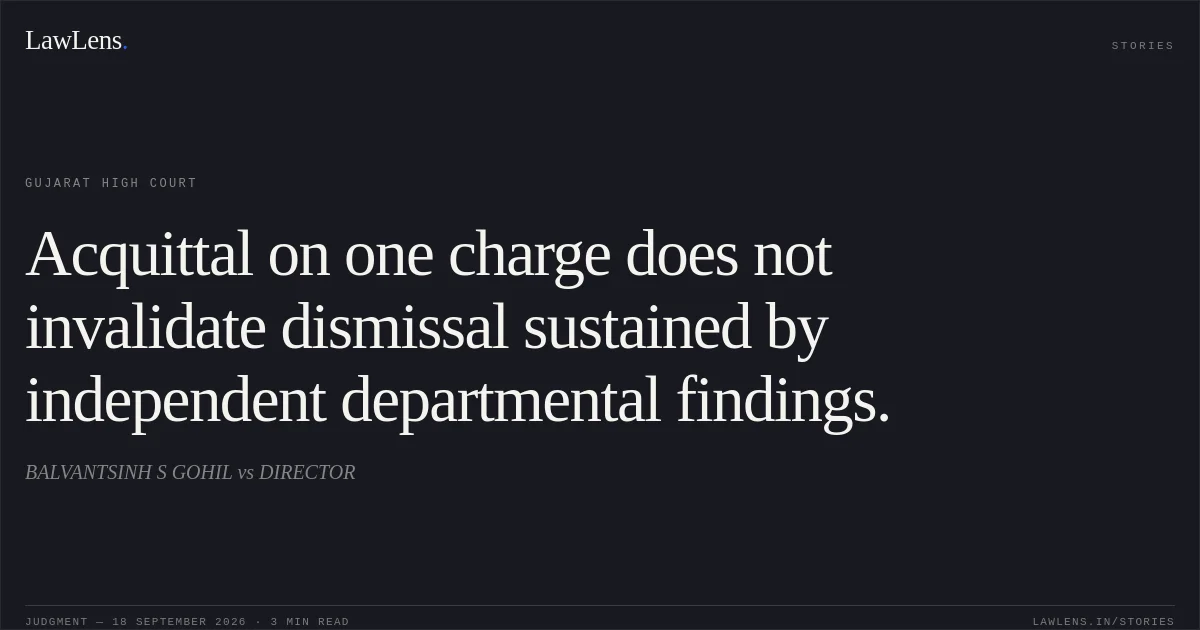
Source reference: p. 6; para. 8The governing principle was that an acquittal on one criminal or departmental allegation does not automatically invalidate independent departmental findings on other charges, particularly where those charges involve serious misconduct and falsification of records.
Source reference: pp. 5–6; paras. 5–8Reasoning
The Court accepted that the criminal acquittal relied upon by the petitioner related only to charge No. 4 and did not displace the findings on the remaining charges.
Source reference: p. 5; para. 5Charges Nos. 3, 6 and 8 were considered particularly serious because they involved fabrication or use of bogus government records, false representations to obtain salary for a prolonged period of unauthorised absence, and production of a bogus medical certificate.
Source reference: p. 5; para. 6Charges Nos. 1 to 3 and 5 to 8 therefore demonstrated misconduct involving falsification of records and an attempt to secure undue financial benefit.
Source reference: p. 6; para. 7Given the petitioner’s responsible position as a Supervisor Instructor, the Court held that retaining him in service would be detrimental to the department.
Source reference: p. 6; para. 7Applying the limited scope of judicial review and finding that the punishment did not shock the conscience of the Court, it declined to interfere with the Tribunal’s decision.
Source reference: p. 6; para. 8The Court separately permitted the widow to make a representation for family pension, leaving the issue to the competent authorities under law.
Source reference: pp. 6–7; paras. 9–10Holding
The writ petition was dismissed, and the Tribunal’s order upholding the petitioner’s dismissal was affirmed.
The Court held that the acquittal relating to charge No. 4 did not nullify the independent findings on the other seven charges, and that dismissal was not disproportionate in light of the proved falsification, false representations, unauthorised absence, and related misconduct.
Source reference: pp. 5–6; paras. 5–8The widow, who had been brought on record after the petitioner’s death, was permitted to submit a representation seeking family pension; the respondents were directed to consider it in accordance with law, notwithstanding dismissal of the writ petition.
Source reference: pp. 6–7; paras. 9–10Original Court PDF
BALVANTSINH S GOHILvsDIRECTOR
Click to open original judgment
Original judgment, available to read, download and summarize on LawLens.in