Facts
The respondent was prosecuted under Section 376(2)(f) IPC for allegedly sexually assaulting a four-and-a-half-year-old girl on 10 August 2008.
Source reference: paras. 2–7The child, who used to visit the respondent for tuition, allegedly returned home bleeding from her private parts and informed her mother that the respondent had caused her pain after removing her underwear and his own trousers.
Source reference: paras. 2–7She was first taken to a private hospital and thereafter to DDU Hospital, where her medical examination recorded a torn hymen and a 1.2 cm genital tear.
Source reference: paras. 26–30The respondent was arrested, and certain articles, including a towel, bedsheet and cloth piece, were seized from his room; the victim’s underwear was subsequently handed over to the police.
Source reference: paras. 3–5The FSL reports recorded the presence of human semen on the victim’s underwear and blood and semen on certain seized articles.
Source reference: paras. 3–5, 30The Trial Court acquitted the respondent of rape under Section 376(2)(f) IPC, holding that penetration had not been expressly proved, but convicted him under Section 354 IPC and sentenced him to rigorous imprisonment for one year and six months.
Source reference: paras. 11–12The State appealed against the acquittal. Leave to appeal was granted by the High Court on 5 May 2011.
Source reference: para. 13Issues
Whether the evidence of the four-and-a-half-year-old victim, read in its natural and childlike context, established penetrative sexual assault under Section 376(2)(f) IPC despite her not expressly using the word “penetration”?
Source reference: paras. 14, 26, 38–43Whether the medical and forensic evidence sufficiently corroborated the victim’s testimony and established the respondent’s guilt beyond reasonable doubt?
Source reference: paras. 29–31, 41–43Whether inconsistencies regarding the respondent’s presence, the alleged tutoring of the victim, and investigative lapses concerning blood-group determination created reasonable doubt warranting affirmation of the acquittal under Section 376 IPC?
Source reference: paras. 18–20, 32–37Law Applied
The Court applied Section 376(2)(f) IPC, which criminalised rape of a girl below twelve years of age at the relevant time, and Section 354 IPC as the lesser offence previously applied by the Trial Court.
Source reference: paras. 1, 8, 11Under Section 118 of the Indian Evidence Act, 1872, a child is competent to testify if capable of understanding questions and giving rational answers.
Source reference: paras. 21–24The testimony of a prosecutrix is not that of an accomplice and does not require corroboration as a matter of law; if reliable, it may be sufficient for conviction, although corroboration is a rule of prudence in assessing a tender-age child witness.
Source reference: paras. 21–24Relying on Radhey Shyam v. State of Rajasthan, (2014) 5 SCC 389, and Pradeep v. State of Haryana, 2023 SCC OnLine SC 777, the Court held that child testimony must be carefully scrutinised for competence and possible tutoring.
Source reference: paras. 23–25Relying on State of H.P. v. Sanjay Kumar, (2017) 2 SCC 51, State of Rajasthan v. Chatra, (2025) 8 SCC 613, and State v. Inderpal, 2025:DHC:11880-DB, the Court held that a child victim’s evidence must be assessed sensitively and without insisting on technical, anatomical or legal terminology; silence, omission or inability to describe the precise act does not defeat the prosecution where the surrounding medical and circumstantial evidence proves the assault.
Source reference: paras. 23–25, 39–40The Court also held that the absence of the victim’s blood-group determination was an investigative lapse which could not outweigh otherwise cogent ocular, medical and forensic evidence.
Source reference: paras. 29–31Reasoning
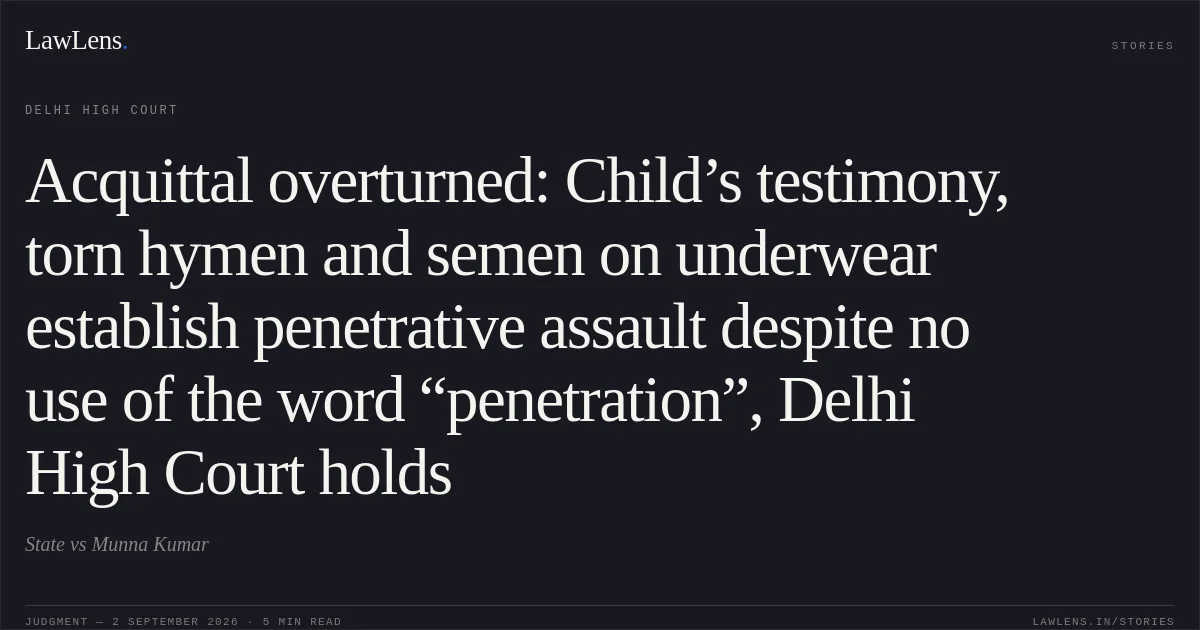
The High Court held that the Trial Court adopted an unduly technical approach by treating the absence of the word “penetration” in the child’s testimony as fatal.
Source reference: paras. 26, 38The victim consistently stated that the respondent removed her underwear and his own clothes, made her lie on the bed, caused pain in her private part, and that blood thereafter began to ooze from that part.
Source reference: paras. 26, 38Given her age, the substance of her narration—not the use of legal terminology—was decisive.
Source reference: paras. 38–40Her prompt disclosure to her mother, the parents’ evidence that she returned bleeding, and the medical finding of a torn hymen and a 1.2 cm genital tear materially corroborated her account.
Source reference: paras. 27–30, 42The Court rejected the alleged contradictions concerning the respondent’s presence, explaining that the mother confronted him shortly after the incident, whereas the father reached his room later, when it was locked.
Source reference: para. 32The victim’s statement that she had been instructed before testifying did not, by itself, establish tutoring, particularly as no material indication of fabricated testimony was shown.
Source reference: para. 34Minor discrepancies regarding the presence of the respondent’s uncle were treated as ancillary and immaterial.
Source reference: para. 35The respondent’s inconsistent and unsubstantiated theories of false implication also failed to establish any motive for such implication.
Source reference: paras. 36–37The FSL findings showing semen on the victim’s underwear, together with blood and semen on articles connected with the respondent’s room, substantially corroborated the prosecution case.
Source reference: paras. 30–31The failure to ascertain the blood group did not neutralise this evidence, especially when the respondent offered no explanation for the presence of semen on the child’s underwear or the seized articles.
Source reference: paras. 30–31The inability to procure the respondent’s semen sample did not establish incapacity for sexual intercourse; medical evidence did not suggest that he was incapable of performing the act.
Source reference: para. 33Considering the ocular, medical and forensic evidence cumulatively, the Court found the prosecution case proved beyond reasonable doubt.
Source reference: paras. 41–43Holding
The High Court answered the issues in favour of the State and held that the respondent’s conduct, as narrated by the child and corroborated by the medical and FSL evidence, constituted penetrative sexual assault punishable under Section 376(2)(f) IPC.
The Trial Court’s acquittal under Section 376(2)(f) IPC and consequential conviction under Section 354 IPC were set aside.
Source reference: paras. 42–44Munna Kumar was convicted under Section 376(2)(f) IPC, and the matter was directed to be listed for hearing on the question of sentence.
Source reference: para. 44Non-bailable warrants were issued for his production, and a fresh nominal roll was requisitioned from the Jail Superintendent.
Source reference: paras. 44–47Acts & Sections Cited
5 provisions across 3 statutes referred to in this judgment. Each provision opens on LawLens.
Indian Penal Code, 18602
Code of Criminal Procedure, 19732
Protection of Children from Sexual Offences Act, 20121
Original Court PDF
StatevsMunna Kumar
Click to open original judgment
Original judgment, available to read, download and summarize on LawLens.in