Facts
The State appealed an acquittal order passed by the Additional Sessions Judge, Navsari, in Sessions Case No. 78 of 2002
Source reference: p. 1-2The prosecution alleged that Mittal (deceased) married Suresh Kori Patel (Accused No. 2) on February 17, 2002. It was alleged that Taraben (Accused No. 1, elder sister-in-law) had an intimate relationship with Accused No. 2 and intended to marry him
Source reference: p. 2On February 18, 2002, Accused No. 1 allegedly served tea laced with poison to the deceased and a companion, Bhavini (PW-6)
Source reference: p. 2While PW-6 remained unaffected, the deceased fell unconscious hours later and was declared dead at the hospital
Source reference: p. 3Police recovered poisonous substance via discovery panchnama from the house of Accused No. 1
Source reference: p. 3The trial court acquitted the respondents on January 13, 2003, citing a lack of evidence regarding motive and administration of poison
Source reference: p. 3-4Issues
1. Whether the prosecution established a complete chain of circumstantial evidence to prove that the accused administered poison to the deceased
Source reference: p. 42. Whether the trial court's judgment of acquittal was perverse or contrary to the evidence on record, warranting interference by the Appellate Court
Source reference: p. 7Law Applied
The court applied Section 302 (Murder) and Section 114 (Abettor present when offence committed) of the Indian Penal Code
Source reference: p. 2Regarding the admissibility of evidence, the court applied Section 27 of the Indian Evidence Act concerning the discovery of facts at the instance of the accused
Source reference: p. 5, 8The court adhered to the established appellate principle that a judgment of acquittal should only be interfered with in "exceptional cases" where there are "compelling substantial reasons" or the findings are "palpably erroneous" or "perverse," maintaining the presumption of innocence reinforced by an acquittal
Source reference: p. 5, 7Reasoning
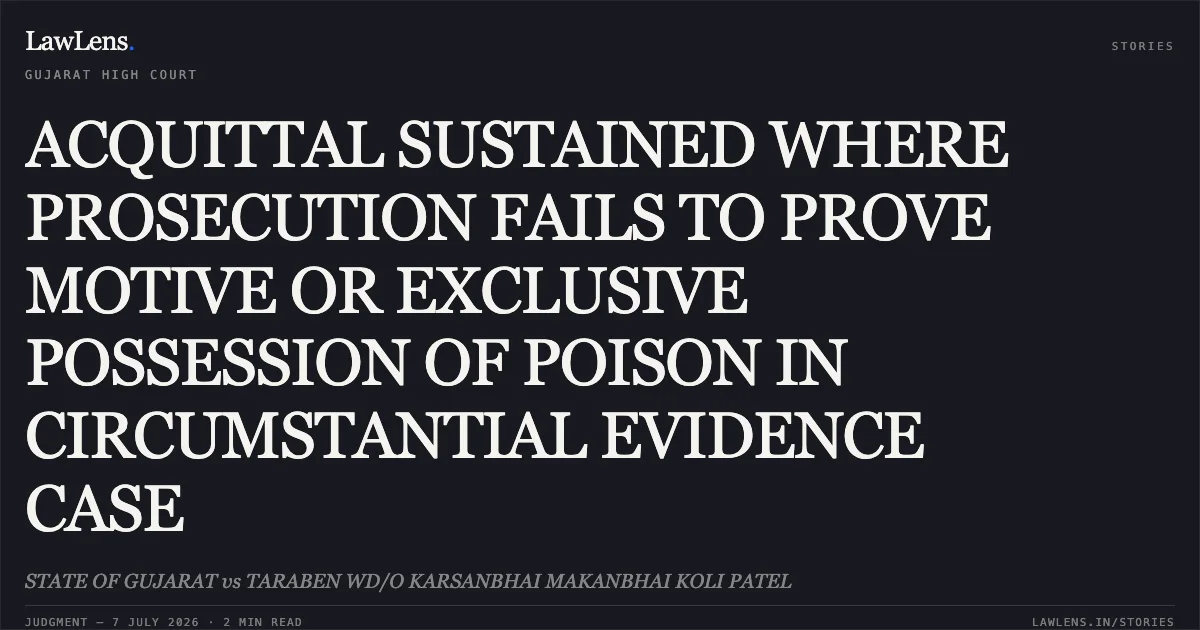
The Court observed that the prosecution’s case rested entirely on circumstantial evidence and the testimony of PW-6. However, PW-6, who allegedly consumed the same tea, suffered no ill effects and required no medical treatment, which negated the theory that the tea served by Accused No. 1 contained poison
Source reference: p. 7-8The court found that the "motive"—the alleged illicit relationship—was not established by clinching evidence
Source reference: p. 8Critically, the discovery panchnama (Exh. 19) for the poisonous substance was not proved under Section 27 of the Evidence Act as the panchas did not support the prosecution
Source reference: p. 5, 8The prosecution further failed to prove that the accused were in possession of or had purchased the poison, as the shopkeeper (PW-11) did not substantiate the claim
Source reference: p. 8Consequently, the court found the chain of circumstances to be broken and insufficient to prove guilt beyond reasonable doubt.
Source reference: no citationHolding
The High Court held that the prosecution miserably failed to prove the charges and that the trial court’s findings were reasonable and based on sound evidence
The Court answered both issues in the negative, finding no perversity in the lower court's judgment
Source reference: p. 9The appeal was dismissed, the judgment of acquittal was upheld, and the bail bonds were ordered to be cancelled
Source reference: p. 9Acts & Sections Cited
2 provisions across 1 statute referred to in this judgment. Each provision opens on LawLens.
Indian Penal Code, 18602
Original Court PDF
STATE OF GUJARATvsTARABEN WD/O KARSANBHAI MAKANBHAI KOLI PATEL
Click to open original judgment
Original judgment, available to read, download and summarize on LawLens.in