01Facts
The NCB (Bengaluru Zonal Unit) prosecuted accused Nos. 1 and 2 (Raju and Manak Chandra) under s. 8(c) r/w ss. 18, 23, 27A, 28 and 29 of the NDPS Act.
The prosecution alleged that on 13.05.2013 at about 5:00 pm, the cabin of lorry No. RJ-20-GA-2252 near Govardhan Cinema Talkies, Yeshwanthapur Mandi, Bengaluru, was searched and 15.038 kg of opium was recovered, and that the accused had conspired to transport it.
¶ 3 · pp. 2–3Charges were framed under s. 8(c) r/w ss. 18, 23, 28 and 29; the accused pleaded not guilty.
Accused Nos. 3 and 4 were proceeded against in a split-up case.
¶ 4 · p. 3The prosecution examined PWs 1–7, marked Exs. P1–P33 and MOs 1–6. The defence led no evidence.
¶ 5 · p. 4By judgment dated 09.07.2015 in Spl. C.C. No. 236/2013, the XXXIII Addl. City Civil & Sessions Judge (NDPS), Bengaluru, acquitted the accused.
The trial court found contradictions in the official witnesses' depositions, no authority letter for PW7's further investigation, non-compliance with recording and signature requirements, and no proven link between the accused and the mobile numbers, and held that conscious possession was not established.
¶ 18–20 · pp. 10–12The State appealed under s. 378(1) Cr.P.C.
¶ 1 · p. 2The respondents contended that the prosecution failed to prove mandatory compliance with s. 50 NDPS Act.
¶ 13 · p. 702Issues
i.1. Whether the trial court was justified in acquitting the accused, such that the High Court should interfere with the judgment of acquittal under s. 378 Cr.P.C.
¶ 14 · p. 7 · ¶ 15 · p. 8ii.2. Whether the prosecution established conscious and intelligent possession of the contraband by accused Nos. 1 and 2, and compliance with the mandatory procedural safeguards under ss. 42 and 50 of the NDPS Act.
¶ 21–23 · pp. 12–1503Law Applied
The Court relied on the principles of appellate interference with acquittals laid down in Constable 907 Surendra Singh v. State of Uttarakhand (2025) 5 SCC 433, Babu Sahebgouda Rudragoudar v. State of Karnataka (2024) 8 SCC 149, Chandrappa v. State of Karnataka (2007) 4 SCC 415, and H.D. Sundara v. State of Karnataka (2023) 9 SCC 581.
¶ 16 · pp. 8–9These cases hold that an acquittal strengthens the presumption of innocence; that the appellate court may re-appreciate evidence; that a possible view favouring acquittal cannot be displaced merely because another view is possible; and that interference is warranted only where the acquittal is perverse, based on misreading or omission of material evidence, or where only a guilt-consistent view is possible.
¶ 16 · pp. 8–9On the NDPS Act, the Court adopted the trial court's reliance on a series of Supreme Court decisions, which the Court summarised as holding that ss. 42 and 50 are mandatory, s. 57 is directory, the s. 54 presumption arises only after the prosecution establishes foundational facts, and the prosecution must prove conscious possession.
¶ 21 · pp. 12–14 · ¶ 22 · pp. 13–15Section 54 of the NDPS Act is referred to as the source of the presumption of culpable mental state, and s. 57 as the reporting obligation of the officer.
¶ 22 · pp. 13–15Provisions in the judgment · 11 · Linked ones open on LawLens
Code of Criminal Procedure, 1973 Section 378Section 313
Narcotic Drugs and Psychotropic Substances Act, 1985 9 provisions
Section 8Section 18Section 23Section 28Section 29Section 50Section 42Section 57Section 5404Reasoning
Applying the Surendra Singh and Chandrappa standard, the Court examined the trial court's reasons and found that they were grounded in the record.
¶ 16 · pp. 8–9The trial court identified specific defects: PW1 obtained only oral permission to search and no authority letter was produced for PW7; PW7 recorded no reasons for a search between sunset and sunrise; PWs 4, 6 and 7 did not sign the mahazar; the FSL report (Ex. P15) did not record the test methods or RF values; and no material linked the mobile numbers in the accused's statements to the accused.
¶ 18–19 · pp. 10–11PW3, the lorry owner, knew nothing of the contraband, and the driver Balchand, who was not examined, fled. No witness stated who was driving the lorry or who had possession of the gunny bag.
¶ 20 · pp. 11–12The accused's confessions stated that they did not know the name of the recipient, which the trial court held cast doubt on their knowledge of the bag's contents.
¶ 20 · p. 12The High Court held that these contradictions broke the chain of circumstantial evidence and created reasonable doubt on conscious possession, so the trial court's view was a possible one.
¶ 23 · p. 15The Court did not separately examine the s. 50 compliance argument raised by the respondents. It relied instead on the trial court's conclusions on the adjudicated principles.
¶ 13 · p. 7 · ¶ 22 · pp. 13–1505Holding
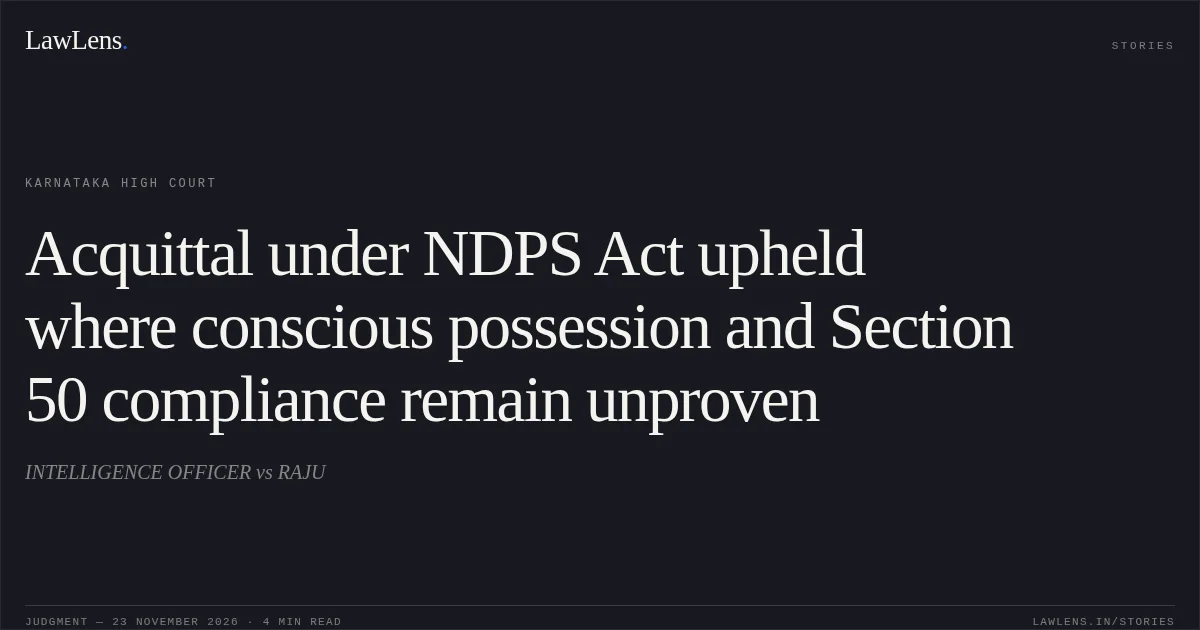
The High Court answered Point No. 1 in the affirmative, holding that the trial court's acquittal was justified and that the prosecution had failed to prove guilt beyond reasonable doubt, including conscious possession, due to material contradictions and the absence of a complete chain of circumstantial evidence.
¶ 19, 23 · pp. 15–16The State's appeal was dismissed. The Registry was directed to send a copy of the judgment and the trial court records to the concerned court. The judgment of acquittal dated 09.07.2015 in Spl. C.C. No. 236/2013 stands affirmed.
¶ 20 · p. 16Original Court PDF
INTELLIGENCE OFFICERvsRAJU
Click to open original judgment
Original judgment, available to read, download and summarize on LawLens.in