01Facts
Respondent No. 2 (Mumtaz, the defacto complainant) and accused Nos. 1 to 4 entered into an agreement of sale for CTS No. EWS 81/A (CTS No. 9287-A) at a total consideration of ₹24,00,000.
¶ 2The complainant paid ₹8,00,000 on 22.12.2017 and ₹12,00,000 on 10.01.2018 through NEFT.
¶ 2The charge sheet records the agreement as dated 23.12.2017.
¶ 10The accused did not execute a registered sale deed.
¶ 2On 17.01.2018 the complainant allegedly learnt that accused Nos. 1 to 5 had sold the property to accused No. 6 for ₹32,15,057.
¶ 2The complaint was lodged on 03.08.2018, leading to Crime No. 09/2018 (Cen PS, Belagavi) and C.C. No. 07/2020 before the III JMFC, Belagavi, for offences under Sections 420 and 406 IPC.
¶ 2, 10The petitioners contended that the complainant had defaulted, that they agreed to refund the amount, and that the complainant had already obtained a civil decree in O.S. No. 312/2018 for enforcement of the agreement, under which the trial court allowed the suit in part, directed refund of ₹24,00,000, and declined specific performance.
¶ 4–5The State contended that a detailed trial was required.
¶ 7The complainant's counsel relied on the filing of the charge sheet.
¶ 8The complainant did not appeal the civil decree, which therefore attained finality.
¶ 11–1202Issues
i.1. Whether criminal proceedings under Sections 420 and 406 IPC can continue against the accused for the same transaction where the complainant has already obtained a civil decree for refund in O.S. No. 312/2018, which has attained finality.
¶ 11–12, 15ii.2. Whether the ingredients of cheating (Section 420 IPC) and criminal breach of trust (Section 406 IPC) are made out on the allegations arising from an agreement of sale and subsequent sale of the same property.
¶ 13–14, 43iii.3. Whether continuation of the prosecution amounts to an abuse of the process of law and to double jeopardy contrary to Article 20(2) of the Constitution.
¶ 6, 1503Law Applied
Section 420 IPC penalises cheating and dishonest inducement to deliver property.
¶ 13Section 406 IPC penalises criminal breach of trust.
¶ 13Cheating requires dishonest intention from the inception of the transaction, whereas criminal breach of trust requires lawful entrustment of property or dominion over it followed by dishonest misappropriation; mere breach of contract does not by itself constitute cheating, and the two offences are mutually exclusive on the same facts, as laid down in Delhi Race Club (1940) Ltd. v. State of U.P., Criminal Appeal No. 3114 of 2024 (decided 23.08.2024).
¶ 14 (quoting paras. 29–31), 43A magistrate or police must ascertain whether the alleged facts genuinely constitute these specific offences.
¶ 14 (quoting para. 42)Continuing criminal proceedings without the necessary ingredients, or on a cause of action already adjudicated civilly, amounts to abuse of process and offends the protection against double jeopardy under Article 20(2) of the Constitution.
¶ 14 (quoting para. 43), 15The petitions were filed under Section 482 Cr.P.C.; the order does not expressly identify the statutory source of its quashing power beyond this.
¶ 1Provisions in the judgment · 4 · Linked ones open on LawLens
Code of Criminal Procedure, 1973 Section 482
Indian Penal Code, 1860 Section 406Section 407Section 420
04Reasoning
The complainant had elected a civil remedy by suing for specific performance and obtaining a refund decree, which was not appealed and became final.
¶ 11–12Applying Delhi Race Club, the dispute was characterised as arising from an agreement of sale and a subsequent sale of the same immovable property.
¶ 43No allegation of entrustment of property to the accused was found, which is the foundational requirement of Section 406 IPC; the accused were the owners and the grievance was non-performance of a contract.
¶ 14, 43The complaint did not establish a dishonest intention from the inception of the transaction, as opposed to a subsequent breach of contract, and therefore the ingredients of Section 420 IPC were not made out.
¶ 14, 43Having held that the ingredients of both offences were not independently made out, continuing the prosecution for the same cause of action already adjudicated in the civil suit would amount to double vexation of the accused and an abuse of process.
¶ 15The charge sheet being filed was not sufficient to outweigh these considerations.
¶ 805Holding
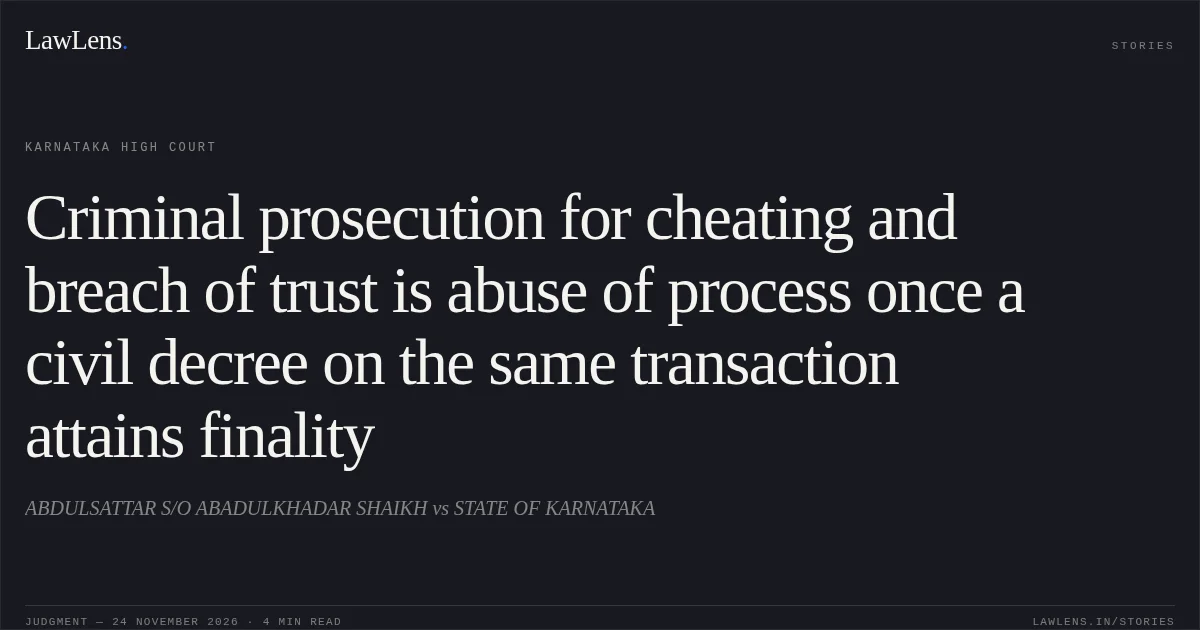
The complainant could not prosecute criminal proceedings for the same cause of action after obtaining and not appealing a civil refund decree, and the ingredients of Sections 420 and 406 IPC were not made out on the facts. Continuing the case would amount to abuse of process and double jeopardy under Article 20(2).
¶ 14–15Both criminal petitions were allowed. Proceedings in C.C. No. 07/2020 before the III JMFC, Belagavi, were quashed as against accused Nos. 1 to 4 and 6. Pending IAs, if any, were disposed of as not surviving.
¶ 15, order cls. (ii)–(iii)Original Court PDF
ABDULSATTAR S/O ABADULKHADAR SHAIKHvsSTATE OF KARNATAKA
Click to open original judgment
Original judgment, available to read, download and summarize on LawLens.in