Facts
The applicant and respondent were married in 2009 and have two children.
Source reference: para. 2, 6The applicant alleged harassment and domestic violence, including an incident in which the respondent gave her Nicip pills while she was unwell, and stated that she thereafter lived at her parental home with the children.
Source reference: para. 2, 6She sought relief under the Protection of Women from Domestic Violence Act, 2005 (“DV Act”).
Source reference: para. 2, 6The JMFC granted her Rs.3,000 per month as rent allowance under Section 19, Rs.2,000 as monetary relief under Section 20, and Rs.2,000 as compensation under Section 22.
Source reference: para. 1–2On the respondent’s appeal, the Appellate Court set aside those awards.
Source reference: para. 1–2The applicant challenged that decision in revision under Sections 438 and 442 of the Bharatiya Nagarik Suraksha Sanhita, 2023.
Source reference: para. 1–2Issues
Whether the Appellate Court was justified in setting aside the relief granted under Sections 19, 20 and 22 of the DV Act without properly assessing the evidence as a whole
Source reference: para. 9–14Whether the respondent’s acquittal in proceedings under Section 498-A of the IPC, or the Family Court’s maintenance award, by itself defeated the applicant’s claim to relief under the DV Act
Source reference: para. 12Law Applied
The Court considered Sections 19, 20 and 22 of the DV Act, which respectively provide for residence-related relief, monetary relief and compensation, and reviewed the challenged orders in criminal revision under Sections 438 and 442 of the BNSS.
Source reference: para. 1, 13–15Allegations in DV Act proceedings are assessed on a preponderance of probabilities, not beyond reasonable doubt.
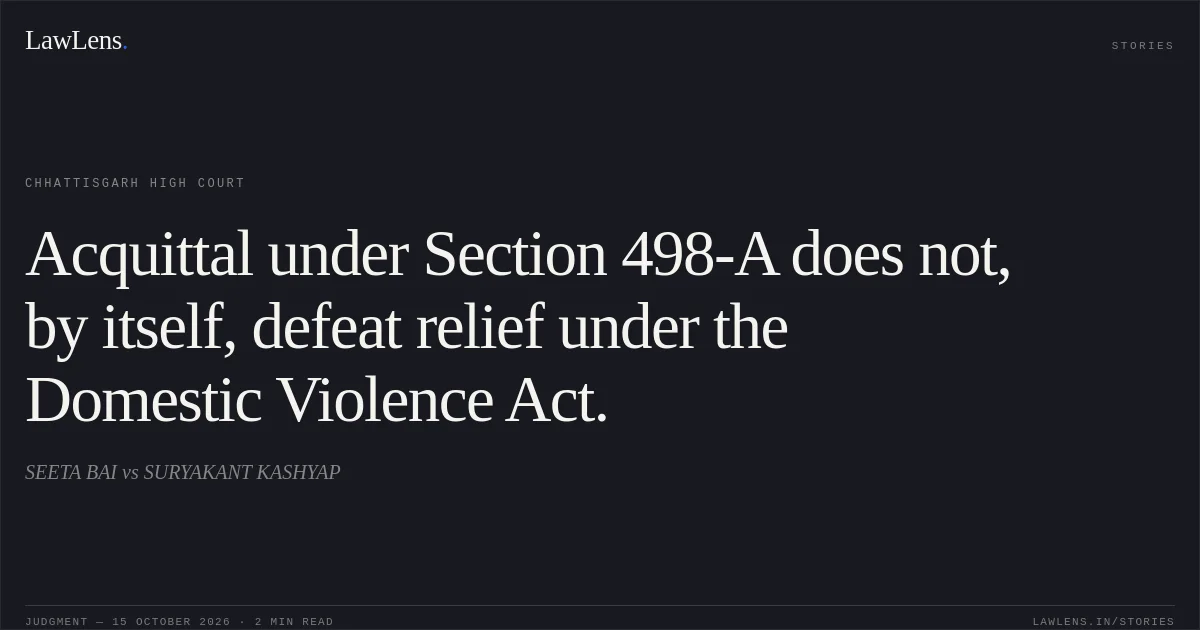
Source reference: para. 14An acquittal under Section 498-A of the IPC does not, by itself, determine entitlement to relief under the DV Act, because the proceedings differ in nature and purpose.
Source reference: para. 12An existing maintenance order is relevant to monetary relief, but does not automatically bar other DV Act relief; the nature of each relief must be assessed separately while avoiding impermissible duplication.
Source reference: para. 12Reasoning
The Court found that although no witness had personally seen the respondent administer the pills, the applicant’s testimony was supported in relevant respects by her father and another witness concerning the matrimonial dispute and hospital visit.
Source reference: para. 9, 11It held that the absence of direct evidence about the pills and the lack of specific dates for every alleged incident did not, by themselves, justify rejecting the claim.
Source reference: para. 9, 11The Project Officer’s report was also relevant and had to be considered alongside the oral evidence.
Source reference: para. 10The witnesses’ evidence was not challenged in cross-examination, the respondent adduced no evidence rebutting the allegations, and the report lent further support to the applicant’s case.
Source reference: para. 14Applying the preponderance-of-probabilities standard, the Court concluded that the Trial Court had properly granted relief and that the Appellate Court had not adequately assessed the evidence.
Source reference: para. 14The acquittal and existing maintenance award did not automatically extinguish the applicant’s entitlement to the distinct reliefs sought under the DV Act.
Source reference: para. 12Holding
The Court answered the issues in the applicant’s favour, set aside the Appellate Court’s judgment dated 4 July 2025, and restored the JMFC’s order dated 21 August 2024 granting Rs.3,000 per month as rent allowance, Rs.2,000 as monetary relief and Rs.2,000 as compensation.
The criminal revision was allowed.
Source reference: para. 15–16Acts & Sections Cited
8 provisions across 2 statutes referred to in this judgment. Each provision opens on LawLens.
Bharatiya Nagarik Suraksha Sanhita, 20232
Protection of Women from Domestic Violence Act, 20056
Original Court PDF
SEETA BAIvsSURYAKANT KASHYAP
Click to open original judgment
Original judgment, available to read, download and summarize on LawLens.in


