Facts
The complainant, a hotel waiter and member of a Scheduled Caste, alleged that on 31.10.2008, the accused assaulted him with an iron pipe and hurled caste-based abuses following a dispute over cleaning work.
Source reference: p. 1-2The prosecution alleged offences under Sections 324, 504, 506(2) of the IPC and Section 3(1)(10) of the SC/ST (Prevention of Atrocities) Act.
Source reference: p. 1-2The trial court (Special Court, Nadiad) acquitted the accused on 01.07.2009 due to lack of evidence and contradictions in testimony.
Source reference: p. 3-4The State preferred this appeal against the acquittal under Section 378 of the Cr.P.C.
Source reference: p. 1Issues
1. Whether the prosecution proved the guilt of the accused for assault and criminal intimidation beyond reasonable doubt in light of hostile witnesses and medical contradictions.
Source reference: p. 16/para 102. Whether the derogatory remarks allegedly made by the accused satisfy the necessary legal ingredients to constitute an offence under Section 3(1)(x) (now 3(1)(r)/(s)) of the SC/ST Act.
Source reference: p. 15/para 8.183. Whether there are "substantial and compelling reasons" to interfere with the trial court’s order of acquittal.
Source reference: p. 20/para 15-16Law Applied
The court primarily applied Section 378 of the Cr.P.C. regarding the powers of the High Court in appeals against acquittal.
Source reference: p. 18It relied on the principle from Chandrappa v. State of Karnataka, which reinforces the "double presumption of innocence" in acquittal cases.
Source reference: p. 19-21For the Atrocities Act, it applied the precedent from Sajan Sakhariya v. State of Kerala, establishing that every insult does not constitute an offence under the SC/ST Act unless directed specifically because the victim is a member of a protected class.
Source reference: p. 15The court also followed the standard of appellate restraint regarding findings of fact as laid down in State of Karnataka v. Hemareddy.
Source reference: p. 17Reasoning
The Court observed that the prosecution’s case was fundamentally weakened by major contradictions: the complainant’s testimony varied from his initial complaint—specifically regarding a new "mobile phone dispute" motive and the claim that he was hit from behind.
Source reference: p. 6, 12Medical evidence failed to corroborate the ocular account; the treating doctor noted the complainant gave a different name for the assailant (Babulbhai vs. Rafikbhai) and that the injuries could be accidental.
Source reference: p. 8-9Witness PW-5 admitted to being inside the hotel during the incident, rendering his testimony ineffective as an eyewitness.
Source reference: p. 14The lack of blood-stained clothes or blood at the scene undermined the allegation of a violent assault.
Source reference: p. 11, 13The Court found that the complainant’s admission that he was "advised/tutored" by a Trust suggested the testimony lacked independent credibility.
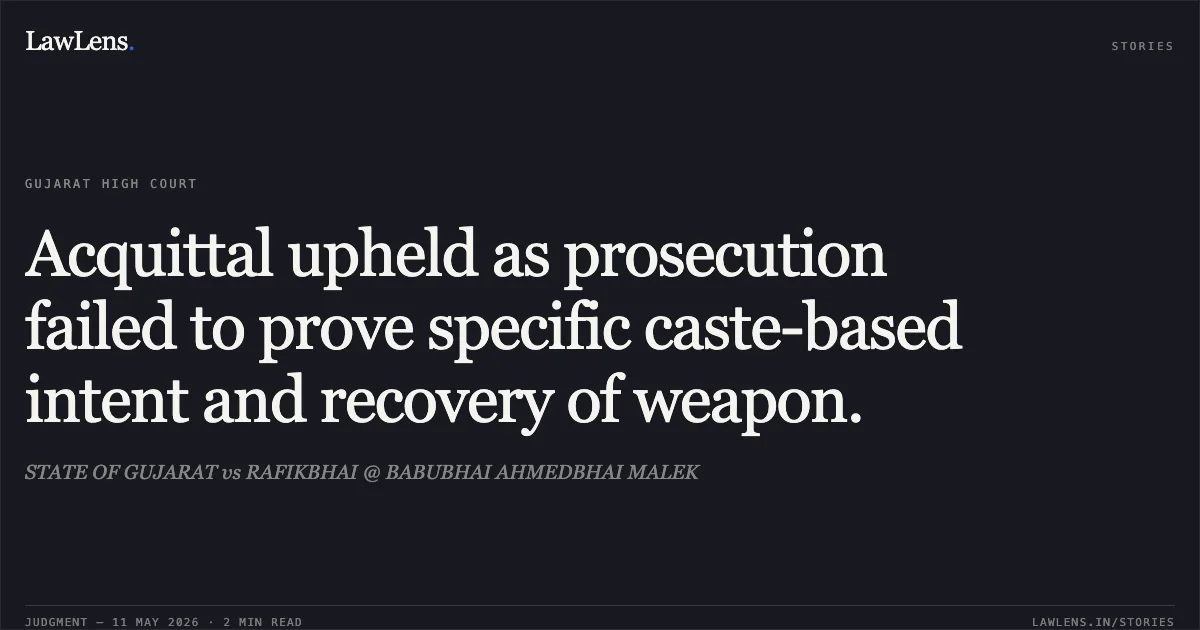
Source reference: p. 13, 15Applying the Sajan Sakhariya principle, the Court held that the prosecution failed to prove the alleged abuses were specifically targeted at the complainant’s caste identity.
Source reference: p. 15Holding
The Court held that the High Court should not interfere with an acquittal merely because a different view is possible, provided the trial court's view is "reasonable and plausible".
The Court dismissed the appeal and upheld the acquittal, directing that the trial court's record be remitted and the acquittal be maintained.
Source reference: p. 22-23Acts & Sections Cited
6 provisions across 3 statutes referred to in this judgment. Each provision opens on LawLens.
Indian Penal Code, 18603
Scheduled Castes and the Scheduled Tribes (Prevention of Atrocities) Act, 19891
Code of Criminal Procedure, 19732
Original Court PDF
STATE OF GUJARATvsRAFIKBHAI @ BABUBHAI AHMEDBHAI MALEK
Click to open original judgment
Original judgment, available to read, download and summarize on LawLens.in