Facts
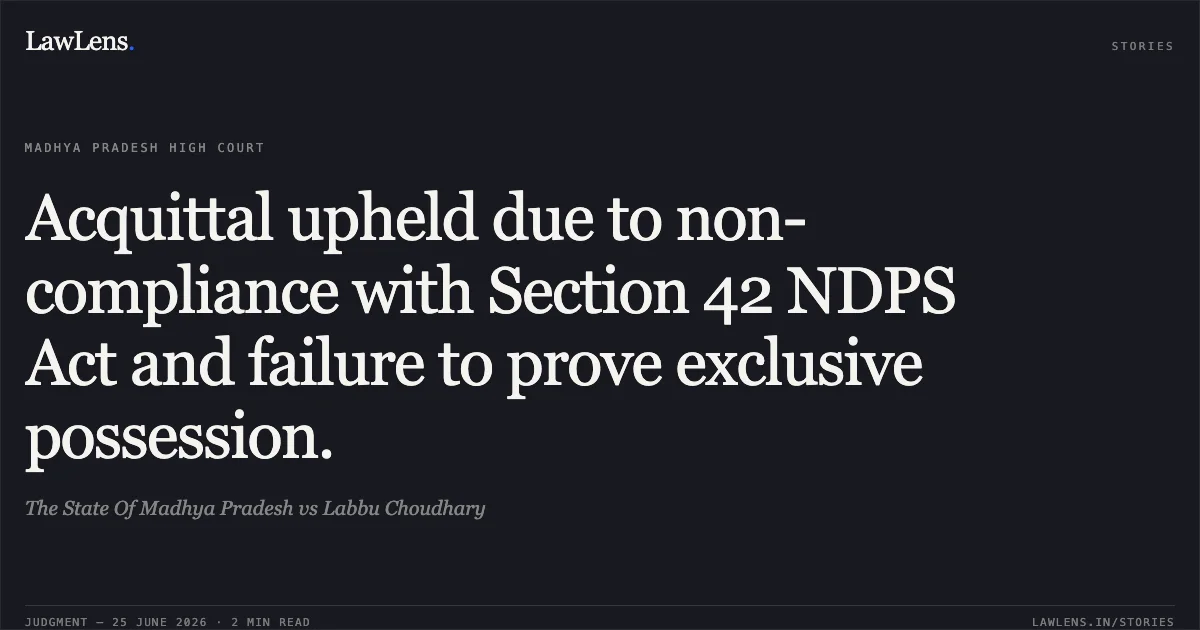
The State appealed against the judgment of the Special Judge, NDPS, Panna, dated 31.10.2022, which acquitted the respondent of charges under Sections 8(C)/20 of the NDPS Act.
Source reference: para. 2The prosecution alleged that on 29.08.2017, police raided the respondent’s house and seized 11 Ganja trees planted in the courtyard.
Source reference: para. 3During the trial, ten witnesses were examined; however, independent seizure witnesses turned hostile.
Source reference: para. 5, 9The State contended that the testimony of police officers remained intact and the trial court acquitted the accused on "fancy grounds".
Source reference: para. 7Issues
1. Whether the prosecution proved the mandatory compliance of Section 42 of the NDPS Act regarding search and seizure procedures.
Source reference: para. 102. Whether the prosecution established the respondent’s exclusive possession and title over the premises where the contraband was found.
Source reference: para. 11-123. Whether there were material irregularities or perversity in the trial court’s judgment warranting interference by the appellate court.
Source reference: para. 14-20Law Applied
The court applied Section 42 of the Narcotic Drugs and Psychotropic Substances (NDPS) Act, 1985, regarding the recording and shifting of information for search and seizure.
Source reference: para. 10It relied on Boota Singh v. State of Haryana (2021) regarding search warrant requirements.
Source reference: para. 10Section 65-B of the Indian Evidence Act for the admissibility of electronic evidence (photographs).
Source reference: para. 12Applied the principles governing appeals against acquittal as established in H.D. Sundara v. State of Karnataka (2023), Babu Sahebagouda Rudragoudar v. State of Karnataka (2024), and Mallappa v. State of Karnataka (2024), which mandate that if two views are possible, the appellate court must uphold the view favoring the accused unless the trial court's decision is perverse.
Source reference: para. 15-19Reasoning
The Court found the prosecution's case fundamentally flawed due to non-compliance with Section 42 of the NDPS Act. There were material contradictions between Rakesh (PW-9) and Rohit (PW-4) regarding whether a search warrant was obtained or if a memorandum was properly submitted to the SDOP office; crucial witnesses from the SDOP office were not examined.
Source reference: para. 10Regarding possession, the prosecution failed to produce documentary evidence (Khasra/Khatoni) to prove the respondent owned the land.
Source reference: para. 11Testimonies were inconsistent: police witnesses described a courtyard with a hand pump and three rooms, while the Patwari (PW-5) described only one room and no hand pump. Additionally, independent witnesses and a defense witness suggested the respondent lived elsewhere and the land was occupied by his son.
Source reference: para. 12The court also noted technical lapses, including the lack of Section 65-B certification for photographs, missing specimen seals on seized material, and the premature inclusion of a crime number on the arrest memo before registration.
Source reference: para. 12-13Holding
The High Court held that the trial court's view was plausible and legally sustainable, as the prosecution failed to prove the respondent's exclusive possession of the premises or strict compliance with NDPS procedures.
Following the principle that acquittal reinforces the presumption of innocence, the Court refused to interfere. The application for leave to appeal (IA No. 1974/2023) and the criminal appeal were dismissed.
Source reference: para. 15, 21Acts & Sections Cited
4 provisions across 2 statutes referred to in this judgment. Each provision opens on LawLens.
Code of Criminal Procedure, 19731
Narcotic Drugs and Psychotropic Substances Act, 19853
Original Court PDF
The State Of Madhya PradeshvsLabbu Choudhary
Click to open original judgment
Original judgment, available to read, download and summarize on LawLens.in