Facts
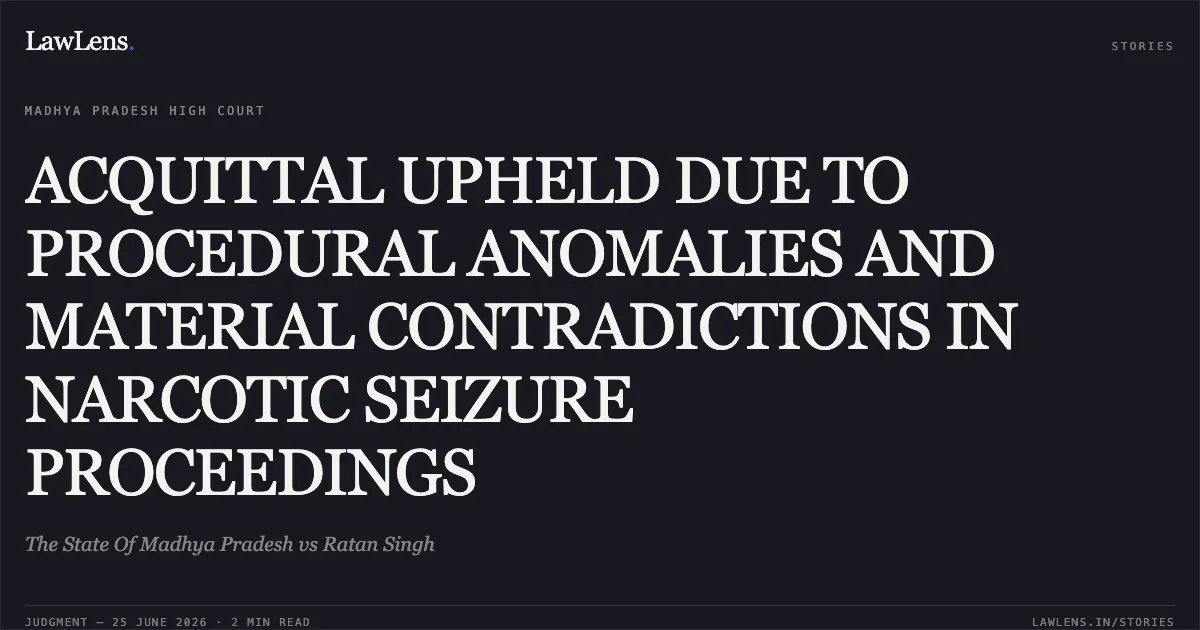
The State appealed against a judgment dated May 5, 2022, by the Special Judge, NDPS Act, Seoni, which acquitted the respondents of charges under Section 8/20 of the NDPS Act.
Source reference: para. 1The prosecution alleged that on January 8, 2019, police intercepted the accused on a motorcycle and seized 23.4 kg of Ganja stored in a blue plastic can.
Source reference: para. 2While the police claimed to have followed all statutory procedures for search and seizure, the independent witnesses (PW-1 and PW-8) turned hostile.
Source reference: para. 6, 8The trial court noted significant procedural anomalies, including discrepancies in the timing of events, the mention of crime numbers on documents prepared prior to FIR registration, and the failure to produce the seized "plastic can" in court.
Source reference: para. 10-14Issues
1. Whether the prosecution proved the seizure of the contraband from the possession of the accused beyond a reasonable doubt given the hostility of independent witnesses and procedural lapses.
Source reference: para. 8, 152. Whether the appellate court should interfere with a trial court’s judgment of acquittal when the findings are based on a plausible view of the evidence.
Source reference: para. 15-16Law Applied
The court applied the evidentiary standards of the Narcotic Drugs and Psychotropic Substances (NDPS) Act, 1985, specifically regarding search and seizure under Section 42.
Source reference: para. 9It emphasized the principle that as the severity of punishment increases, the burden on the prosecution to prove its case becomes heavier.
Source reference: para. 8The court relied on H.D. Sundara v. State of Karnataka (2023) and Mallappa v. State of Karnataka (2024), which establish that an acquittal reinforces the presumption of innocence and should only be overturned if the trial court's view is "perverse," "wholly unreasonable," or "legally implausible" under Section 378 of the CrPC.
Source reference: para. 16, 20Reasoning
The High Court found the prosecution's case riddled with "anomalies" and "material contradictions".
Source reference: para. 12-15Key discrepancies included: (a) Constable PW-10 allegedly departed with samples on Jan 9, yet the accompanying draft letter was dated Jan 10; (b) documents prepared before the FIR contained the final crime number, which remained unexplained; (c) the primary container (the plastic can) was never produced in court or deposited in the malkhana; and (d) witnesses gave conflicting accounts of whether the seizure occurred in the morning or at night.
Source reference: para. 9, 10, 11, 12PW-6 admitted that the sampling and sealing were conducted at the police station rather than the spot of the incident, demolishing the reliability of the recovery.
Source reference: para. 14The Court reasoned that these gaps created a "possible view" in favor of the accused, precluding appellate interference.
Source reference: para. 15, 21Holding
The High Court held that the trial court’s decision was neither perverse nor faulty, as the prosecution failed to establish the charges beyond a reasonable doubt.
The Court affirmed that an appellate court cannot substitute its own view for a "legally plausible view" taken by the trial court.
Source reference: para. 20the application for leave to appeal was dismissed, and the acquittal of the respondents was upheld.
Source reference: para. 22Acts & Sections Cited
5 provisions across 2 statutes referred to in this judgment. Each provision opens on LawLens.
Code of Criminal Procedure, 19732
Narcotic Drugs and Psychotropic Substances Act, 19853
Original Court PDF
The State Of Madhya PradeshvsRatan Singh
Click to open original judgment
Original judgment, available to read, download and summarize on LawLens.in