Facts
The State of Chhattisgarh filed an acquittal appeal under Section 378(1) of the Cr.P.C. challenging the judgment dated 27.06.2018 passed by the First Additional Sessions Judge, Durg.
Source reference: para. 1The respondents, along with a deceased accused (Ishwar) and an absconding accused (Ramu Telgu), were charged under Section 307 of the IPC and Section 25 of the Arms Act for allegedly assaulting the victim, Raja Naykar (PW-5), with a knife.
Source reference: para. 6During the trial, the injured eye-witness (PW-5) provided inconsistent testimony regarding the involvement of the respondents when confronted with his prior statements recorded under Sections 161 and 164 of the Cr.P.C.
Source reference: para. 6Furthermore, the Investigating Officer (PW-8) testified that the injuries were caused by the deceased accused, Ishwar, and that respondent Kailash did not cause any injury.
Source reference: para. 6Issues
1. Whether the High Court should interfere with an order of acquittal if the trial court’s view is a "possible view" based on the evidence.
Source reference: para. 52. Whether the acquittal of the respondents for offences under Section 307 IPC and Section 25 of the Arms Act suffered from patent perversity or misreading of material evidence.
Source reference: para. 6Law Applied
The Court primarily applied Section 378(1) of the Cr.P.C. regarding appeals against acquittal.
Source reference: para. 1It relied on the principles established in Constable 907 Surendra Singh & Another v. State of Uttarakhand (2025 INSC 11) and Babu Sahebagouda Rudragoudar v. State of Karnataka (2024) 8 SCC 149, which dictate that an appellate court must respect the "double presumption of innocence" in favour of the accused.
Source reference: para. 5The rule establishes that interference is only warranted if the judgment suffers from patent perversity, misreading of evidence, or if no two reasonable views are possible.
Source reference: para. 5Reasoning
The Court observed that the testimony of the injured eye-witness (PW-5) was unreliable due to significant omissions and contradictions when compared to his previous legal statements.
Source reference: para. 6Crucially, the Court noted that the Investigating Officer (PW-8) explicitly stated that the injury was caused by the deceased accused, Ishwar, and not by the respondents.
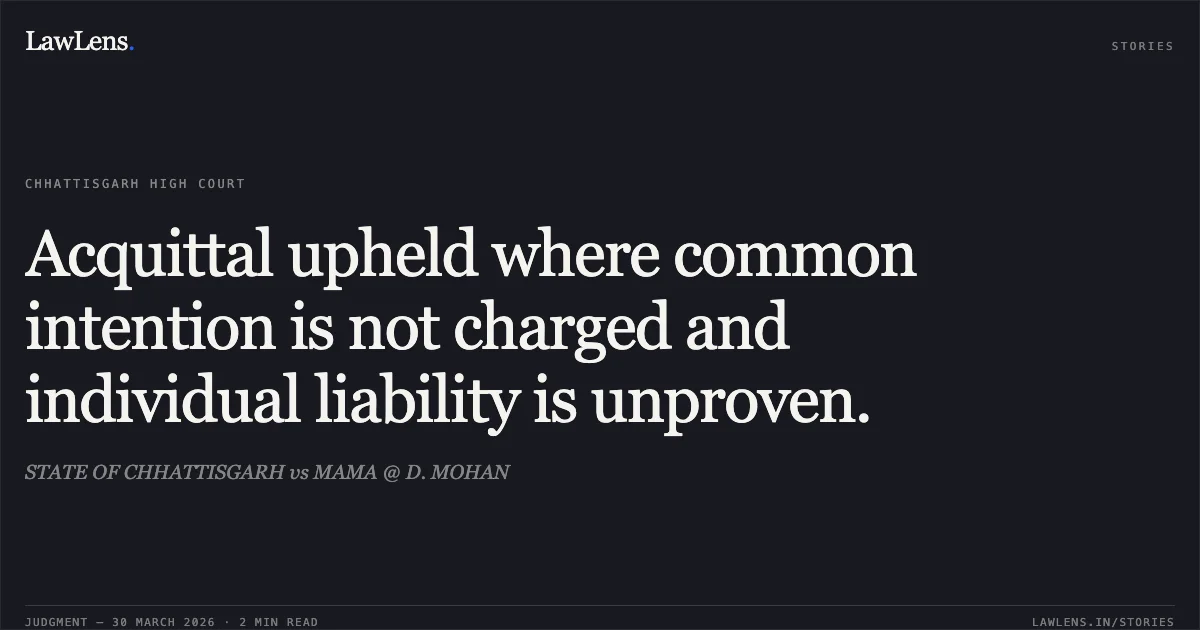
Source reference: para. 6The Court further highlighted a procedural gap: the respondents were only charged under Section 307 IPC individually, and not in conjunction with Section 34 IPC (common intention).
Source reference: para. 6Consequently, applying the restrictive standards for reversing acquittals, the Court found that the trial court's decision was a reasonable and possible view based on the record, as the prosecution failed to prove the specific acts of the respondents beyond a reasonable doubt.
Source reference: para. 6Holding
The High Court dismissed the State’s appeal, holding that there was no illegality or perversity in the impugned judgment.
The Court affirmed the acquittal of the respondents, concluding that no substantial grounds existed to disturb the trial court's findings.
Source reference: para. 6The appeal was dismissed.
Source reference: para. 6Acts & Sections Cited
6 provisions across 3 statutes referred to in this judgment. Each provision opens on LawLens.
Code of Criminal Procedure, 19733
Indian Penal Code, 18602
Arms Act, 19591
Original Court PDF
STATE OF CHHATTISGARHvsMAMA @ D. MOHAN
Click to open original judgment
Original judgment, available to read, download and summarize on LawLens.in