Facts
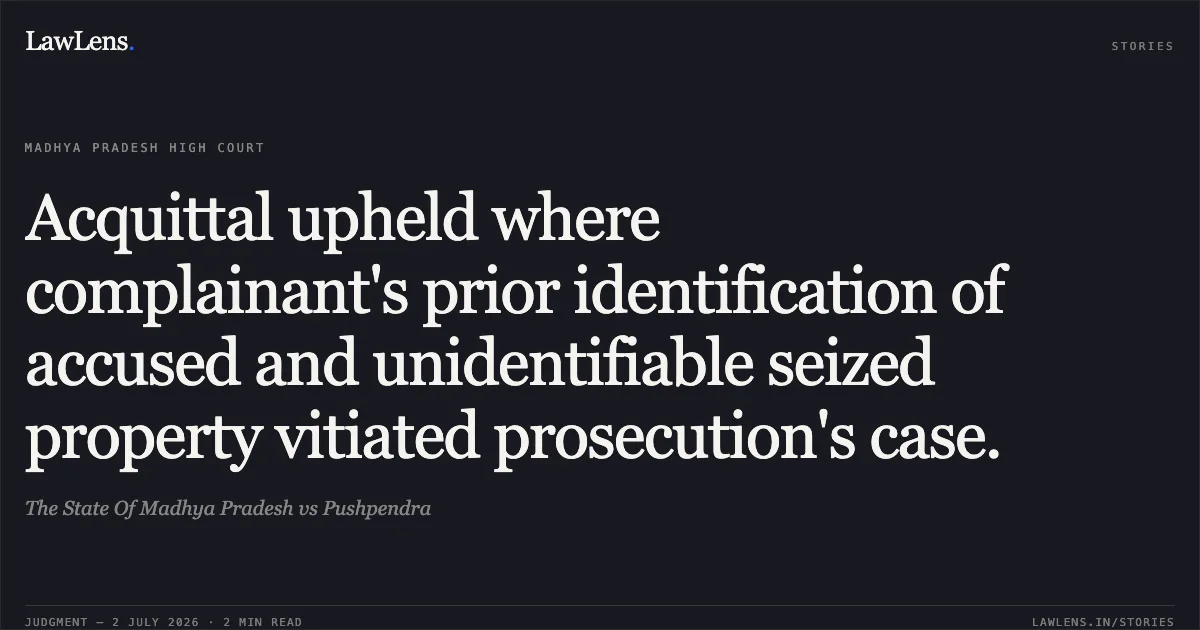
On March 11, 2015, Mohd. Rahish (PW-3), a truck driver transporting 200 bags of sesame, was intercepted by four persons in a Tavera vehicle, abducted, and robbed of the truck and produce.
Source reference: para. 2The police registered a case under Sections 392 and 365 of the IPC and subsequently recovered sesame, cash, and vehicles based on memorandum statements under Section 27 of the Evidence Act.
Source reference: para. 3The prosecution charged twelve respondents with various offences including dacoity (Section 395), kidnapping (365), and illegal possession of arms.
Source reference: para. 1The Trial Court (Additional Sessions Judge, Banda) acquitted all respondents on December 22, 2022. The State filed this application for leave to appeal the acquittal.
Source reference: para. 1, 5Issues
1. Whether the identification of the accused by the complainant during the Test Identification Parade (TIP) was legally reliable despite allegations of prior exposure.
Source reference: para. 82. Whether the prosecution established the identity of the seized property (sesame and Innova car) as the actual objects involved in the dacoity.
Source reference: para. 9, 103. Whether the procedural lapses in the seizure of firearms and lack of independent witnesses vitiated the charges under the Arms Act.
Source reference: para. 13, 144. Whether the High Court should interfere with a judgment of acquittal when the Trial Court’s view is a "plausible view".
Source reference: para. 15, 19Law Applied
An appellate court should not overturn an acquittal if the trial court’s view is "legally plausible," even if an alternative view exists, as established in H.D. Sundara v. State of Karnataka (2023), Babu Sahebagouda Rudragoudar v. State of Karnataka (2024), and Mallappa v. State of Karnataka (2024).
Source reference: para. 15, 16, 17Section 27 of the Evidence Act regarding recoveries and Section 25(1-B)(A) of the Arms Act regarding possession of illegal weapons.
Source reference: para. 3, 13Reasoning
The complainant (PW-3) admitted in court that the police had shown him the accused prior to the TIP, rendering the identification parade meaningless.
Source reference: para. 8The recovered sesame was a common agricultural product, and the prosecution failed to conduct any identification proceedings to link it to the stolen bags.
Source reference: para. 10While a Tavera was used in the crime, an Innova was seized, and no link was established between the two.
Source reference: para. 9Regarding the Arms Act, the court noted the absence of independent seizure witnesses and the failure of the Seizure Officer (PW-8) to produce Roznamcha entries or Malkhana records to prove safe custody; furthermore, the expert (PW-9) admitted the firearm was non-functional.
Source reference: para. 13, 14The court reasoned that since the Trial Court’s findings were based on a comprehensive appreciation of these evidentiary gaps, they could not be termed "perverse" or "illegal".
Source reference: para. 18, 20Holding
The prosecution failed to prove the guilt of the respondents beyond a reasonable doubt and the Trial Court had taken a plausible view of the evidence.
The application for leave to appeal (I.A. No. 5024 of 2023) was dismissed, and consequently, the criminal appeal was dismissed.
Source reference: para. 21Acts & Sections Cited
8 provisions across 3 statutes referred to in this judgment. Each provision opens on LawLens.
Indian Penal Code, 18606
Arms Act, 19591
Code of Criminal Procedure, 19731
Original Court PDF
The State Of Madhya PradeshvsPushpendra
Click to open original judgment
Original judgment, available to read, download and summarize on LawLens.in


