Facts
The complainant, Kalubhai Ramjibhai Parmar, a member of a Scheduled Caste and a security guard at Moksh Temple/crematorium, alleged that on 4 July 2009 at approximately 11:30 p.m., the accused arrived in a drunken condition, abused him, and assaulted him when he refused to open the gate.
Source reference: pp. 1–2, paras. 1–2.2It was alleged that accused No. 2 caught the complainant by the neck and accused No. 1 inflicted a knife injury.
Source reference: pp. 1–2, paras. 1–2.2An FIR was registered at Bhavnagar City “D” Division Police Station for offences under Sections 323, 324, 504 and 114 of the IPC, Section 3(1)(10) of the SC/ST (Prevention of Atrocities) Act, 1989, and Section 135 of the Bombay Police Act.
Source reference: pp. 1–2, paras. 1–2.2After investigation and committal, the trial court acquitted the accused in Special (Atrocity) Case No. 5 of 2012 by judgment dated 2 October 2012.
Source reference: pp. 1–2, paras. 1, 6–7The State preferred the present appeal against acquittal under Section 378 of the Code of Criminal Procedure, 1973.
Source reference: pp. 1–2, paras. 1, 6–7Issues
Whether the trial court was justified in acquitting the accused of the offences alleged against them?
Source reference: p. 9, para. 11Whether the trial court properly appreciated the oral and documentary evidence produced by the prosecution?
Source reference: p. 9, para. 11Whether the impugned judgment of acquittal suffered from any illegality, irregularity, or perversity warranting appellate interference?
Source reference: p. 9, para. 11Whether the prosecution proved beyond reasonable doubt the identity and involvement of the accused in the assault and the ingredients of the offence under Section 3(1)(10) of the SC/ST Act?
Source reference: pp. 6–8, paras. 12–14Law Applied
The Court applied Sections 323, 324, 504 and 114 of the IPC, Section 3(1)(10) of the SC/ST (Prevention of Atrocities) Act, 1989, Section 135 of the Bombay Police Act, and the appellate jurisdiction under Section 378 CrPC.
Source reference: pp. 1–2, paras. 1–2.2For an offence under Section 3(1)(10) of the SC/ST Act, the prosecution must establish that abusive or insulting words were uttered against a person belonging to an SC/ST community on the basis of that person’s caste or tribe, in a place within public view.
Source reference: p. 8, para. 14The Court relied on Chandrappa v. State of Karnataka, (2007) 4 SCC 415, as reaffirmed in Rajesh Prasad v. State of Bihar, (2022) 3 SCC 471, Babu Sahebagouda Rudragoudar v. State of Karnataka, (2024) 8 SCC 149, and Ramesh v. State of Karnataka, (2024) 9 SCC 169, for the principles governing appeals against acquittal: although the appellate court may reappreciate the evidence, an acquittal carries a double presumption of innocence, and interference is unwarranted where two reasonable views are possible.
Source reference: pp. 9–12, paras. 15–18The Court also referred to Shajan Skaria v. State of Kerala, AIR 2024 SC 4557, and subsequent decisions concerning the requirements of Section 3(1)(10) of the SC/ST Act.
Source reference: pp. 8, 10, para. 14, 17Reasoning
The Court found material inconsistencies in the prosecution evidence.
Source reference: p. 6, para. 12The complainant stated that the incident occurred at about 11:30 p.m., whereas the security contractor testified that he received the complainant’s call at about 11:00 p.m.; further, the complainant initially did not disclose the assailants’ names to the contractor.
Source reference: p. 6, para. 12The medical evidence also created doubt: before the doctor, the complainant named only “Jagdish,” said to be accused No. 2, as the assailant, whereas the FIR attributed the knife injury to accused No. 1.
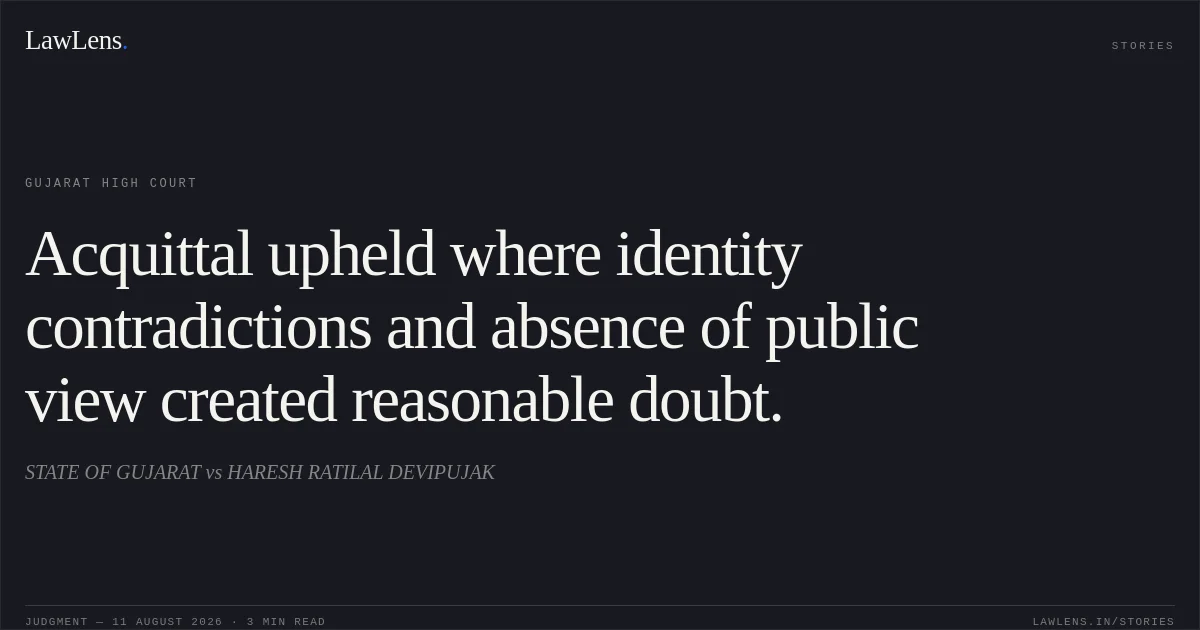
Source reference: p. 7, para. 13Since the accused were allegedly unknown to the complainant, no test identification parade was conducted and no satisfactory evidence explained their identification.
Source reference: p. 7, para. 13The Court further noted that accused No. 1 himself belonged to the SC/ST community, and that the complainant admitted that no person other than the accused and himself was present at the place of occurrence.
Source reference: p. 8, para. 14Consequently, the prosecution failed to establish the caste-based insult in a place within public view, an essential ingredient of Section 3(1)(10).
Source reference: p. 8, para. 14Applying the heightened restraint applicable to an appeal against acquittal, the Court held that the trial court’s view was a reasonable one and was neither perverse nor manifestly illegal.
Source reference: pp. 9–12, paras. 15–20Holding
The High Court answered the issues in favour of the accused.
It held that the prosecution failed to prove their identity, involvement, and the alleged offences beyond reasonable doubt, including the ingredients of Section 3(1)(10) of the SC/ST Act.
Source reference: pp. 12–13, paras. 19–20The State’s appeal was dismissed, the trial court’s judgment of acquittal dated 2 October 2012 was confirmed, the bail bonds were cancelled, and the record and proceedings were directed to be returned to the trial court.
Source reference: p. 13, para. 21Acts & Sections Cited
8 provisions across 3 statutes referred to in this judgment. Each provision opens on LawLens.
Code of Criminal Procedure, 19733
Indian Penal Code, 18604
Scheduled Castes and the Scheduled Tribes (Prevention of Atrocities) Act, 19891
Original Court PDF
STATE OF GUJARATvsHARESH RATILAL DEVIPUJAK
Click to open original judgment
Original judgment, available to read, download and summarize on LawLens.in