Facts
The appellant (PW2) filed an appeal under Section 372 of the Cr.P.C. challenging the acquittal of Respondent Nos. 2 and 3 (A1 and A2).
Source reference: p. 2The prosecution alleged that on 31.12.2011, during a quarrel involving the appellant's cousins, A1 attacked the appellant with a knife while A2 held him, causing injury to his right arm.
Source reference: p. 2, 8The Trial Court acquitted the accused of charges under Section 324 read with Section 34 of the IPC via judgment dated 27.09.2017.
Source reference: p. 4The appellant joined the medical evidence and procedural lapses but contended that the injured witness's testimony was sufficient for conviction.
Source reference: p. 5A cross-case (FIR No. 01/2012) under Section 307 IPC was also registered against the appellant and his family regarding the same incident.
Source reference: p. 4, 11Issues
1. Whether there is any legal infirmity in the Trial Court's judgment of acquittal warranting interference by the Appellate Court.
Source reference: p. 72. Whether an appellate court can invoke Section 222 of the Cr.P.C. to convict an accused under Section 307 IPC when they were originally charged under Section 324 IPC.
Source reference: p. 29Law Applied
Section 324 of the IPC regarding voluntarily causing hurt by dangerous weapons.
Source reference: p. 16Section 307 IPC concerning attempt to murder.
Source reference: p. 33Section 32(2) of the Indian Evidence Act, which allows statements made in the ordinary course of professional duty (such as MLCs) to be relevant if the maker is unavailable.
Source reference: p. 19Sections 47 and 67 for proof of handwriting.
Source reference: p. 24-25Section 222 Cr.P.C., holding that a person can be convicted of a "minor offence" not charged, provided the offences are cognate.
Source reference: p. 29-31S.M. Multtani v. State of Karnataka to define "minor offence".
Source reference: p. 31Chandrappa v. State of Karnataka regarding the limited scope of interference in acquittals.
Source reference: p. 36Reasoning
The Court found that while the IO committed dereliction of duty by failing to recover the weapon or examine material eyewitnesses (Sultan and Suhail), the appellant failed to pursue legal remedies against the investigation during the trial.
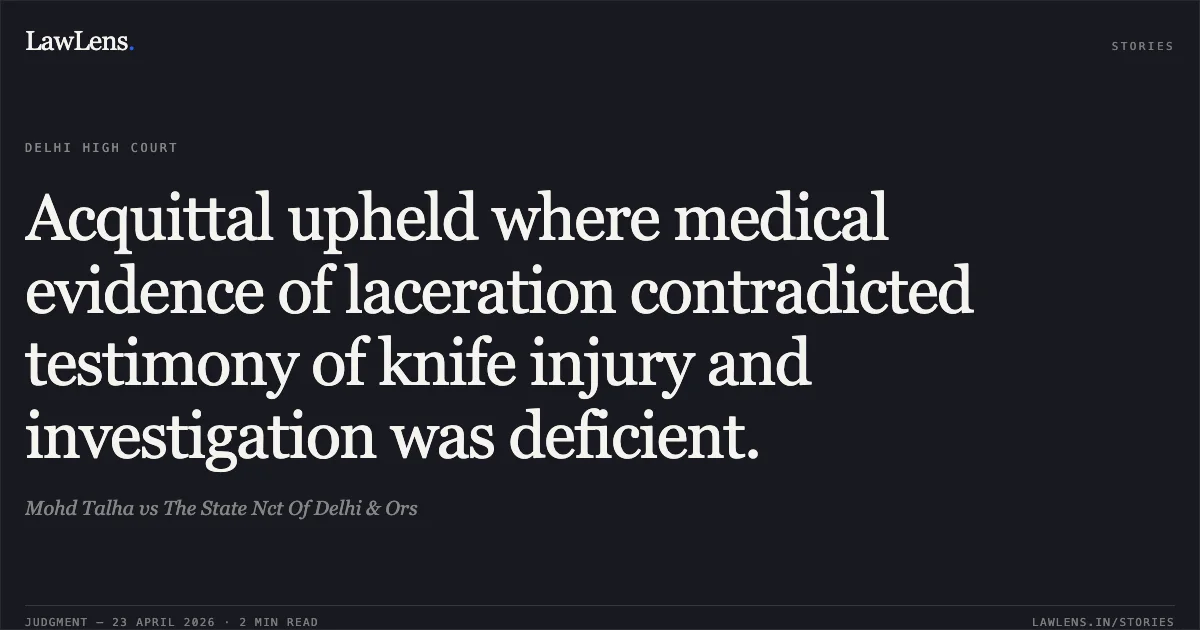
Source reference: p. 17, 28Critically, the medical evidence (MLC Ext. PW4/A) recorded "lacerated wounds," which PW5 testified are typically caused by blunt objects, contradicting the appellant’s testimony of a "piercing" knife injury.
Source reference: p. 26The Court rejected the appellant's plea to convict the respondents under Section 307 IPC via Section 222 Cr.P.C., reasoning that Section 307 is not a "minor offence" relative to Section 324 IPC; rather, Section 324 is a minor offence relative to 307.
Source reference: p. 35-36Since the ingredients of intention and knowledge for murder were not established and the medical evidence was inconsistent with the oral testimony, the Trial Court’s view was deemed a "plausible" one.
Source reference: p. 36Holding
The Court held that Section 222(1) Cr.P.C. cannot be invoked to convict an accused of a more serious offence (Section 307 IPC) than the one charged (Section 324 IPC).
The Court further held that in the absence of the examining doctor, an MLC is admissible under Section 32(2) of the Evidence Act if the handwriting is proved by a familiar witness.
Source reference: p. 25The High Court dismissed the appeal, upholding the acquittal of the respondents.
Source reference: p. 37Acts & Sections Cited
18 provisions across 2 statutes referred to in this judgment. Each provision opens on LawLens.
Code of Criminal Procedure, 1973
Indian Penal Code, 18607
Original Court PDF
Mohd TalhavsThe State Nct Of Delhi & Ors
Click to open original judgment
Original judgment, available to read, download and summarize on LawLens.in