Facts
The appellant, Zafar, the first informant and an injured witness, challenged the judgment dated 05.05.2026 by which the Sessions Judge, Amroha acquitted the accused/opposite parties of offences under Sections 323/34, 336/34, 304/34 and 504 IPC arising from Case Crime No. 15 of 2015, Police Station Hasanpur, District Amroha.
Source reference: para. 1The prosecution alleged that, on 14.01.2015 at about 11:00 a.m., a dispute arose after a household box was thrown onto the accused’s roof.
Source reference: paras. 4–5, 22The accused allegedly abused the complainant’s family and assaulted them with bricks or stones, injuring Zafar and Muzaffar and causing Akhtar, Zafar’s father, to fall and die.
Source reference: paras. 4–5, 22The FIR was registered within approximately thirty minutes of the incident, naming Ajeet, Nagina and Suleman @ Pappu.
Source reference: para. 5Zafar and Muzaffar were medically examined and found to have simple injuries.
Source reference: paras. 8–9The post-mortem disclosed only one lacerated injury on Akhtar’s face; the cause of death could not be ascertained, and the autopsy surgeon opined that death might have resulted from cardiac arrest.
Source reference: paras. 10–13The trial court acquitted the accused after finding material inconsistencies in the eyewitness accounts, the place of occurrence, the medical evidence and the prosecution investigation.
Source reference: paras. 24–26, 45The appellant accordingly preferred the present appeal.
Source reference: para. 27Issues
1. Whether the prosecution established the place of occurrence with sufficient certainty and consistency?
Source reference: para. 44(i)2. Whether the oral and medical evidence established the manner of occurrence alleged by the prosecution?
Source reference: para. 44(ii)Law Applied
The prosecution was required to prove the charged offences under Sections 323/34, 336/34, 304/34 and 504 IPC beyond reasonable doubt, including the alleged common intention, acts of causing hurt, endangerment to personal safety, culpable homicide not amounting to murder, and abusive conduct.
Source reference: paras. 14, 16, 24In a case based on direct evidence, the prosecution must establish the place of occurrence before its evidence regarding the manner of occurrence can be meaningfully relied upon.
Source reference: para. 48Minor discrepancies may be disregarded, but material contradictions concerning the location and manner of the incident may create reasonable doubt.
Source reference: para. 48In an appeal against acquittal, interference is unwarranted where the trial court has considered the relevant evidence, has not misconstrued the record, and its conclusion is the only possible conclusion on the evidence.
Source reference: para. 53Reasoning
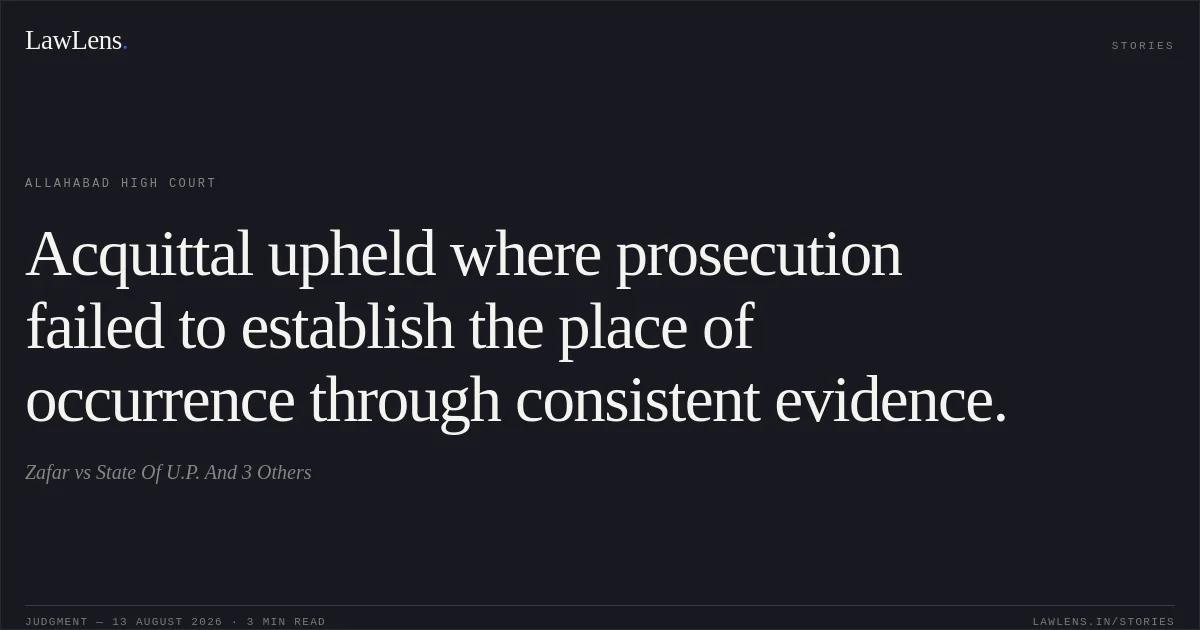
The High Court upheld the trial court’s finding that the prosecution failed to establish the place of occurrence.
Source reference: para. 48The eyewitness accounts materially differed: PW-2 stated that the accused threw stones from their house into the complainant’s house, whereas PW-4 stated that the injured persons and the deceased were present in the accused’s house when the pelting occurred.
Source reference: para. 48The location of the deceased’s body also shifted between the house of Parvez, the house of accused Ayyub, and the complainant’s house, without any satisfactory explanation.
Source reference: paras. 45(xii), 48The site plan and the inquest report were inconsistent, and the Investigating Officer found no bricks or stones at the alleged place of occurrence.
Source reference: para. 45(ix)–(xi)The medical evidence further weakened the prosecution case: the deceased had only a non-fatal facial injury, while the autopsy surgeon opined that death might have resulted from cardiac arrest; the injuries of the two alleged injured witnesses were also medically capable of being caused by a fall or collision rather than brick pelting.
Source reference: paras. 10–12, 33, 40, 45(i)–(iii)Since the place of occurrence itself was not proved, the court held that the issue concerning the precise manner of occurrence did not survive for determination.
Source reference: para. 49The High Court found no omission of relevant evidence or misconstruction of the record by the trial court.
Source reference: para. 53Holding
The High Court answered the first issue against the prosecution, holding that it failed to conclusively establish the place of occurrence.
Consequently, the prosecution’s evidence regarding the manner of occurrence could not sustain the convictions sought by the appellant.
Source reference: no citationThe acquittal was found neither illegal nor perverse, and the appeal was dismissed.
Source reference: paras. 52–55Acts & Sections Cited
12 provisions across 3 statutes referred to in this judgment. Each provision opens on LawLens.
Bharatiya Nagarik Suraksha Sanhita, 20231
Indian Penal Code, 1860
Code of Criminal Procedure, 19732
Original Court PDF
ZafarvsState Of U.P. And 3 Others
Click to open original judgment
Original judgment, available to read, download and summarize on LawLens.in