Facts
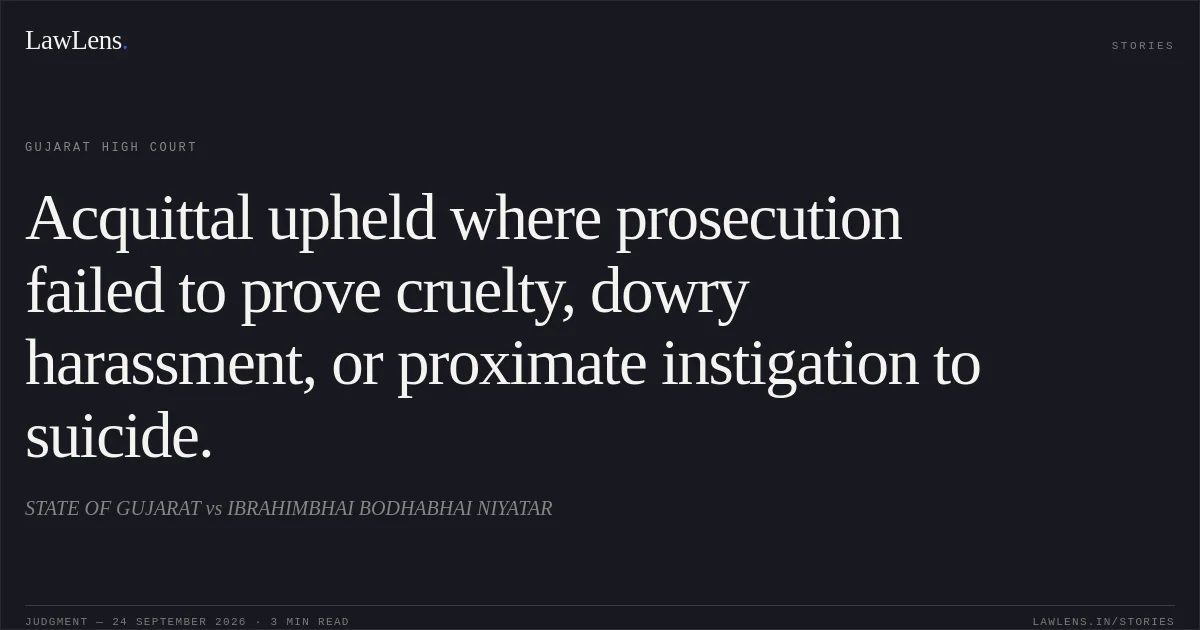
The deceased, Vahidaben, married respondent No. 1, Yasinbhai Ibrahimbhai, in 1998 and had a daughter.
Source reference: p.5; para.11The prosecution alleged that her in-laws—respondents Nos. 1 to 3—harassed and taunted her for bringing insufficient dowry and subjected her to physical and mental cruelty.
Source reference: p.5; para.11She allegedly consumed aluminium phosphate and died on 21 September 2002.
Source reference: p.5; para.11An accidental-death entry was initially recorded, and the investigating officer reported that no material indicating dowry-related harassment or ill-treatment had emerged.
Source reference: p.6; para.12A summary report was submitted before the Sub-Divisional Magistrate, who directed further investigation.
Source reference: p.6; para.12Thereafter, the deceased’s father lodged an FIR alleging offences under Sections 498A and 306 IPC and Sections 3 and 7 of the Dowry Prohibition Act.
Source reference: p.6; para.12The trial court, in Sessions Case No. 177 of 2003, acquitted the accused on 16 September 2009.
Source reference: p.1; paras.1, 5–6The State preferred the present appeal under Section 378(1)(3) of the Code of Criminal Procedure, 1973, challenging the acquittal.
Source reference: p.1; paras.1, 5–6Issues
1. Whether the trial court was justified in acquitting the respondents of the offences under Sections 306 and 498A IPC and Sections 3 and 7 of the Dowry Prohibition Act?
Source reference: p.7; para.10(1)2. Whether the trial court properly appreciated the oral and documentary evidence placed by the prosecution?
Source reference: p.7; para.10(2)3. Whether the impugned judgment of acquittal suffered from any illegality, irregularity, or perversity warranting appellate interference?
Source reference: p.7; para.10(3)Law Applied
The Court applied Sections 498A and 306 IPC and Sections 3 and 7 of the Dowry Prohibition Act, requiring proof beyond reasonable doubt of cruelty, dowry-related harassment, and abetment of suicide.
Source reference: p.1; para.1For Section 306 IPC, the Court relied on Section 107 IPC, under which abetment requires instigation, conspiracy accompanied by an act or illegal omission, or intentional aid.
Source reference: p.8; para.15Relying on Gangula Mohan Reddy v. State of Andhra Pradesh, (2010) 1 SCC 750, and Ramesh Kumar v. State of Chhattisgarh, (2001) 9 SCC 618, the Court held that a clear, proximate, and intentional act of instigation or abetment leading to suicide must be proved.
Source reference: p.8; paras.16–17In an appeal against acquittal, the appellate court may reappreciate the evidence, but the accused enjoy a reinforced double presumption of innocence; where two reasonable views are possible, the acquittal should not be disturbed.
Source reference: pp.10–12; paras.19–22This principle was drawn from Chandrappa v. State of Karnataka, (2007) 4 SCC 415, Rajesh Prasad v. State of Bihar, (2022) 3 SCC 471, Babu Sahebagouda Rudragoudar v. State of Karnataka, (2024) 8 SCC 149, and Ramesh v. State of Karnataka, (2024) 9 SCC 169.
Source reference: pp.10–12; paras.19–22Reasoning
The High Court found that the prosecution evidence did not reliably establish dowry demand, cruelty, or harassment by the respondents.
Source reference: p.7; para.13The deceased’s parents admitted that their earlier statements contained no allegations of ill-treatment, harassment, or dowry demand.
Source reference: p.7; para.13They also acknowledged a community resolution prohibiting dowry demands and a settlement between the parties.
Source reference: p.7; para.13The initial investigation into the accidental death had similarly found no sufficient material against the accused, and the prosecution failed to satisfactorily explain why the FIR was lodged approximately one year later, after which the witnesses allegedly changed their versions.
Source reference: pp.6–7; para.14Even assuming the suicide, the evidence did not disclose any clear, proximate, or intentional act of instigation or intentional aid satisfying Section 107 IPC and thereby attracting Section 306 IPC.
Source reference: pp.8–9; paras.15–18Since the trial court’s view was a reasonable one based on the evidence and was not perverse or manifestly illegal, the reinforced presumption of innocence prevented appellate substitution of a contrary view.
Source reference: pp.10–13; paras.19–24Holding
The High Court answered the issues in favour of the respondents.
It held that the prosecution failed to prove beyond reasonable doubt the offences under Sections 306 and 498A IPC and Sections 3 and 7 of the Dowry Prohibition Act, and that the trial court had correctly appreciated the evidence and recorded the acquittal.
Source reference: p.13; paras.23–24The State’s appeal was dismissed, the judgment and order of acquittal dated 16 September 2009 were confirmed, the bail bonds were cancelled, and the record and proceedings were directed to be returned to the trial court.
Source reference: p.14; para.25Acts & Sections Cited
7 provisions across 3 statutes referred to in this judgment. Each provision opens on LawLens.
Code of Criminal Procedure, 19732
Indian Penal Code, 18603
Original Court PDF
STATE OF GUJARATvsIBRAHIMBHAI BODHABHAI NIYATAR
Click to open original judgment
Original judgment, available to read, download and summarize on LawLens.in