Facts
The deceased, daughter of the complainant, married respondent No. 1 approximately two years before the incident.
Source reference: pp. 1–2, paras. 1–6The prosecution alleged that respondent Nos. 1 and 2 subjected her to harassment and thereby abetted her suicide.
Source reference: pp. 1–2, paras. 1–6On 16 August 2008, the deceased consumed poison and died.
Source reference: pp. 1–2, paras. 1–6The respondents were charged under Sections 306 and 498A of the Indian Penal Code, with the charge also referring to Section 107 IPC.
Source reference: pp. 1–2, paras. 1–6The prosecution examined ten witnesses and produced six documentary exhibits; the accused denied the allegations in their statements under Section 313 CrPC.
Source reference: pp. 1–2, paras. 1–6The Sessions Court, Dahod, acquitted both accused by judgment dated 31 March 2009 in Sessions Case No. 4 of 2009.
Source reference: pp. 1–2, paras. 1–6The State preferred an appeal against acquittal under Section 378(1) and (3) CrPC.
Source reference: pp. 1–2, paras. 1–6Issues
Whether the trial Court was justified in acquitting the respondents of the offences under Sections 306 and 498A IPC.
Source reference: p. 5, para. 10(1)Whether the trial Court properly appreciated the oral and documentary evidence adduced by the prosecution.
Source reference: p. 5, para. 10(2)Whether the judgment of acquittal suffered from illegality, irregularity, or perversity warranting interference in appeal.
Source reference: p. 5, para. 10(3)Whether the prosecution proved beyond reasonable doubt that the respondents subjected the deceased to cruelty or abetted her suicide.
Source reference: pp. 6–7, para. 11.1Law Applied
The Court applied Sections 306, 498A and 107 IPC, requiring proof of abetment or instigation to suicide and, in the case of Section 498A, legally cognizable cruelty.
Source reference: p. 7, para. 11.1It considered the presumptions under Sections 113A and 113B of the Indian Evidence Act, holding that such presumptions arise only when their foundational facts are established.
Source reference: p. 7, para. 11.1Under Section 378 CrPC, an appellate court has full power to reappreciate evidence in an appeal against acquittal, but an acquittal carries a double presumption of innocence, and where two reasonable views are possible, the appellate court should ordinarily adopt the view favourable to the accused.
Source reference: pp. 8–10, paras. 12–15The Court relied on Chandrappa v. State of Karnataka, (2007) 4 SCC 415; Rajesh Prasad v. State of Bihar, (2022) 3 SCC 471; Babu Sahebagouda Rudragoudar v. State of Karnataka, (2024) 8 SCC 149; and Ramesh v. State of Karnataka, (2024) 9 SCC 169, concerning appellate restraint in appeals against acquittal.
Source reference: paras. 14–15Reasoning
The Court found that the evidence of the principal witnesses—PW-4, the deceased’s father; PW-5, her maternal uncle; PW-6, her mother; and PW-7, her brother—did not establish specific acts of cruelty, harassment, instigation, or abetment.
Source reference: p. 6, para. 11The deceased and respondent No. 1 had generally lived at Surat for masonry work and, when visiting their native village, stayed at the complainant’s house without any prior complaint of mistreatment.
Source reference: p. 6, para. 11No specific role was attributed to respondent No. 2.
Source reference: p. 6, para. 11The complainant’s allegation that respondent No. 1 had beaten the deceased with bricks was contradicted by the post-mortem evidence, which disclosed no bodily injuries; the medical evidence established death by poisoning but did not show whether the poison had been self-consumed, forcibly administered, or accidentally consumed.
Source reference: p. 6, para. 11The prosecution also failed to connect the pesticide with either respondent.
Source reference: no citationIn the absence of proof of cruelty or a proximate act of instigation or abetment, the statutory presumptions under Sections 113A and 113B of the Evidence Act could not be invoked.
Source reference: p. 7, para. 11.1Applying the double-presumption principle and the rule against disturbing a reasonable acquittal, the Court held that the trial Court’s view was neither perverse nor legally unsustainable.
Source reference: pp. 8–10, paras. 12–17Holding
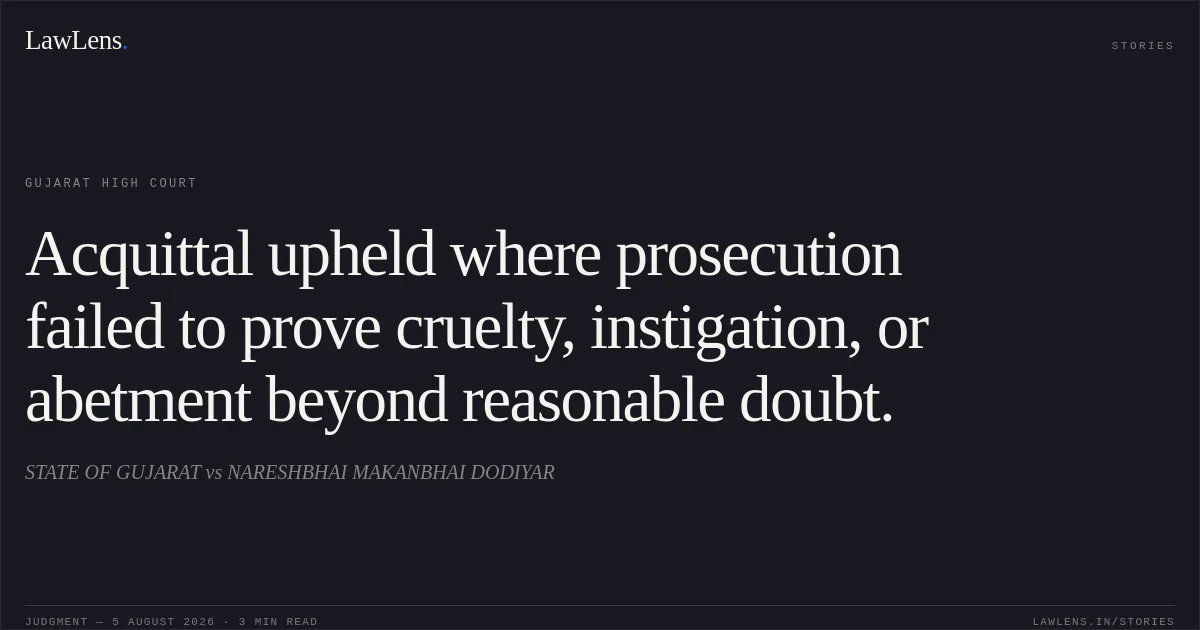
The High Court answered the issues against the State, holding that the prosecution had failed to prove beyond reasonable doubt that the respondents committed cruelty under Section 498A IPC or abetted the deceased’s suicide under Section 306 IPC.
Finding no illegality, irregularity, or perversity in the trial Court’s judgment, the Court dismissed the State’s appeal and confirmed the order of acquittal dated 31 March 2009.
Source reference: p. 11, para. 18The respondents’ bail bonds were cancelled, and the record and proceedings were directed to be sent back to the trial Court.
Source reference: p. 11, para. 18Acts & Sections Cited
4 provisions across 2 statutes referred to in this judgment. Each provision opens on LawLens.
Code of Criminal Procedure, 19732
Indian Penal Code, 18602
Original Court PDF
STATE OF GUJARATvsNARESHBHAI MAKANBHAI DODIYAR
Click to open original judgment
Original judgment, available to read, download and summarize on LawLens.in