Facts
On 12 September 2010, the police allegedly received secret information that the respondent was transporting ganja in an Indica car bearing registration No. GJ-12-W-1690.
Source reference: pp.2–4, paras.2–4A police raiding party, accompanied by two panch witnesses, intercepted the vehicle and allegedly recovered approximately 5 kg of ganja from a rexine bag kept in its boot.
Source reference: pp.2–4, paras.2–4Samples were drawn, sealed and sent for analysis, and the respondent was arrested.
Source reference: pp.2–4, paras.2–4The prosecution charged him under Sections 8(c), 20(b) and 29 of the Narcotic Drugs and Psychotropic Substances Act, 1985 (“NDPS Act”).
Source reference: pp.2–4, paras.2–4The prosecution examined 12 witnesses and relied on documentary evidence, including the panchnama, consent letter, analysis report and FSL report.
Source reference: pp.2–4, paras.2–4The trial court acquitted the respondent, holding that the prosecution had failed to establish the charge and had not complied with the mandatory safeguards under Sections 42(2), 50, 52, 55 and 57 of the NDPS Act.
Source reference: pp.4–6, paras.6–10The State preferred an appeal against acquittal under Section 378(1) and (3) of the Code of Criminal Procedure, 1973.
Source reference: pp.4–6, paras.6–10Issues
1. Whether the trial court was justified in acquitting the respondent of the offences under Sections 8(c), 20(b) and 29 of the NDPS Act.
Source reference: p.6, para.11(1)2. Whether the trial court properly appreciated the oral and documentary evidence led by the prosecution.
Source reference: p.6, para.11(2)3. Whether the acquittal judgment suffered from illegality, irregularity or perversity warranting appellate interference.
Source reference: p.6, para.11(3)Law Applied
The court considered the offences under Sections 8(c), 20(b) and 29 of the NDPS Act and the procedural safeguards under Sections 42(2), 50, 52, 55 and 57 of the Act.
Source reference: pp.9–11, paras.15–20Section 42(2) requires secret information reduced into writing under Section 42 to be forwarded to the superior officer; Sections 50, 52, 55 and 57 prescribe safeguards relating to search, arrest, seizure, custody of seized articles and reporting of arrest and seizure.
Source reference: pp.9–11, paras.15–20In an appeal against acquittal under Section 378 CrPC, the appellate court has full power to reappreciate the evidence, but the accused benefits from a strengthened or “double presumption” of innocence; where two reasonable views are possible, the acquittal should not ordinarily be disturbed.
Source reference: pp.12–14, paras.21–24These principles were drawn from Chandrappa v. State of Karnataka, (2007) 4 SCC 415; Rajesh Prasad v. State of Bihar, (2022) 3 SCC 471; Babu Sahebagouda Rudragoudar v. State of Karnataka, (2024) 8 SCC 149; and Ramesh v. State of Karnataka, (2024) 9 SCC 169.
Source reference: pp.12–14, paras.21–24Reasoning
The High Court held that the prosecution case substantially rested on police testimony because the panch witnesses did not support the prosecution.
Source reference: p.8, para.13Although police evidence could not be rejected merely for that reason, the court found material deficiencies: the prosecution did not establish when or whether the written secret information was received by the Deputy Superintendent of Police as required under Section 42(2).
Source reference: p.9, para.15It did not prove that the respondent was informed that the complainant was a Gazetted Officer and that he could seek search before another Gazetted Officer.
Source reference: p.9, para.16It failed to establish compliance with Sections 50, 55 and 57.
Source reference: pp.9–10, para.17The non-examination of the Scientific Officer who had initially analysed the substance, discrepancies among prosecution witnesses, and the Investigating Officer’s failure to clarify inconsistencies concerning Exhibits 49 and 54 further weakened the prosecution case.
Source reference: p.10, paras.18–19Since these deficiencies created reasonable doubt regarding the legality of the search, seizure, custody and proof of the contraband, the trial court’s view was held to be a reasonable one and not perverse or manifestly illegal.
Source reference: pp.10–12, paras.19–22, 25–26Holding
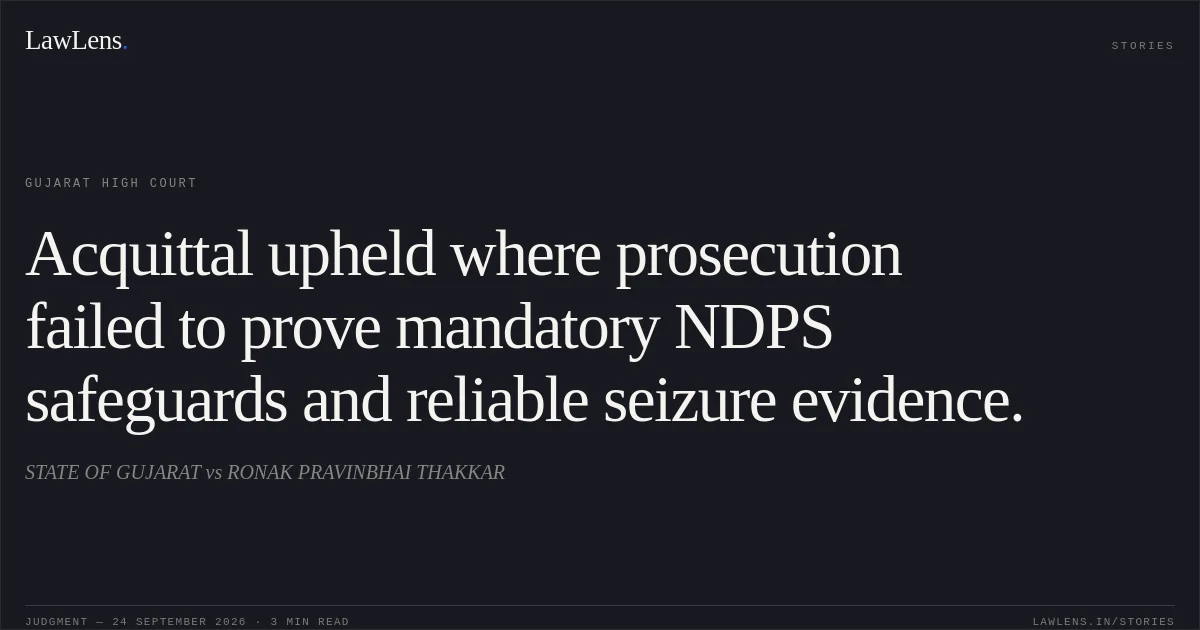
The High Court answered all issues against the State.
It held that the prosecution had failed to prove the respondent’s guilt beyond reasonable doubt and that the trial court had correctly appreciated the evidence and applied the relevant NDPS Act safeguards.
Source reference: pp.14–15, paras.25–27The State’s appeal was dismissed, the respondent’s acquittal was confirmed, his bail bond was cancelled, and the record and proceedings were directed to be returned to the trial court.
Source reference: p.15, para.27Acts & Sections Cited
11 provisions across 2 statutes referred to in this judgment. Each provision opens on LawLens.
Code of Criminal Procedure, 19732
Narcotic Drugs and Psychotropic Substances Act, 1985
Original Court PDF
STATE OF GUJARATvsRONAK PRAVINBHAI THAKKAR
Click to open original judgment
Original judgment, available to read, download and summarize on LawLens.in