Facts
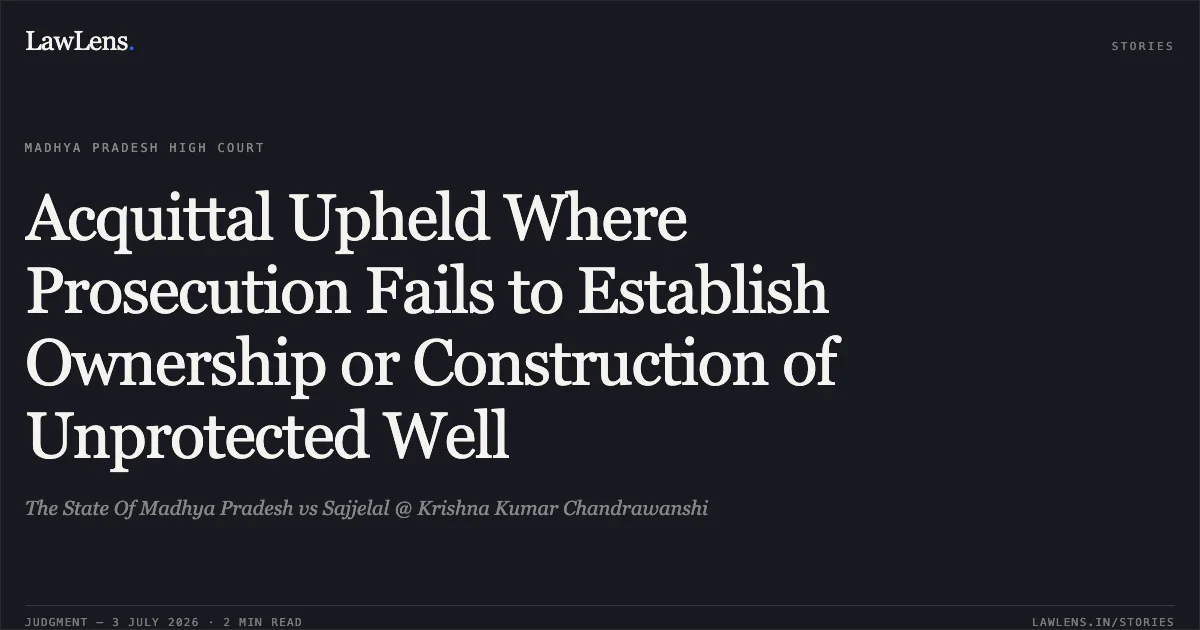
The State appealed against a July 2022 judgment by the JMFC, Lakhnadon, which acquitted the respondent of charges under Section 304-A of the IPC
Source reference: para. 4The prosecution alleged that two individuals drowned in a well purportedly constructed by the respondent without protective walls
Source reference: para. 5, 11Investigating authorities filed a charge sheet after witnesses claimed the respondent owned the well
Source reference: para. 6, 11However, the trial court acquitted the respondent, finding a lack of evidence linking him to the ownership or construction of the well
Source reference: para. 8, 9Issues
1. Whether the prosecution provided sufficient documentary or ocular evidence to prove the respondent’s ownership or control over the well where the drowning occurred
Source reference: para. 11, 122. Whether the trial court’s judgment of acquittal was perverse or based on an erroneous appreciation of evidence warranting appellate interference
Source reference: para. 14, 15Law Applied
The court applied Section 378 of the CrPC regarding appeals against acquittal
Source reference: para. 4It relied on the principle that the presumption of innocence is reinforced by an acquittal, as established in H.D. Sundara v. State of Karnataka and Babu Sahebagouda Rudragoudar v. State of Karnataka, which restrict appellate interference to cases of patent perversity or manifest error
Source reference: para. 16, 17The court also referenced Mallappa & others v. State of Karnataka, highlighting that if two views are possible, the view favoring the accused must prevail
Source reference: para. 20Reasoning
The High Court observed that while prosecution witnesses claimed the respondent built the well, their testimonies were "omnibus in nature" and lacked specific details
Source reference: para. 11Critically, the prosecution failed to produce revenue records, electricity bills, or irrigation data to link the well to the respondent
Source reference: para. 12The court noted that the respondent’s actual field was located approximately one kilometer away, and no pipeline or connection existed between the two
Source reference: para. 11, 12Since the Investigating Officer failed to examine local officials or secure land surveys, the court determined that the trial court's conclusion—that the well's connection to the accused remained unproven—was a plausible view
Source reference: para. 12, 15Holding
The Court held that the trial court’s findings were neither perverse nor legally unsustainable
Under the limited scope of Section 378 CrPC, the High Court declined to substitute its own view for that of the trial court. Consequently, the application for leave to appeal was refused, and the criminal appeal was dismissed
Source reference: para. 21, 22Acts & Sections Cited
1 provisions across 1 statute referred to in this judgment. Each provision opens on LawLens.
Code of Criminal Procedure, 19731
Original Court PDF
The State Of Madhya PradeshvsSajjelal @ Krishna Kumar Chandrawanshi
Click to open original judgment
Original judgment, available to read, download and summarize on LawLens.in