Facts
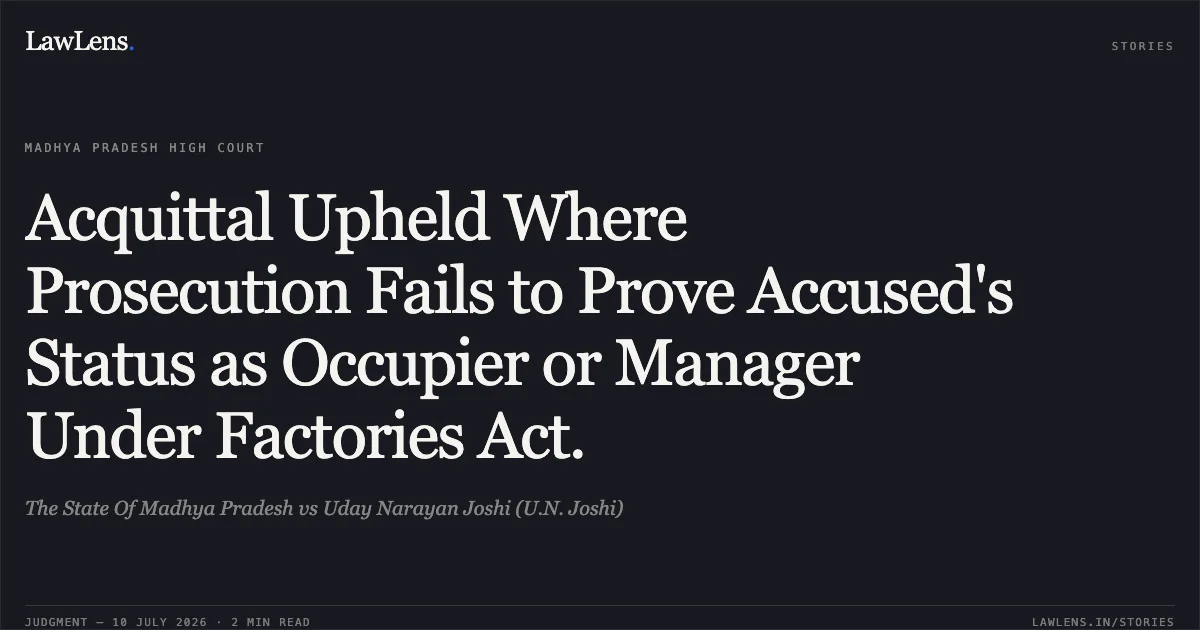
The State filed an appeal against the judgment dated August 27, 2022, passed by the Judicial Magistrate First Class, Bina, which acquitted the respondents of offences under Sections 7-A, 88 r/w Rule 108, 92, and 102 of the Factories Act, 1948
Source reference: para. 1The prosecution alleged that on June 22, 2010, a fatal accident occurred at Bharat Oman Refineries Limited involving a worker, Vinod Prasad, who died after a SWAS panel fell on him
Source reference: para. 2The State contended that the respondents, as the "occupier" and "manager," failed to ensure safety measures and delayed reporting the accident
Source reference: para. 8witnesses testified that the deceased was not on duty regarding the panel and was attempting to remove timber from beneath it when it fell
Source reference: para. 10, 12Issues
1. Whether the prosecution proved beyond reasonable doubt that the respondents were the "Occupier" and "Manager" of the factory as defined under the Factories Act on the date of the incident.
Source reference: para. 8 / 152. Whether the accident was caused by the negligence or failure of the respondents to maintain safety standards under Section 7-A of the Factories Act.
Source reference: para. 5 / 15Law Applied
The court applied Section 7-A of the Factories Act, 1948, which mandates the general duties of occupiers to ensure the health and safety of workers
Source reference: para. 7It examined Section 88 regarding the mandatory notice of accidents and Section 92, which provides penalties for contraventions
Source reference: para. 7the court relied on the principles for appellate interference in acquittals established in H.D. Sundara v. State of Karnataka (2023) and Mallappa v. State of Karnataka (2024), which dictate that if the trial court’s view is "legally plausible," the appellate court should not overturn it even if an alternative view exists
Source reference: para. 16-18Reasoning
The Court found the prosecution's case fundamentally flawed as it failed to produce documentary evidence clarifying the respondents' official status as "Occupier" or "Manager" on the date of the offence
Source reference: para. 8, 15The testimony of the main investigator, Mukesh Jain (PW-1), revealed significant lapses: he did not investigate the installation process of the panel (managed by BHEL), failed to obtain a post-mortem report to confirm the cause of death, and admitted he did not know the respondents personally
Source reference: para. 9-11the court noted that prosecution witnesses (PW-3 and PW-5) supported the defense theory that the deceased caused the accident himself while trying to remove wood from under the panel for personal use, which was outside his line of duty
Source reference: para. 12-13Since PW-5 was not declared hostile, his testimony was binding on the prosecution
Source reference: para. 13Holding
The Court held that the prosecution utterly failed to prove negligence or the legal status of the accused
The High Court dismissed the application for leave to appeal and upheld the acquittal. The trial court's findings were deemed a "plausible view" based on a proper appreciation of evidence, precluding appellate interference. The delay of 31 days in filing the appeal was condoned, but the appeal was dismissed on its merits
Source reference: para. 1, 20-22Acts & Sections Cited
1 provisions across 1 statute referred to in this judgment. Each provision opens on LawLens.
Code of Criminal Procedure, 19731
Original Court PDF
The State Of Madhya PradeshvsUday Narayan Joshi (U.N. Joshi)
Click to open original judgment
Original judgment, available to read, download and summarize on LawLens.in