Facts
The deceased, Sonalben, was married to respondent no. 1 (Babubhai). It was alleged that respondent no. 1 had an illicit relationship with respondent no. 4 (his sister-in-law), leading to mental and physical harassment of the deceased
Source reference: p. 2On 26.09.2007, Sonalben committed suicide by self-immolation
Source reference: p. 2The prosecution alleged that constant torture drove her to this act, charging the respondents under Sections 498(A) and 306 read with Section 34 of the IPC
Source reference: p. 1-2The Trial Court acquitted all four respondents on 07.08.2009, citing inconsistencies in witness testimonies and lack of evidence
Source reference: p. 1, 5The State appealed this acquittal to the High Court
Source reference: p. 5Issues
1. Whether the Trial Court erred in law and fact by acquitting the respondents despite the testimonies of the deceased’s family regarding harassment and illicit relations
Source reference: p. 52. Whether the prosecution proved the charges of abetment of suicide (Sec. 306) and cruelty (Sec. 498A) beyond a reasonable doubt
Source reference: p. 83. Whether there are "substantial and compelling reasons" or manifest illegalities required to interfere with an order of acquittal in an appellate jurisdiction
Source reference: p. 9-10Law Applied
The court applied Section 378 of the Cr.P.C. regarding appeals against acquittal
Source reference: p. 1the fundamental principle of criminal jurisprudence that an accused is presumed innocent until proven guilty, a presumption reinforced by an acquittal
Source reference: p. 9The court applied the "Double Presumption" rule and the "Two Views" doctrine as established in Chandrappa v. State of Karnataka (2007) and Rajesh Prasad v. State of Bihar (2022), which mandate that if two reasonable conclusions are possible, the appellate court must not disturb an acquittal
Source reference: p. 10, para. 42, p. 11It further referenced Ramesh v. State of Karnataka (2024) regarding the high threshold for reversing acquittals
Source reference: p. 10-11Reasoning
The Court observed that the prosecution’s primary witnesses (PW 1, 2, and 4—father, uncle, and mother) concealed material facts, specifically that they had accompanied the deceased to a Dargah in Rajasthan shortly before the incident, a fact revealed only by defense evidence
Source reference: p. 7Crucially, the prosecution failed to disclose that respondent no. 1 had sustained burn injuries while attempting to save the deceased and had taken her to the hospital himself
Source reference: p. 7-8The court noted that respondent no. 1 lived 35km away from the other accused, weakening the joint harassment theory
Source reference: p. 7Evidence from an independent witness suggested the deceased was of unstable mind and frequently quarreled at the husband’s workplace
Source reference: p. 8The High Court found the Trial Court’s reasoning for discarding the testimony of interested witnesses as cogent and well-supported by evidence
Source reference: p. 8, 12Holding
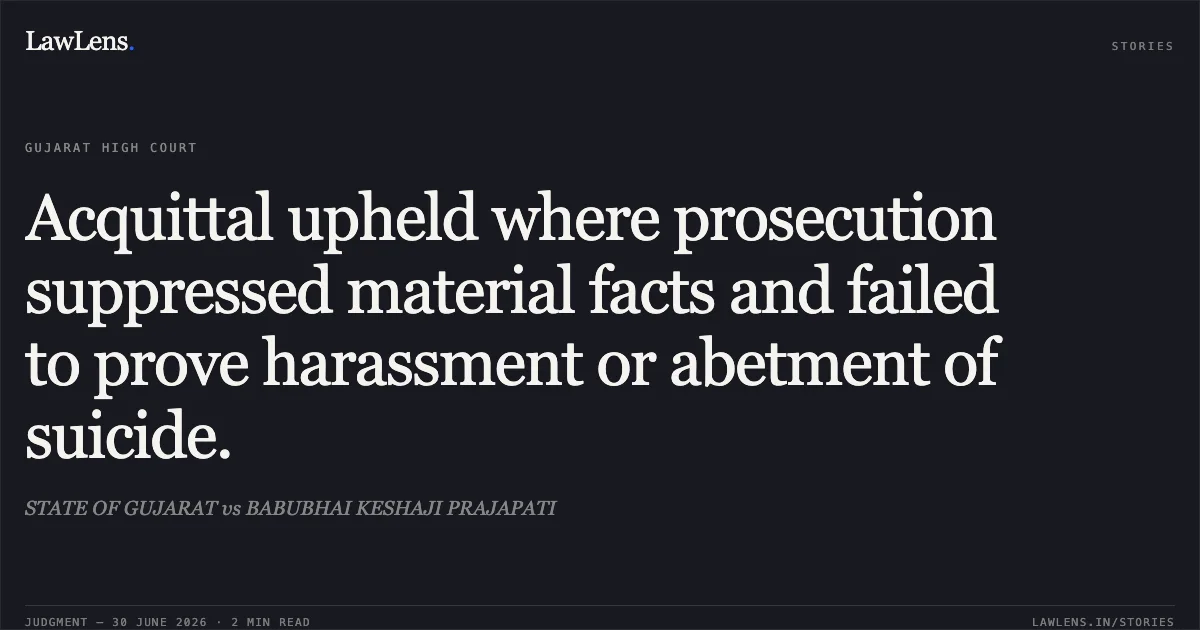
The High Court dismissed the appeal and confirmed the Trial Court's judgment of acquittal
The Court held that the prosecution failed to prove its case beyond a reasonable doubt and there was no manifest illegality or perversity in the Trial Court’s findings
Source reference: p. 12The court reaffirmed that since a second reasonable view favoring acquittal was possible, interference was legally impermissible; All bail bonds were cancelled
Source reference: p. 11-12Acts & Sections Cited
4 provisions across 2 statutes referred to in this judgment. Each provision opens on LawLens.
Code of Criminal Procedure, 19732
Indian Penal Code, 18602
Original Court PDF
STATE OF GUJARATvsBABUBHAI KESHAJI PRAJAPATI
Click to open original judgment
Original judgment, available to read, download and summarize on LawLens.in