01Facts
Bhavnaben, daughter of the complainant, married accused Bharatbhai by court marriage on 24 August 2004 and initially resided in a joint family with her husband and in-laws.
pp. 2–3 · ¶ 2The complainant alleged that the accused demanded dowry, including ₹2 lakh and a flat, and subjected Bhavnaben to physical and mental harassment, ultimately causing her to commit suicide by hanging.
pp. 2–3 · ¶ 2On 23 January 2008, Bhavnaben was found hanging inside her flat, which she had been occupying separately with her husband for approximately two years.
pp. 10–11 · ¶ 12–15The incident was initially registered as an accidental death, and the police recorded statements of the complainant and other witnesses without any allegation of dowry-related harassment.
pp. 10–11 · ¶ 12–15The complainant lodged the FIR only on 3 March 2008, approximately two months after the incident.
p. 8 · ¶ 10.2The Sessions Court acquitted the accused of offences under Sections 498A, 323, 306, 504 and 114 of the Indian Penal Code, 1860, and Sections 3 and 7 of the Dowry Prohibition Act.
pp. 3–5 · ¶ 2.2–6The complainant and the State preferred separate appeals against the acquittal.
pp. 1–2 · ¶ 1–1.202Issues
i.Whether the Trial Court was justified in acquitting the accused of the charged offences?
p. 9 · ¶ 11(1)ii.Whether the Trial Court properly appreciated the oral and documentary evidence led by the prosecution?
p. 9 · ¶ 11(2)iii.Whether the impugned judgment of acquittal suffered from illegality, irregularity or perversity warranting appellate interference?
p. 9 · ¶ 11(3)iv.Whether the prosecution proved beyond reasonable doubt that the accused subjected Bhavnaben to cruelty, dowry-related harassment, or abetted her suicide?
pp. 13–15 · ¶ 18–1903Law Applied
The Court applied Sections 498A, 306, 107, 323, 504 and 114 of the IPC, requiring legally reliable proof of cruelty, instigation or intentional aiding for an offence of abetment of suicide; the prosecution also invoked Sections 3 and 7 of the Dowry Prohibition Act concerning dowry transactions and demands.
pp. 2–3 · ¶ 2The Court held that an unnatural death or suicide, by itself, does not establish abetment under Section 306 IPC or cruelty under Section 498A IPC; specific and credible evidence linking the accused with the alleged harassment or instigation is necessary.
pp. 13–15 · ¶ 18–19Regarding the alleged diary, the Court required proof of its genuineness and authorship in accordance with the Indian Evidence Act, particularly where the document had not been properly seized, preserved or examined by a handwriting expert.
p. 13 · ¶ 17On appellate review of acquittal, the Court relied on Chandrappa v. State of Karnataka, (2007) 4 SCC 415; Rajesh Prasad v. State of Bihar, (2022) 3 SCC 471; Babu Sahebagouda Rudragoudar v. State of Karnataka, (2024) 8 SCC 149; and Ramesh v. State of Karnataka, (2024) 9 SCC 169, affirming that although an appellate court may fully reappreciate the evidence, the accused carries a reinforced or “double” presumption of innocence after acquittal, and an acquittal should not be disturbed where two reasonable views are possible.
pp. 15–17 · ¶ 20–23Provisions in the judgment · 10 · Linked ones open on LawLens
Code of Criminal Procedure, 1973 Section 378Section 209Section 313
Indian Penal Code, 1860 Section 323Section 306Section 504Section 114Section 107
04Reasoning
The Court accepted that Bhavnaben’s death was unnatural and that the medical evidence established death by asphyxia resulting from strangulation.
p. 11 · ¶ 14However, the prosecution failed to prove the necessary connection between the accused and the alleged cruelty, dowry demand or suicide.
pp. 10–13 · ¶ 13, 15 and 18The complainant and PW-4, who were among the first persons present at the scene, had not alleged harassment or dowry demands in their initial statements.
pp. 10–13 · ¶ 13, 15 and 18The evidence also showed that Bhavnaben had lived separately with her husband for two years, while the other accused resided approximately ten kilometres away, weakening the allegation of continuing harassment by those accused.
p. 14 · ¶ 19The alleged diary was not found during the initial inspection, was not supported by the panch or investigating witnesses, was not accompanied by any seizure panchnama, and was never subjected to handwriting verification; consequently, it could not safely be relied upon.
pp. 12–13 · ¶ 16–17The delayed FIR, lodged nearly two months after the incident without a satisfactory explanation, further affected the reliability of the prosecution case.
p. 13 · ¶ 17Applying the heightened standard governing appeals against acquittal, the Court found that the Trial Court’s conclusions were reasonable and neither perverse nor legally infirm.
pp. 14–17 · ¶ 19–2305Holding
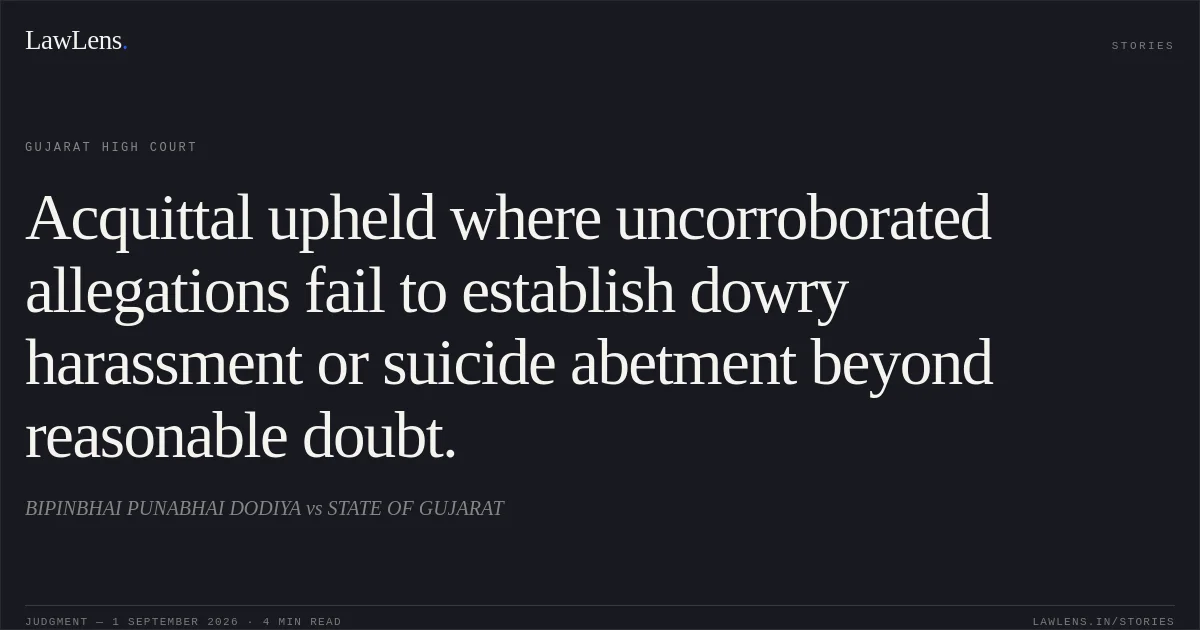
The High Court held that the prosecution failed to prove beyond reasonable doubt that the accused had subjected Bhavnaben to cruelty or dowry-related harassment, or had instigated or abetted her suicide.
pp. 14–18 · ¶ 19, 24–25The Trial Court had properly appreciated the evidence and its acquittal did not suffer from illegality, perversity or material infirmity.
pp. 14–18 · ¶ 19, 24–25Both Criminal Appeal No. 354 of 2012 and Criminal Appeal No. 994 of 2012 were dismissed, the order of acquittal was confirmed, the bail bonds were cancelled, and the record and proceedings were directed to be returned to the Trial Court.
p. 18 · ¶ 26Original Court PDF
BIPINBHAI PUNABHAI DODIYAvsSTATE OF GUJARAT
Click to open original judgment
Original judgment, available to read, download and summarize on LawLens.in