Facts
The complainant, Khodabhai Kalidas Makwana, alleged that on 26 January 2008, while he had gone to Paniya Pond to fetch water, the six accused assembled with sticks, abused and threatened him, and insulted him by referring to his caste.
Source reference: p.2, para.2An earlier alleged incident on 23 January 2008 involved the first respondent allegedly assaulting the complainant’s brother with a stick, but no complaint was lodged regarding that incident.
Source reference: p.2, para.2The complainant lodged the FIR two days after the alleged occurrence.
Source reference: p.2, para.2Following investigation, a charge-sheet was filed for offences under Sections 143, 147, 148, 149, 504 and 506(2) of the IPC, Section 135 of the Bombay Police Act, and Sections 3(1)(5) and 3(1)(10) of the Scheduled Castes and Scheduled Tribes (Prevention of Atrocities) Act, 1989.
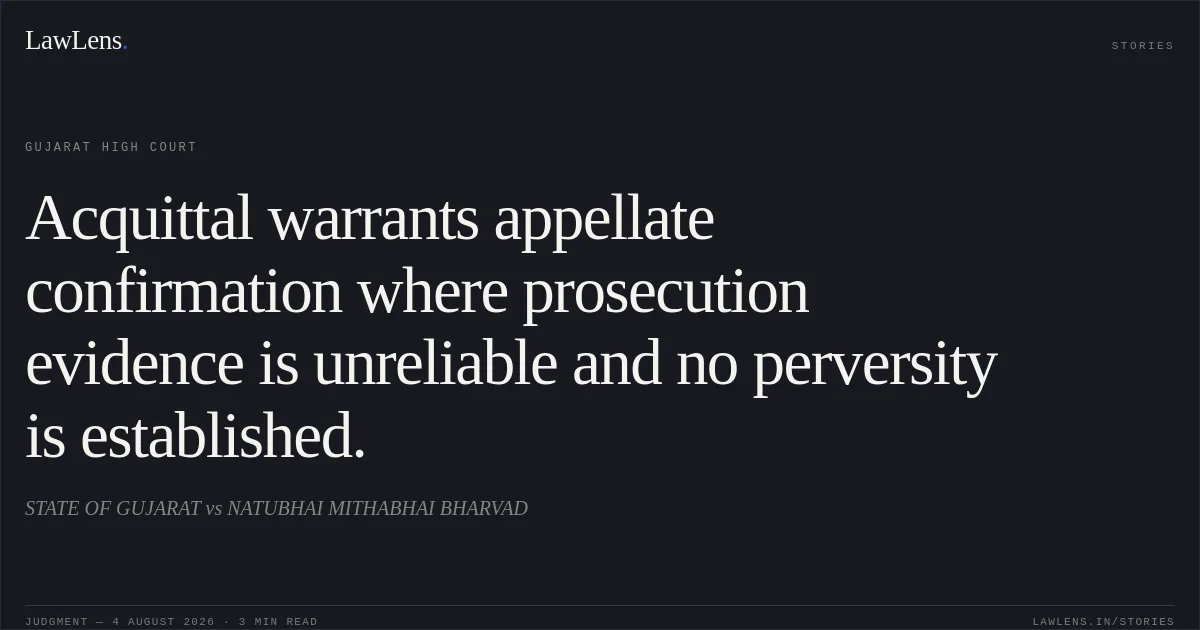
Source reference: pp.2–3, paras.2.2–2.4The Special Judge and Additional Sessions Judge, Nadiad, acquitted all accused on 16 June 2010.
Source reference: no citationThe State preferred an appeal against acquittal under Section 378(1)(3) of the Code of Criminal Procedure, 1973.
Source reference: p.1, para.1Issues
1. Whether the trial court was justified in acquitting the accused of the offences charged?
Source reference: p.5, para.9(1)2. Whether the trial court properly appreciated the oral and documentary evidence led by the prosecution?
Source reference: p.5, para.9(2)3. Whether the impugned judgment of acquittal suffered from illegality, irregularity, perversity, or any other infirmity warranting appellate interference?
Source reference: pp.5, 8–9, para.9(3); paras.11–14Law Applied
The Court applied Section 378(1)(3) CrPC governing appeals against acquittal, along with the charged offences under Sections 143, 147, 148, 149, 504 and 506(2) IPC, Section 135 of the Bombay Police Act, and Sections 3(1)(5) and 3(1)(10) of the SC/ST (Prevention of Atrocities) Act, 1989.
Source reference: p.1, para.1; pp.2–3, paras.2.2–2.3For an appeal against acquittal, the appellate court has full power to review and reappreciate the evidence, but the accused benefit from a double presumption of innocence; where two reasonable views are possible, the acquittal should ordinarily not be disturbed.
Source reference: pp.8–11, paras.12–15The Court relied principally on Chandrappa v. State of Karnataka, (2007) 4 SCC 415, as reaffirmed in Rajesh Prasad v. State of Bihar, (2022) 3 SCC 471, Babu Sahebagouda Rudragoudar v. State of Karnataka, (2024) 8 SCC 149, and Ramesh v. State of Karnataka, (2024) 9 SCC 169.
Source reference: pp.9–11, paras.14–15Regarding Section 3(1)(10) of the Atrocities Act, the Court relied on Shajan Skaria v. State of Kerala, AIR 2024 SC 4557, Gunjan @ Girija Kumari v. State (NCT of Delhi), 2026 (0) INSC 468, and related decisions, holding that the prosecution must establish intentional caste-based insult in a public place and within public view through credible and cogent evidence.
Source reference: p.7, para.11; p.10, para.14Reasoning
The High Court found that the prosecution evidence did not establish the charges beyond reasonable doubt.
Source reference: no citationThe FIR was lodged after a two-day delay without satisfactory explanation.
Source reference: p.6, para.10Although the complainant’s wife was projected as an eyewitness, she admitted that she had not witnessed the incident and had learned about it from the complainant.
Source reference: p.6, para.10Material omissions, contradictions, and improvements in the testimony of another material witness were proved through the Investigating Officer, while an additional witness was admittedly not present at the occurrence.
Source reference: p.6, para.11The Court further noted that the alleged incident occurred in an agricultural field rather than in a public place or within public view, thereby failing to satisfy the statutory requirement for the caste-insult offence under Section 3(1)(10) of the Atrocities Act.
Source reference: p.7, para.11The mere fact that the accused, who belonged to the Bharvad community and were traditionally engaged in animal husbandry, carried sticks did not establish that the sticks were used as weapons or prove the alleged unlawful assembly and assault.
Source reference: pp.7–8, para.11Applying the restrictive principles governing appellate interference with acquittals, the Court held that the trial court’s assessment was a reasonable view supported by the record and was neither perverse nor manifestly illegal.
Source reference: pp.8–11, paras.12–15Holding
The High Court answered the issues in favour of the accused.
It held that the prosecution had failed to prove the alleged IPC, Bombay Police Act, and Atrocities Act offences beyond reasonable doubt, and that the trial court had correctly appreciated the evidence and acquitted the accused.
Source reference: pp.11–12, paras.16–17The State’s appeal was dismissed, the order of acquittal dated 16 June 2010 was confirmed, the bail bonds were cancelled, and the record and proceedings were directed to be returned to the trial court.
Source reference: p.12, para.18Acts & Sections Cited
9 provisions across 3 statutes referred to in this judgment. Each provision opens on LawLens.
Code of Criminal Procedure, 19732
Indian Penal Code, 18606
Scheduled Castes and the Scheduled Tribes (Prevention of Atrocities) Act, 19891
Original Court PDF
STATE OF GUJARATvsNATUBHAI MITHABHAI BHARVAD
Click to open original judgment
Original judgment, available to read, download and summarize on LawLens.in