Facts
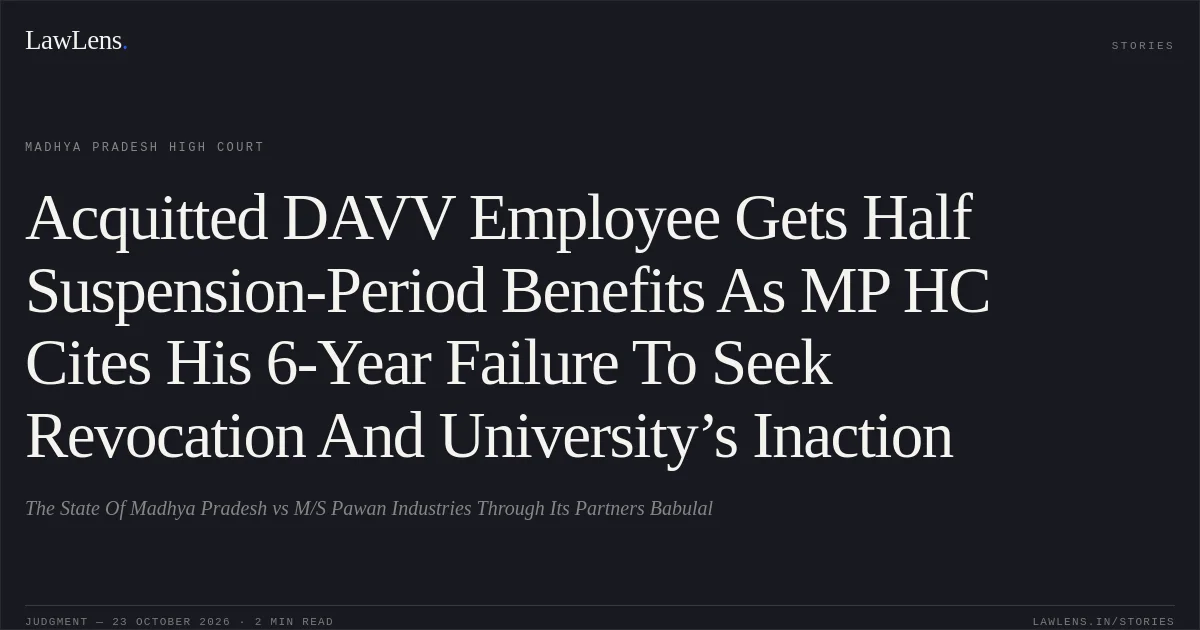
The respondent, an Assistant Grade III at Devi Ahilya Vishwavidyalaya (DAVV), was placed under suspension from 14 February 2010 following his arrest in a criminal case concerning the alleged theft of examination answer-sheets.
Source reference: pp. 1–3, paras. 2–6He was acquitted on 16 November 2016 and later sought full pay and consequential benefits for the suspension period.
Source reference: pp. 1–3, paras. 2–6DAVV partly allowed his claim by order dated 24 July 2020.
Source reference: pp. 1–3, paras. 2–6The writ court quashed that order and directed payment of the benefits for the relevant period, relying on Babulal Jhad v. State of Madhya Pradesh.
Source reference: pp. 1–3, paras. 2–6DAVV appealed, arguing, among other things, that the respondent had not worked and had not sought revocation of his suspension during the trial
Source reference: pp. 1–3, paras. 2–6Issues
1. Whether an employee deemed suspended due to detention in a criminal case, who is later acquitted and faces no disciplinary proceedings, is entitled to full pay and allowances for the suspension period
Source reference: pp. 6–7, para. 92. Whether, in the circumstances of this case, the writ court’s direction granting the respondent all benefits for the suspension period should be upheld or modified
Source reference: pp. 7–8, paras. 10–12Law Applied
Rule 9(5) of the Madhya Pradesh Civil Services (Classification, Control and Appeal) Rules, 1966 provides that an order of suspension made or deemed to have been made under the rule continues until modified or revoked by the competent authority, subject to the stated exceptions and procedures
Source reference: pp. 6–7, para. 9Relying on Babulal Jhad v. State of Madhya Pradesh and the authorities cited there, the Court stated that a government servant deemed suspended because of detention exceeding 48 hours, who is acquitted and reinstated without disciplinary proceedings, cannot be denied pay and allowances for the suspension period merely because he did not work
Source reference: pp. 4–6, para. 8The Court also considered Union of India v. Jaipal Singh, cited by DAVV
Source reference: p. 4, para. 6Reasoning
The Court accepted the general principle that an employee in the respondent’s position may be entitled to pay and allowances after acquittal where no disciplinary proceedings are initiated.
Source reference: pp. 7–8, paras. 9–11However, it considered the respondent’s failure to seek revocation of his suspension during the lengthy period of suspension, as well as the absence of evidence that he submitted the monthly certificate required for subsistence allowance.
Source reference: pp. 7–8, paras. 9–11It also found DAVV at fault for failing to initiate disciplinary proceedings despite the serious allegations.
Source reference: pp. 7–8, paras. 9–11Balancing the conduct of both parties, the Court concluded that the respondent should not receive the full benefits ordered by the writ court, but should receive half
Source reference: pp. 7–8, paras. 9–11Holding
The appeal was partly allowed.
The respondent’s entitlement was reduced from 100% to 50% of the benefits granted by the writ court.
Source reference: p. 8, paras. 12–13DAVV was directed to calculate the amount within four weeks and pay it to the respondent
Source reference: p. 8, paras. 12–13Acts & Sections Cited
5 provisions across 1 statute referred to in this judgment. Each provision opens on LawLens.
Indian Penal Code, 18605
Original Court PDF
The State Of Madhya PradeshvsM/S Pawan Industries Through Its Partners Babulal
Click to open original judgment
Original judgment, available to read, download and summarize on LawLens.in