Facts
The petitioner, a State Bank of India officer, was appointed as a Clerk-cum-Cashier in 1976 and was subsequently promoted to MMGS-III. He served as Branch Manager of the Bihar School Examination Board Branch, Patna, from 6 June 2006 to 31 October 2009
Source reference: pp. 2–3After his transfer, the Bank issued him a charge-sheet dated 11 July 2011 containing eleven charges alleging unauthorized enhancement of overdraft/cash-credit limits, permitting overdrawing beyond sanctioned limits, exceeding delegated financial powers, and failing to report irregularities, in violation of Rule 50(4) of the SBI Officers’ Service Rules, 1992
Source reference: pp. 3–5Following a departmental inquiry, charges 1, 4, 5, 6, 7, 8 and 11 were held proved; charges 2 and 9 were partly proved; and charges 3 and 10 were not proved
Source reference: pp. 16–17The disciplinary authority, after considering the inquiry report, the petitioner’s representation and granting him a personal hearing, imposed the penalty of reduction from MMGS-III to MMGS-II, fixation of pay at the minimum of the lower scale until retirement, stoppage of increments during the period, and postponement of future increments under Rules 67(f) and 67(g)
Source reference: pp. 4–5, 17–18The appellate authority upheld the punishment by order dated 15/24 December 2012
Source reference: pp. 5–6The petitioner challenged both orders under Article 226 of the Constitution, contending that the charges were not properly proved, that he had acted under the instructions of his controlling officer, that the Bank ultimately suffered no loss because the dues were recovered, and that the punishment was disproportionate
Source reference: pp. 6–10Issues
1. Whether the disciplinary and appellate orders were liable to be quashed on the ground that the inquiry findings were unsupported by evidence, that the controlling officer was not examined, or that the petitioner acted under oral directions?
Source reference: pp. 6–10, 18–202. Whether subsequent recovery of the Bank’s dues and absence of proved personal gain or ultimate financial loss negated the misconduct arising from unauthorized enhancement of limits and permitting overdrawing?
Source reference: pp. 12–14, 19–203. Whether the penalty imposed under Rules 67(f) and 67(g) of the SBI Officers’ Service Rules, 1992 was disproportionate to the proved misconduct and warranted interference under Article 226?
Source reference: pp. 8–10, 20–25Law Applied
The Court applied Rule 50(4) of the State Bank of India Officers’ Service Rules, 1992, requiring bank officers to discharge their duties with integrity, honesty, devotion and diligence, and Rules 67(f) and 67(g), which authorize reduction in grade/pay and consequences relating to increments
Source reference: pp. 3–5, 17–18It reiterated that judicial review of disciplinary proceedings under Article 226 is limited to correcting errors of law, procedural irregularity, violation of natural justice or findings leading to manifest injustice; the High Court does not sit as an appellate authority to reappreciate evidence
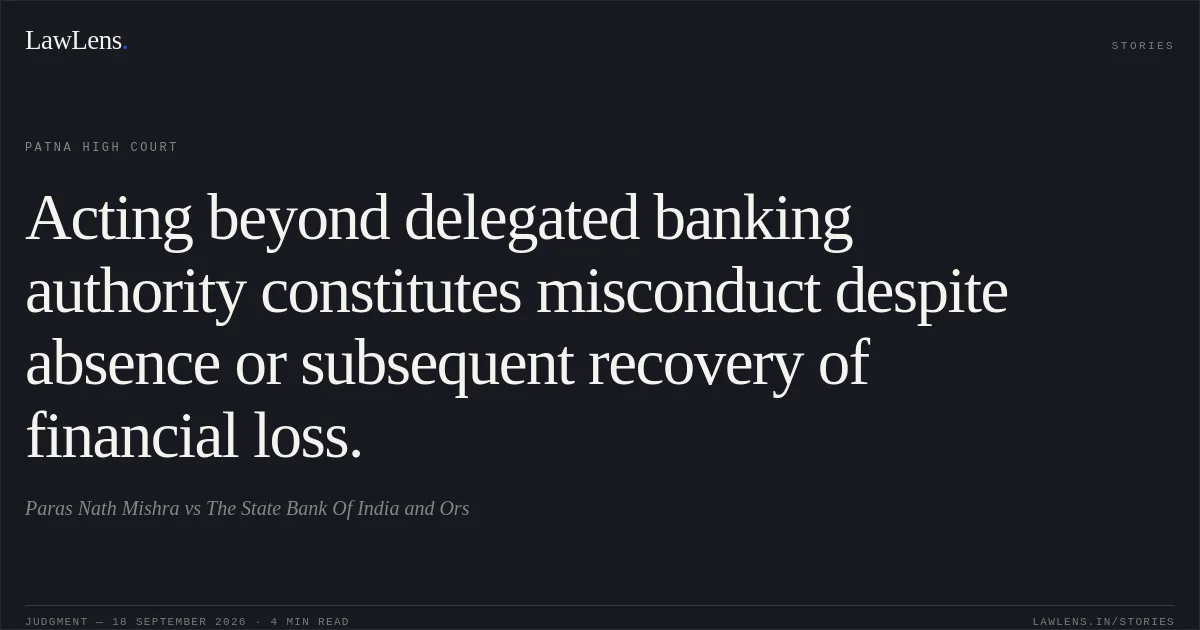
Source reference: pp. 15–16Relying on State Bank of India v. Bela Bagchi, 2005 (7) SCC 435, the Court held that bank officers are subject to a higher standard of honesty and integrity, and that acting beyond authority constitutes misconduct irrespective of whether the Bank ultimately suffers loss
Source reference: pp. 23–24It also considered General Manager (Personnel), Syndicate Bank v. B.S.N. Prasad, 2025 (3) SCC 601, on proportionality of punishment, and State Bank of India v. Ramadhar Sao, 2025 INSC 1010, on the limited scope of judicial review and the adequacy of reasons where the disciplinary authority accepts the inquiry findings
Source reference: pp. 9–12, 15–16Reasoning
The Court found that the petitioner had been given adequate opportunity throughout the disciplinary process, including an opportunity to submit his defence, respond to the inquiry report, and receive a personal hearing before punishment was imposed
Source reference: pp. 16–18The inquiry established that he had exceeded his authority by enhancing the cash-credit limit of M/s Shree Computer from ₹15 lakhs to ₹30 lakhs, permitting overdrawing beyond sanctioned limits, and failing to report irregularities; no documentary authorization from the controlling officer was produced
Source reference: pp. 12–14, 18–20The Court held that the petitioner’s reliance on oral directions, branch growth, and subsequent recovery of dues could not justify violation of banking discipline. Under Bela Bagchi, unauthorized conduct by a bank officer is itself misconduct, regardless of ultimate loss or recovery
Source reference: pp. 19–20, 23–24The Court further held that the disciplinary authority had independently considered the inquiry report and the petitioner’s defence, while the appellate authority had affirmed the decision. Since the findings were based on evidence and no procedural or natural-justice violation was demonstrated, reappreciation of the evidence was impermissible in writ jurisdiction
Source reference: pp. 15–16, 21–22The penalty was not considered shocking or disproportionate, particularly because the misconduct exposed the Bank to an alleged loss of approximately ₹49.74 lakhs and the petitioner was not dismissed but was reduced to a lower grade with consequential pay restrictions
Source reference: pp. 19–22Holding
The High Court answered the issues against the petitioner. It held that the inquiry findings were supported by evidence, that subsequent recovery did not erase the misconduct, and that the punishment imposed under Rules 67(f) and 67(g) was not disproportionate or otherwise amenable to interference under Article 226
The writ petition was accordingly dismissed, and the disciplinary order dated 13 June 2012 and appellate order dated 15 December 2012 were upheld. Pending applications, if any, were also disposed of
Source reference: paras. 18–20Original Court PDF
Paras Nath MishravsThe State Bank Of India and Ors
Click to open original judgment
Original judgment, available to read, download and summarize on LawLens.in