Facts
The applicant, a Retired Senior Section Engineer (SSE) of Eastern Railway, was transferred on administrative grounds to the Signal Telecom (S) Training School, Liluah, via an order dated 26.07.2018.
Source reference: p. 3He joined as an Instructor/Engg. on 26.11.2018 and discharged training duties until his superannuation on 30.04.2023.
Source reference: p. 3, 14Following retirement, the applicant requested the grant of "Training Allowance" based on Railway Board Circulars from 1989 and 2003, citing parity with similarly placed employees.
Source reference: p. 3The respondents rejected his representation on 13.09.2023, contending that the applicant was not selected through the formal procedure prescribed in RBE No. 127/2001—which requires aptitude assessments and interviews—nor had he undergone the requisite trainer training.
Source reference: p. 3-4, 6-7Issues
1. Whether the applicant is entitled to Training Allowance under Railway Board Circulars despite the respondents' claim that he was not formally selected through the procedure prescribed in RBE No. 127/2001?
Source reference: p. 7 / para. 7.22. Whether the denial of the allowance is arbitrary and discriminatory given that the applicant performed the duties of an Instructor for several years and similarly situated employees were granted the benefit?
Source reference: p. 4-5 / para. 5.1, 5.2Law Applied
The court primarily applied Railway Board Circular RBE No. 21/2003, which defines "Faculty" as any government employee who joins a training institute to impart training and establishes a 15% Training Allowance for those drawn from the field.
Source reference: p. 11-12RBE No. 127/2001, which outlines selection criteria for trainers based on aptitude and performance.
Source reference: p. 11Railway Board Circular dated 28.03.1989 regarding Teaching Allowance.
Source reference: p. 12The Tribunal relied on the Supreme Court precedent East Coast Railway Another v. Mahadev Appa Rao Others, which stipulates that administrative orders must be judged solely by the reasons stated within the order and cannot be supplemented by fresh reasons during litigation.
Source reference: p. 15Reasoning
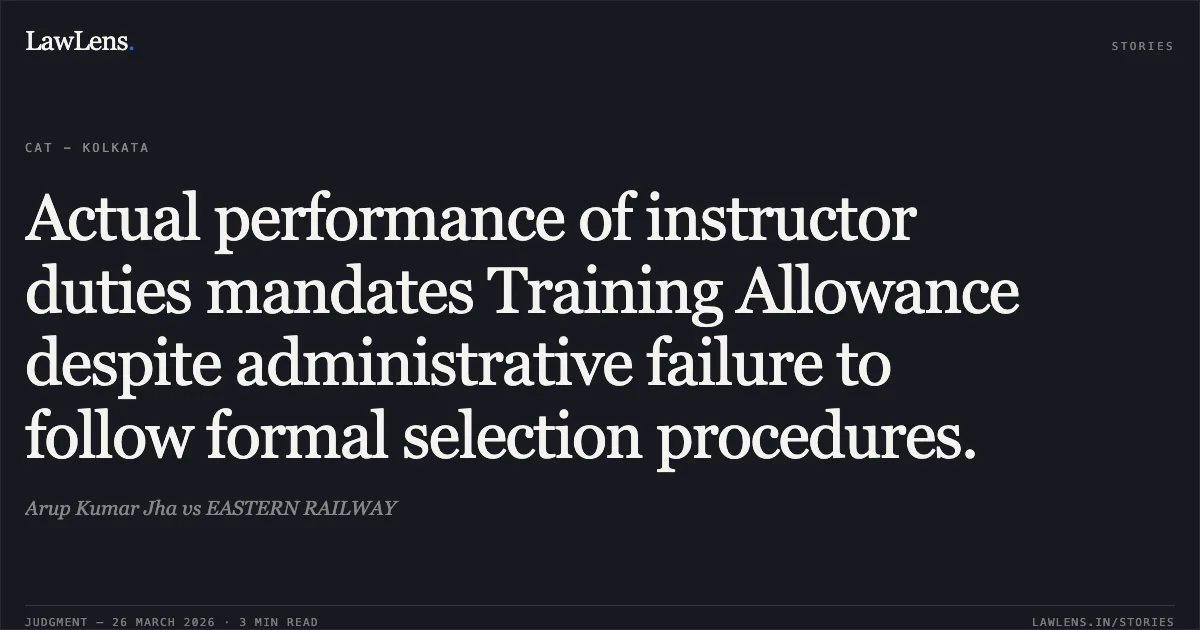
The Tribunal reasoned that the entitlement to Training Allowance is fundamentally tied to the nature of the duties performed.
Source reference: p. 12While the respondents argued that the applicant missed formal selection hurdles under RBE No. 127/2001, the Tribunal observed that the applicant was posted as an "Instructor" by the respondents themselves and served in that capacity for nearly five years without being repatriated to his parent cadre.
Source reference: p. 13-14The court found that Paragraph 5(d) of RBE 21/2003 excludes only "staff" not directly engaged in training; since the applicant was officially recorded as an "Instructor" upon joining, this exclusion did not apply.
Source reference: p. 14The Tribunal held that the respondents could not benefit from their own administrative failure to conduct a formal selection process or training session to deny an employee the allowances attached to the duties they permitted him to perform.
Source reference: p. 13Additionally, the Tribunal noted that the respondents failed to distinguish the applicant’s case from those in O.A. No. 1420 of 2016 and O.A. No. 111 of 2020, where similarly situated instructors received the allowance.
Source reference: p. 15Holding
The Tribunal quashed the impugned communication dated 13.09.2023, labeling the denial of the allowance as arbitrary.
It held that the applicant’s continuous service as an Instructor entitled him to consideration for the benefit.
Source reference: p. 16The respondents were directed to reconsider the applicant's claim for Training Allowance for his tenure at the ST Training School, Liluah, and pass a reasoned speaking order within eight weeks.
Source reference: p. 16If found entitled, the respondents must extend all consequential benefits in accordance with the law.
Source reference: p. 16Original Court PDF
Arup Kumar JhavsEASTERN RAILWAY
Click to open original judgment
Original judgment, available to read, download and summarize on LawLens.in