Facts
The Appellants (Defendants 1st Party) challenged a first appellate court judgment that reversed a trial court decree in a title suit.
Source reference: para. 5The dispute concerned the inheritance of property belonging to late Keshar Pujhar and Akli Pujharin. The Respondents (Plaintiffs) claimed to be the biological daughters and descendants of the deceased.
Source reference: para. 5-6The Appellants contended that Appellant No. 3 (Chitesh Kumar @ Arun Kumar) was the validly adopted son of Akli Pujharin via a registered deed dated 25.06.1990.
Source reference: para. 5-6The trial court dismissed the suit, upholding the adoption; however, the first appellate court reversed this, finding the adoption deed to be a sham document created to grab property.
Source reference: para. 3, 9The Appellants moved the High Court on the ground that the appellate court erred in its findings regarding the validity of the adoption.
Source reference: para. 4Issues
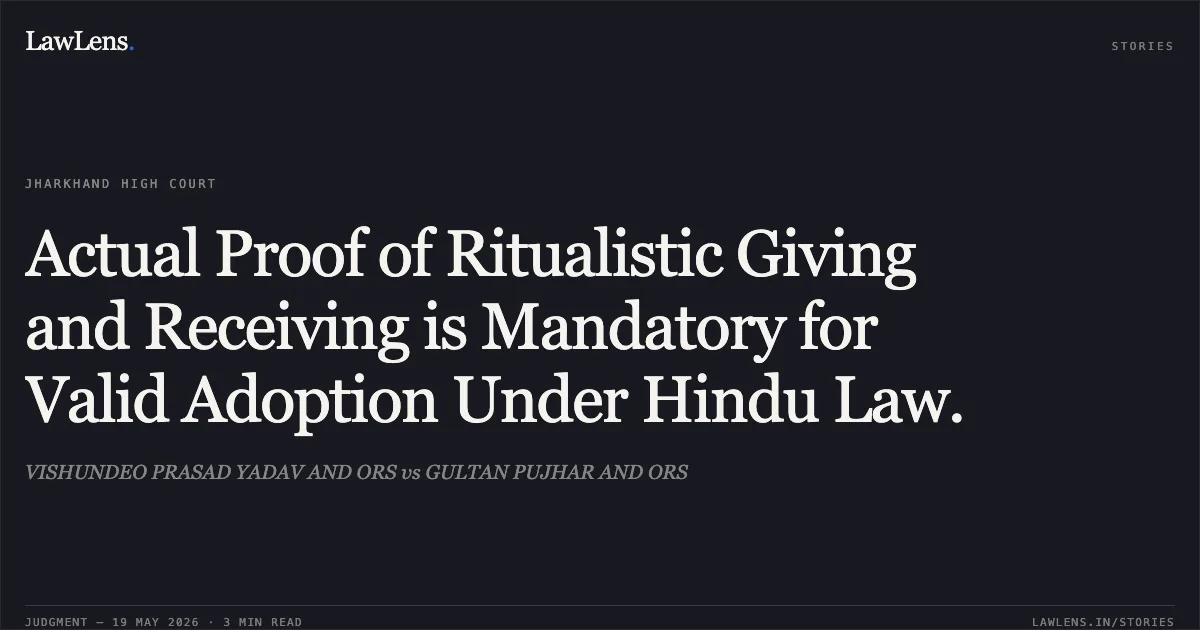
1. Whether the adoption of Appellant No. 3 by Akli Pujharin was legally valid in the absence of evidence regarding the ceremony of "giving and taking".
Source reference: para. 8, 102. Whether the findings of the first appellate court regarding the fraudulent nature of the adoption deed were perverse so as to warrant interference under Section 100 of the CPC.
Source reference: para. 11-12Law Applied
The Court relied on established principles of Hindu Law concerning adoption as described in Golapchandra Sarkar Sastri on Hindu Law (8th Edn.) and Mayne’s Hindu Law (11th Edn.). These authorities mandate that the ceremonies of "giving and taking" (actual manual delivery of the child) are absolutely essential for a valid adoption; mere execution or registration of a deed without such delivery is insufficient.
Source reference: para. 10The Court also applied Section 100 of the Code of Civil Procedure (CPC), 1908, which restricts Second Appeals only to cases involving substantial questions of law and precludes re-appreciation of evidence unless perversity is proven.
Source reference: para. 11-12Reasoning
The High Court scrutinized the first appellate court’s reasoning, which found several discrepancies in the Appellants' claims. Specifically, the adoption deed was silent on the existence of Akli’s biological daughters, and Appellant No. 3 (the alleged adopted son) continued to identify his natural father as "father" and his natural mother as "mother" in legal proceedings and school records even after the purported adoption.
Source reference: para. 8-9The appellate court noted that after adoption, a child should be "implanted" in the new family and disassociated from the birth family, which did not occur here. Furthermore, inconsistency in school certificates (Ex. D) and the lack of credible oral evidence regarding the mandatory "giving and taking" ceremony led to the conclusion that the adoption was a sham.
Source reference: para. 8, 9-10The High Court determined that the appellate court had provided cogent reasons and that the Appellants failed to demonstrate any "perversity" in the findings of fact.
Source reference: para. 11Holding
The High Court dismissed the Second Appeal, affirming the judgment of the first appellate court.
The Court held that a valid adoption requires the physical "giving and taking" of the child, and a registered deed alone cannot substitute for this essential ritual. No substantial question of law was found to exist, as the appellate court’s reversal of the trial court's judgment was based on a sound appreciation of evidence regarding the fraudulent nature of the adoption.
Source reference: para. 10, 11-12Acts & Sections Cited
2 provisions across 2 statutes referred to in this judgment. Each provision opens on LawLens.
Code of Criminal Procedure, 19731
Code of Civil Procedure, 19081
Original Court PDF
VISHUNDEO PRASAD YADAV AND ORSvsGULTAN PUJHAR AND ORS
Click to open original judgment
Original judgment, available to read, download and summarize on LawLens.in