01Facts
The appellants (landowners) instituted a suit for ejectment and recovery of arrears of rent amounting to ₹8,10,000/- against the respondents
¶ 3-4The suit property, measuring 1575 sq. mts., was converted for "Non-Agricultural Commercial, Petrol Station purposes" via an order dated 03.12.2018
¶ 6, 15A lease deed was executed on 06.03.2021 for 29 years and 11 months specifically for setting up a retail petroleum outlet
¶ 6, 13While the petrol station was fully constructed and fuel dispensing units were installed, the business had not yet commenced due to a pending NOC from the NHAI
¶ 7, 17On 14.03.2024, the Principal District and Sessions Judge, Chikkamagaluru (Commercial Court), ordered the return of the plaint, holding that the suit did not involve a "commercial dispute" under Section 2(1) of the Commercial Courts Act, 2015 (CC Act)
¶ 1The appellants challenged this order before the High Court.
02Issues
i.Whether the suit for ejectment and recovery of rent involving property leased for a petrol station, which is constructed but not yet operational, constitutes a "commercial dispute" under Section 2(1)(c)(vii) of the Commercial Courts Act, 2015
¶ 2, 803Law Applied
The court primarily applied Section 2(1)(c)(vii) of the Commercial Courts Act, 2015, which defines a "commercial dispute" as one arising out of agreements relating to immovable property "used exclusively in trade or commerce"
¶ 9The court relied on the expansive interpretation of the phrase "arising out of" as established in Doypack Systems (P) Ltd. vs. Union of India, which includes expressions "pertaining to" and "in relation to"
¶ 10The court interpreted the word "used" as appearing in Section 2(1)(c)(vii) of the CC Act in light of the Supreme Court's decision in Ambalal Sarabhai Enterprises Ltd. vs. K.S. Infraspace LLP, distinguishing between "actual use" and "future use"
¶ 20-21Provisions in the judgment · 3 · Linked ones open on LawLens
Commercial Courts Act, 2015 Section 2Section 13
Code of Civil Procedure, 1908 Section 26
04Reasoning
The High Court examined whether the suit property satisfied the "actual use" criteria required by the CC Act.
The court rejected the respondent's restrictive interpretation that "used" implies only active revenue-generating operations
¶ 21It observed that the property had already been legally converted for commercial use and a petrol station was physically constructed with equipment installed
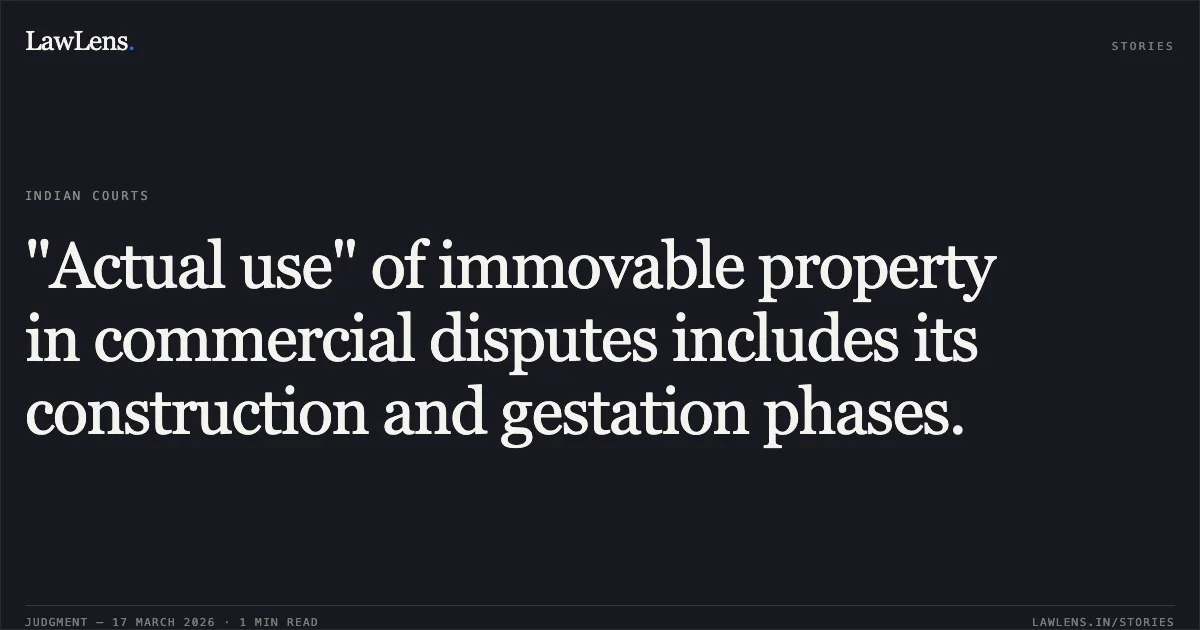
¶ 15-17The court reasoned that the gestation period of a business—including construction and setting up infrastructure—is an integral part of the commercial enterprise and its profit-making apparatus
¶ 18It distinguished Ambalal Sarabhai, noting that in that case, the property had not been converted and its commercial use was merely a future possibility, whereas here, the property was currently being utilized for the purpose of establishing a retail outlet
¶ 24, 26The court emphasized that the CC Act’s objective of "ease of doing business" would be frustrated if disputes arising during the setup phase of a commercial project were excluded from the specialized jurisdiction of Commercial Courts
¶ 23, 2505Holding
The High Court allowed the appeal and set aside the order dated 14.03.2024
¶ 27The court held that the dispute qualifies as a "commercial dispute" because the property was being used exclusively for a commercial purpose (the establishment of a petrol pump), regardless of whether revenue operations had commenced
¶ 18-19The court restored the plaint and directed the parties to appear before the Commercial Court on 10.04.2026 for further proceedings
¶ 27Original Court PDF
SRI K H NARAYANAvsSRI S L BALAKRISHNA
Click to open original judgment
Original judgment, available to read, download and summarize on LawLens.in