Facts
The respondent’s son, Satyajit Das, was a workman who died in a motor vehicle accident on October 19, 2019, while in the course of employment
Source reference: p. 2-3The Commissioner, Employees Compensation, Kamrup, awarded the respondent Rs. 13,63,280/- plus 12% interest, calculating compensation based on a monthly wage of Rs. 12,000/- (comprised of base salary plus Rs. 100 daily allowance)
Source reference: p. 2-4The Insurance Company appealed, contending that the statutory wage ceiling at the time of the accident was capped at Rs. 8,000/- per month as per a 2010 Central Government Notification and that daily allowances should not be included in "wages"
Source reference: p. 4Issues
1. Whether the learned Commissioner was justified in considering the wage of the deceased at Rs. 12,000/- per month when the statutory ceiling under the 2010 Notification was Rs. 8,000/-?
Source reference: p. 3-4, para. 52. Whether daily allowances paid to a workman should be included in the definition of "wages" under Section 2(m) of the Employees Compensation Act, 1923?
Source reference: p. 5-6, para. 11Law Applied
The court applied Section 4(1B) of the Employees Compensation Act, 1923, regarding the Central Government's power to specify monthly wages by notification
Source reference: p. 7It interpreted the deletion of "Explanation II" to Section 4 by Act 45 of 2009, which previously imposed a mandatory "deeming" ceiling on wages
Source reference: p. 7-8The court further applied the definition of "wages" under Section 2(m) of the Act, which includes any privilege or benefit estimatable in money, excluding only specific items like traveling allowances/concessions or special expenses entailed by the nature of employment
Source reference: p. 8Reasoning
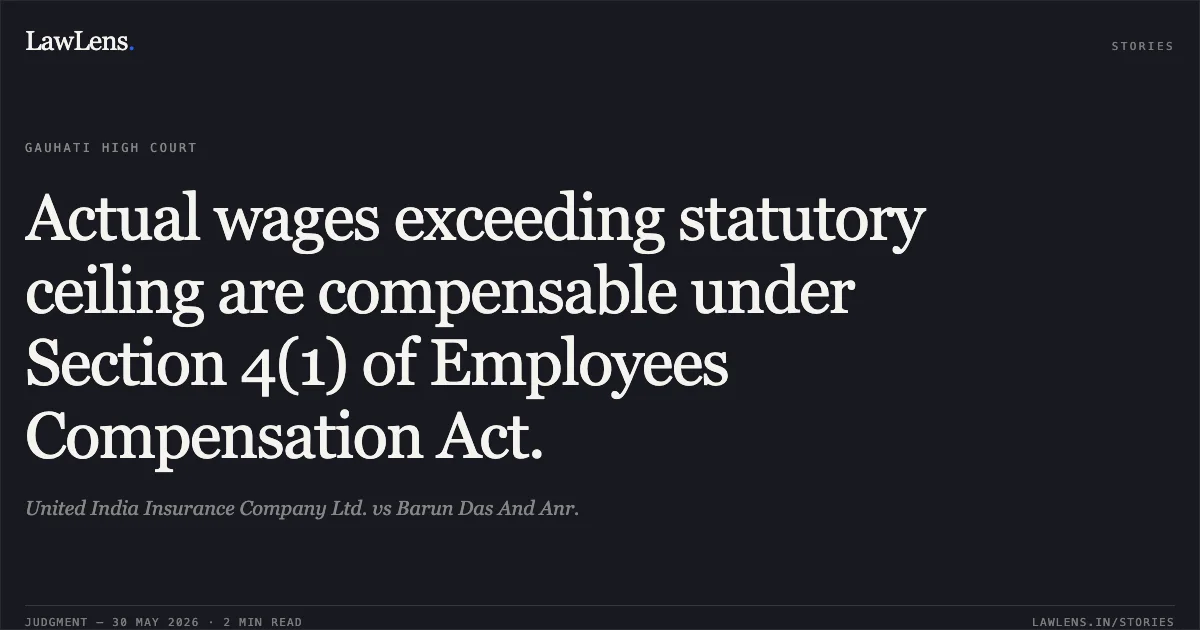
The court reasoned that since the legislature deleted the "deeming provision" (Explanation II) in 2009, the amounts specified by the Central Government under Section 4(1B) (such as the Rs. 8,000/- limit in the 2010 Notification) do not constitute an absolute upper ceiling if the claimant can prove higher actual earnings
Source reference: p. 7-8It held that for social welfare legislation, actual wages must be considered unless the notification specifically states the amount is a "cap"
Source reference: p. 8Regarding the daily allowance, the court observed that Section 2(m) only excludes "special expenses" and "traveling allowances." Since the appellant failed to prove that the daily allowance was intended for specific employment-related expenses, it fell within the broad definition of "wages" as a benefit estimatable in money
Source reference: p. 8-9Holding
The court answered the substantial question of law in the affirmative, upholding the Commissioner's assessment
It held that the actual wage of Rs. 12,000/- was the correct basis for computation as the 2010 Notification did not serve as a restrictive ceiling post-2009 amendment
Source reference: p. 8, 9The appeal was dismissed, and the Insurance Company was directed to pay the outstanding compensation within four weeks
Source reference: p. 10Acts & Sections Cited
5 provisions across 1 statute referred to in this judgment. Linked provisions open on LawLens.
Employee5
Original Court PDF
United India Insurance Company Ltd.vsBarun Das And Anr.
Click to open original judgment
Original judgment, available to read, download and summarize on LawLens.in