Facts
The Appellant/Insurance Company challenged an award dated 14/01/2020 passed by the Motor Accident Claims Tribunal, Baikunthpur, which granted Rs. 5,05,600/- to the claimants for the death of Rambai in a motor accident.
Source reference: p. 2, para 1The Appellant contended that the deceased was an occupant in the offending vehicle and, since the insurance policy was a "liability only" policy, the risk of passengers was not covered.
Source reference: p. 3, para 2Along with the appeal, the Appellant filed an application under Order 41 Rule 27 of the Code of Civil Procedure (CPC) to introduce the insurance policy as additional evidence to prove the lack of coverage.
Source reference: p. 3, para 2Issues
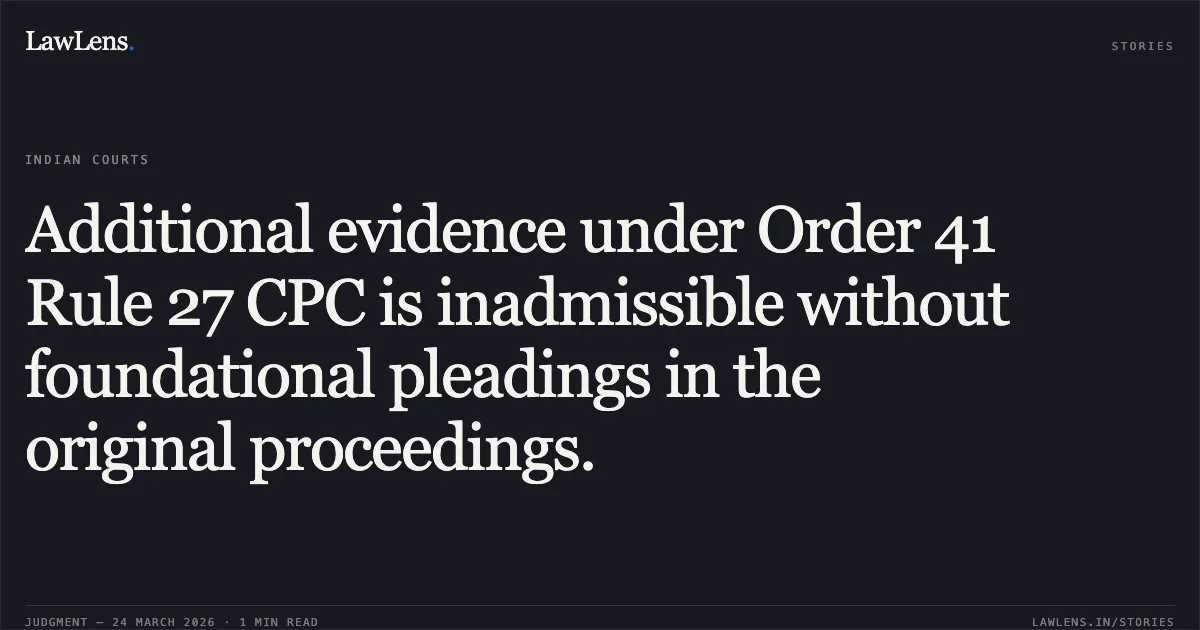
1. Whether an appellant can seek to lead additional evidence under Order 41 Rule 27 of the CPC when the underlying facts supporting such evidence were not specifically pleaded in the original written statement.
Source reference: p. 3, para 4 / p. 6, para 72. Whether the Insurance Company can be held liable for compensation if the policy coverage for occupants was not specifically contested during the trial.
Source reference: p. 6, para 7Law Applied
The Court primarily applied Order 41 Rule 27 of the CPC regarding the production of additional evidence in the Appellate Court.
Source reference: p. 3, para 2It relied on the Supreme Court precedent in Iqbal Ahmed (Dead) by LRs. and Anr. v. Abdul Shukoor (2025), which established that a court must first examine the pleadings to ensure the case sought to be set up by additional evidence was actually pleaded in the original trial; otherwise, such evidence is inconsequential.
Source reference: p. 4, para 5Furthermore, the Court cited Gobind Singh and Others v. Union of India and Others (2026), affirming that parties do not possess a vested or automatic right to seek admission of additional evidence at the appellate stage, and such provisions cannot be invoked if the court can render a judgment based on the existing record.
Source reference: p. 5, para 6Reasoning
The Court found that the Appellant’s written statement before the Claims Tribunal lacked any specific pleading regarding the nature of the policy being "liability only" or the exclusion of risk for occupants.
Source reference: p. 3, para 4Applying the principles from Iqbal Ahmed, the Court reasoned that without necessary pleadings to support the evidence, permitting additional evidence under Order 41 Rule 27 would be a futile exercise.
Source reference: p. 4, para 5 / p. 6, para 7The Court emphasized that the Appellant failed to lead any evidence regarding these policy limitations during the original proceedings.
Source reference: p. 6, para 7Consequently, the Appellant was barred from raising a new defense for the first time at the appellate stage, as the additional evidence did not serve to fill a lacuna but rather attempted to construct a case that was never pleaded.
Source reference: p. 6, para 7Holding
The High Court dismissed the appeal and the application filed under Order 41 Rule 27 of the CPC.
The Court held that the Insurance Company could not be permitted to introduce the insurance policy as additional evidence due to the absence of specific pleadings in the trial court.
Source reference: p. 6, para 7The original award of the Motor Accident Claims Tribunal was upheld, maintaining the liability of the Insurance Company.
Source reference: p. 6, para 8Acts & Sections Cited
2 provisions across 2 statutes referred to in this judgment. Each provision opens on LawLens.
Motor Vehicles Act, 19881
Code of Civil Procedure, 19081
Original Court PDF
UNITED INDIA INSURANCE COMPANY LIMITEDvsSAMARU SAI
Click to open original judgment
Original judgment, available to read, download and summarize on LawLens.in