Facts
Respondent No. 1/plaintiff instituted Original Suit No. 447 of 2022 seeking a permanent injunction against the revisionist and the proforma respondents in respect of land bearing Khasra No. 39/1, Dehradun. Her claim of ownership was founded on a registered sale deed dated 22 March 2004 executed in favour of her mother, Smt. Jagdishwari Gupta, and a registered Will allegedly executed by her mother in the plaintiff’s favour. The revisionist disputed the plaintiff’s title and contended that the vendor, Smt. Pushpa Tandon, had no lawful title or authority to execute the sale deed
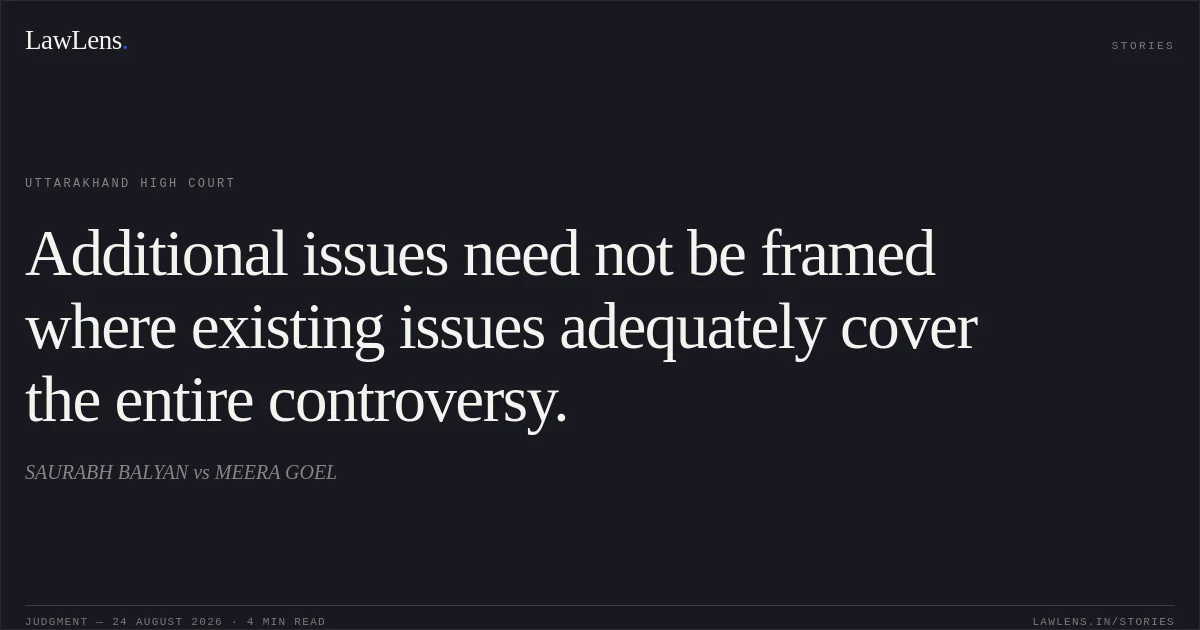
Source reference: paras. 2, 4–5The Trial Court framed six issues on 3 July 2026, including whether the plaintiff was the owner/bhumidhar in possession on the basis of the Will and whether she was entitled to the injunction. On an application by defendant No. 1, the Trial Court subsequently framed an additional issue concerning the lawful right of the plaintiff’s mother to transfer the property by Will. The revisionist thereafter sought framing of four further issues under Order XIV Rule 5 CPC, primarily concerning the maintainability of the injunction suit without declaratory relief, the vendor’s title and authority, the plaintiff’s title under the Will, and alleged fraud in the sale deed and mutation proceedings. The application was rejected on 14 July 2026 on the ground that the proposed issues were already covered by the issues framed. The revisionist challenged that order under Section 115 CPC.
Source reference: paras. 8–12Issues
1. Whether the Trial Court erred in refusing to frame the additional issues sought by the revisionist under Order XIV Rule 5 CPC, particularly issues concerning the plaintiff’s title, the vendor’s authority, the validity of the Will, and the alleged fraud in the sale deed and mutation proceedings?
Source reference: paras. 10–132. Whether the impugned order dated 14 July 2026 suffered from jurisdictional error or material irregularity warranting interference under Section 115 CPC?
Source reference: paras. 1, 7, 13–153. Whether the issues already framed sufficiently covered the controversy between the parties, including the question of the plaintiff’s entitlement to permanent injunction without separate declaratory relief?
Source reference: paras. 8–13Law Applied
The Court applied Order XIV Rule 5 CPC, which empowers the court to amend, strike out, or add issues at any time before pronouncement of judgment where necessary for determining the matters in controversy. The purpose of framing issues is to identify the questions requiring adjudication, indicate the matters on which evidence is necessary, and determine the burden of proof. However, non-framing of an issue in the precise form suggested by a party is not material where the parties are aware of their respective cases and the controversy is substantially covered by the existing issues
Source reference: para. 13The Court also applied the restrictive scope of Section 115 CPC, under which an interlocutory order may not be varied or reversed unless the statutory requirements for revision, including jurisdictional error or material irregularity, are satisfied; the proviso further restricts interference with orders that would not finally dispose of the suit even if made in favour of the revisionist
Source reference: para. 7Reasoning
The Court compared the four proposed issues with the six original issues and the additional issue already framed. It held that the plaintiff’s ownership and possession under the Will were directly covered by the principal issue regarding her status as owner/bhumidhar in possession, while the legality of the mother’s transfer by Will was expressly covered by the additional issue framed on 9 July 2026
Source reference: paras. 8–9, 13The remaining matters concerning the sale deed, the vendor’s authority, the plaintiff’s derivative title, mutation, and the effect of the alleged defects could be examined while adjudicating the existing issues and determining the plaintiff’s entitlement to injunction. Since the parties were fully aware of their rival title claims and could lead evidence on those matters, the absence of separately worded issues did not prejudice the revisionist. The Trial Court had therefore properly exercised its discretion under Order XIV Rule 5 CPC. The High Court also noted that the Trial Court had been directed to decide the suit expeditiously within four months, which supported avoiding redundant or overlapping issues. No jurisdictional error, illegality, or material irregularity was found in the impugned order
Source reference: paras. 10–14Holding
The High Court held that the additional issues sought by the revisionist were substantially covered by the issues already framed and that the parties could lead evidence on all material aspects of their rival claims. The order dated 14 July 2026 rejecting the revisionist’s application under Order XIV Rule 5 CPC was found to be legally sound and free from jurisdictional error or material irregularity
Accordingly, the civil revision was dismissed
Source reference: para. 15Acts & Sections Cited
3 provisions across 2 statutes referred to in this judgment. Each provision opens on LawLens.
Code of Civil Procedure, 19081
Specific Relief Act, 19632
Original Court PDF
SAURABH BALYANvsMEERA GOEL
Click to open original judgment
Original judgment, available to read, download and summarize on LawLens.in