Facts
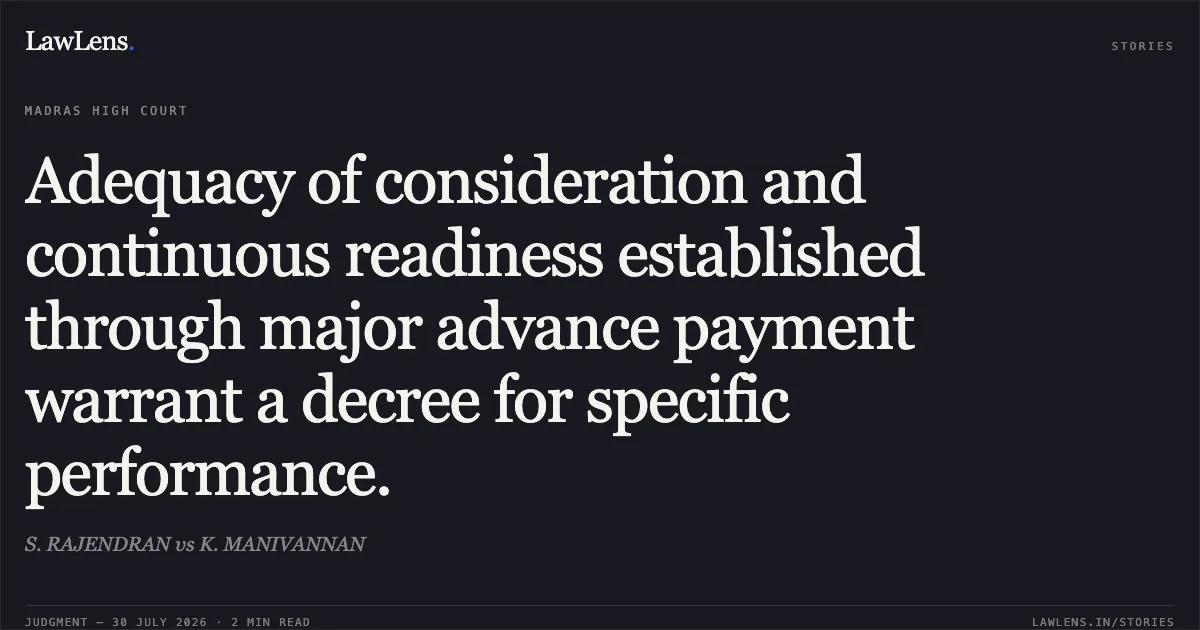
The Plaintiff (Respondent) filed a suit for specific performance based on a registered sale agreement dated 17.06.1998 for agricultural land
Source reference: p.5The total consideration was Rs.1,50,000/-, of which Rs.1,25,000/- was paid as advance, with the balance due in one year
Source reference: p.6The Defendant (Appellant) denied execution, alleging forgery and undervaluation
Source reference: p.7The Trial Court and First Appellate Court concurrently decreed the suit, relying on expert evidence (P.W.4 P.W.5) and the testimony of the attesting witness (P.W.2) and scribe’s son (P.W.3)
Source reference: p.9, 10During the pendency of the Second Appeal, the executing court executed the sale deed and ordered delivery of possession, leading to the Civil Revision Petition
Source reference: p.11Issues
1. Whether the Plaintiff proved continuous readiness and willingness under Section 16(c) of the Specific Relief Act given the one-year period to pay a small balance
Source reference: para. 16/Substantial Question 1 32. Whether the agreement was void for uncertainty regarding property identification/boundaries
Source reference: para. 16/Substantial Question 23. Whether the contract granted the Plaintiff an unfair advantage under Section 20 of the Specific Relief Act due to alleged inadequacy of price
Source reference: para. 16/Substantial Question 44. Whether the executing court erred in ordering delivery to subsequent purchasers without leave of court
Source reference: para. 12, 37Law Applied
The Court applied Section 16(c) of the Specific Relief Act, 1963 (unamended), requiring the Plaintiff to plead and prove continuous readiness and willingness
Source reference: p.20Section 20 was applied regarding the judicial discretion to grant specific performance, noting that inadequacy of consideration alone is not a ground to refuse relief
Source reference: p.23Evidence Law (Section 45) was cited regarding the admissibility of private expert testimony
Source reference: p.19For execution, the Court applied Order 21 Rule 16 and Section 146 of the CPC regarding the rights of transferees/subsequent purchasers
Source reference: p.25The principle from High Court Bar Association, Allahabad v. State of Uttar Pradesh (2024) regarding the non-automatic lapse of interim stay orders
Source reference: p.26Reasoning
The Court found the Defendant’s plea of forgery unsubstantiated as the agreement was registered and the expert evidence (P.W.4 P.W.5)—obtained with the Defendant’s consent and based on specimen signatures given in open court—confirmed common authorship
Source reference: p.19The Plaintiff demonstrated readiness and willingness by paying 83% of the price upfront and issuing a legal notice (Ex.A.2) within the stipulated time
Source reference: p.21Regarding the lack of boundaries, the Court held that identification by survey numbers and specific extent was sufficient for agricultural land
Source reference: p.22On the issue of unfair advantage, the Court noted the Defendant failed to produce any documentary evidence (e.g., guideline registers) to prove the alleged market value of Rs.4,00,000/-, making the Section 20 defense untenable
Source reference: p.23In the Revision, the Court held that subsequent purchasers had locus standi to seek possession alongside the decree-holder under Section 146 CPC
Source reference: p.26Holding
The Court held that the concurrent findings of the lower courts were based on a proper appreciation of evidence regarding the validity of the registered agreement and the Plaintiff's readiness
The High Court dismissed both the Second Appeal and the Civil Revision Petition
Source reference: p.27Acts & Sections Cited
7 provisions across 2 statutes referred to in this judgment. Each provision opens on LawLens.
Code of Civil Procedure, 19084
Specific Relief Act, 19633
Original Court PDF
S. RAJENDRANvsK. MANIVANNAN
Click to open original judgment
Original judgment, available to read, download and summarize on LawLens.in