Facts
The assessee filed its return of income for Assessment Year (AY) 2015-16, which was selected for scrutiny.
Source reference: para. 2The Assessing Officer (AO) passed a scrutiny assessment order under Section 143(3) of the Income Tax Act (the "Act") on May 31, 2017
Source reference: para. 2The Principal Commissioner of Income Tax (PCIT) reviewed the order and, finding it erroneous and prejudicial to the interest of the revenue, issued a notice under Section 263 of the Act.
Source reference: para. 2On March 27, 2021, the PCIT set aside the AO’s order, directing a fresh enquiry into three issues: taxability of payments to Avenue Venture Real Estate Fund, deductions under Section 35(2AB), and commission payments to M/s Reynolds Petro Chems Ltd
Source reference: para. 2The assessee appealed to the Income Tax Appellate Tribunal (ITAT), Patna, which quashed the PCIT’s order on June 20, 2022, restoring the AO's original assessment
Source reference: para. 4The Revenue then filed the instant Miscellaneous Appeal before the High Court
Source reference: para. 5Issues
1. Whether the ITAT was correct in law by accepting the assessee’s claim under Section 35(2AB) solely because a similar issue was dropped by the PCIT, Mumbai?
Source reference: para. 1(i)2. Whether the ITAT's order improperly restricted the PCIT’s powers under Section 263 to direct a reframing of the assessment order where no proper enquiry or investigation was conducted by the AO?
Source reference: para. 1(ii)3. Whether the ITAT was justified in holding that the PCIT was not authorized to explore the taxability of Rs. 20,17,86,432/- given the alleged lack of enquiry by the AO?
Source reference: para. 1(iii)4. Whether the ITAT was justified in quashing the Section 263 order regarding commission payments of Rs. 1,61,83,762/- where the PCIT observed a lack of proper verification?
Source reference: para. 1(iv)Law Applied
Section 263 of the Income Tax Act, which empowers the Commissioner to revise orders that are "erroneous in so far as they are prejudicial to the interests of the revenue"
Source reference: para. 6Section 263 cannot be invoked if the AO has conducted a reasonable enquiry, even if the assessment order does not contain a detailed discussion on every issue
Source reference: para. 9CIT, Patna v. Mr. Mukul Kumar (2009) 4 PLJR 417, which held that if materials on record demonstrate that an enquiry was made regarding expenditure, the ITAT is justified in quashing a revisionary order
Source reference: para. 10Reasoning
The Revenue contended that the AO's failure to discuss specific issues in the assessment order constituted a "lack of enquiry," rendering the order erroneous
Source reference: para. 6However, the court observed that the assessee had submitted invoices, TDS details, and explanations during the original assessment proceedings
Source reference: para. 9The court reasoned that the language or brevity of an assessment order is the AO's prerogative and does not necessarily imply a lack of mind application or enquiry
Source reference: para. 9By applying the Mukul Kumar precedent, the court noted that the ITAT had already performed a factual appreciation of the records and determined that the AO had indeed conducted a reasonable enquiry
Source reference: para. 10Since the ITAT found that the AO took a "plausible view" based on the evidence, the court determined that the PCIT could not substitute its own view under Section 263
Source reference: para. 9-11Holding
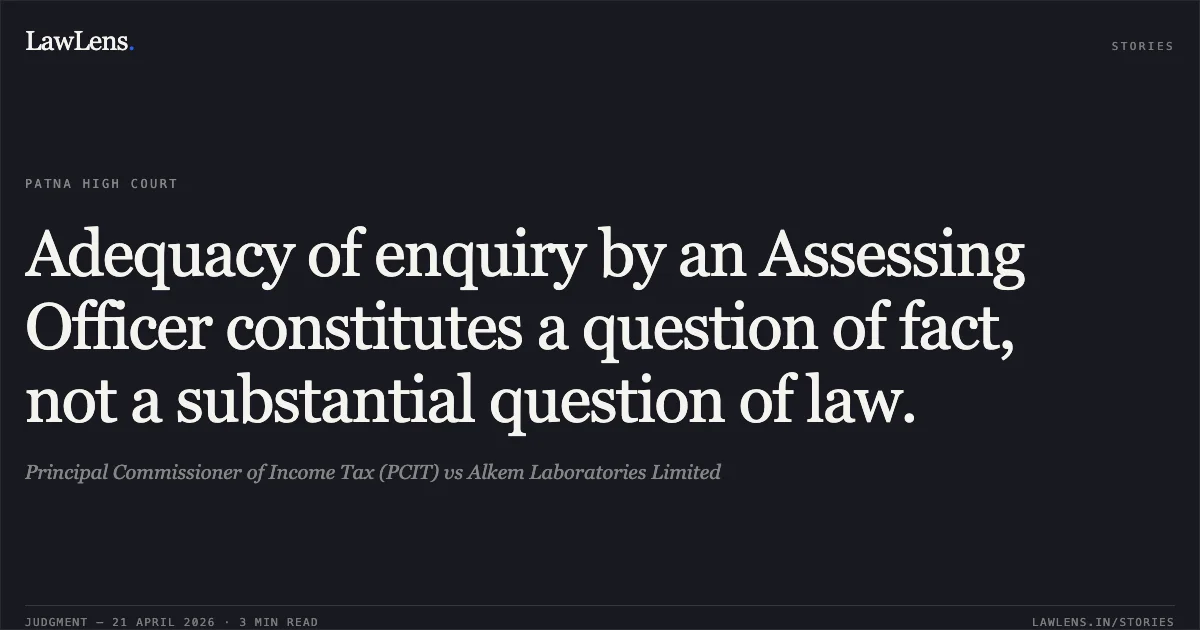
The High Court held that the determination of whether an AO conducted a proper enquiry is a "pure question of fact"
Since the ITAT had already concluded as a matter of fact that a reasonable enquiry was held, no "substantial question of law" arose for consideration under the High Court's appellate jurisdiction
Source reference: para. 12Consequently, the High Court dismissed the appeal and upheld the ITAT’s order quashing the Section 263 revision
Source reference: para. 12Acts & Sections Cited
4 provisions across 1 statute referred to in this judgment. Linked provisions open on LawLens.
Income Tax Act, 19614
Original Court PDF
Principal Commissioner of Income Tax (PCIT)vsAlkem Laboratories Limited
Click to open original judgment
Original judgment, available to read, download and summarize on LawLens.in