Facts
The petitioners filed a writ petition seeking to quash a demolition process initiated by the Kolkata Port Trust (formerly CPT) and Calcutta Dock Labour Board (CDLB) regarding residential quarters at 2 Brook Lane, Garden Reach, Kolkata
Source reference: para. 1The petitioners claimed to be residents of these public premises, relying on copies of Aadhar Cards to prove occupation
Source reference: para. 2They contended that the authorities were demolishing the structures without following the mandatory eviction procedures under the Act of 1971
Source reference: para. 5Conversely, the Port Trust argued that the structures were at imminent risk of collapse, posing a threat to life, and that the petitioners failed to provide any evidence of settled or lawful possession
Source reference: paras. 10-11Issues
1. Whether the petitioners established "unauthorised occupation" within the meaning of Section 2(g) of the Act of 1971 to entitle them to the protection of statutory eviction procedures
Source reference: para. 202. Whether the respondent authorities were required to serve notice and conduct proceedings under Sections 4 and 5 of the Act of 1971 before proceeding with demolition
Source reference: para. 20Law Applied
Section 2(g) defines "unauthorised occupation" as occupation without authority or the continuation of stay after such authority has expired
Source reference: para. 13Section 4 mandates that an Estate Officer must issue a show-cause notice if there is information regarding unauthorised occupation
Source reference: para. 14Section 5 prescribes the procedure for eviction after considering the occupant's response
Source reference: para. 14The Court distinguished the precedent Board of Trustees for the Port of Kolkata & Anr. vs. Vijay Kumar Arya & Ors. (2009), noting it applies where a prior lease or legal authority to occupy had been established and subsequently revoked
Source reference: para. 21Reasoning
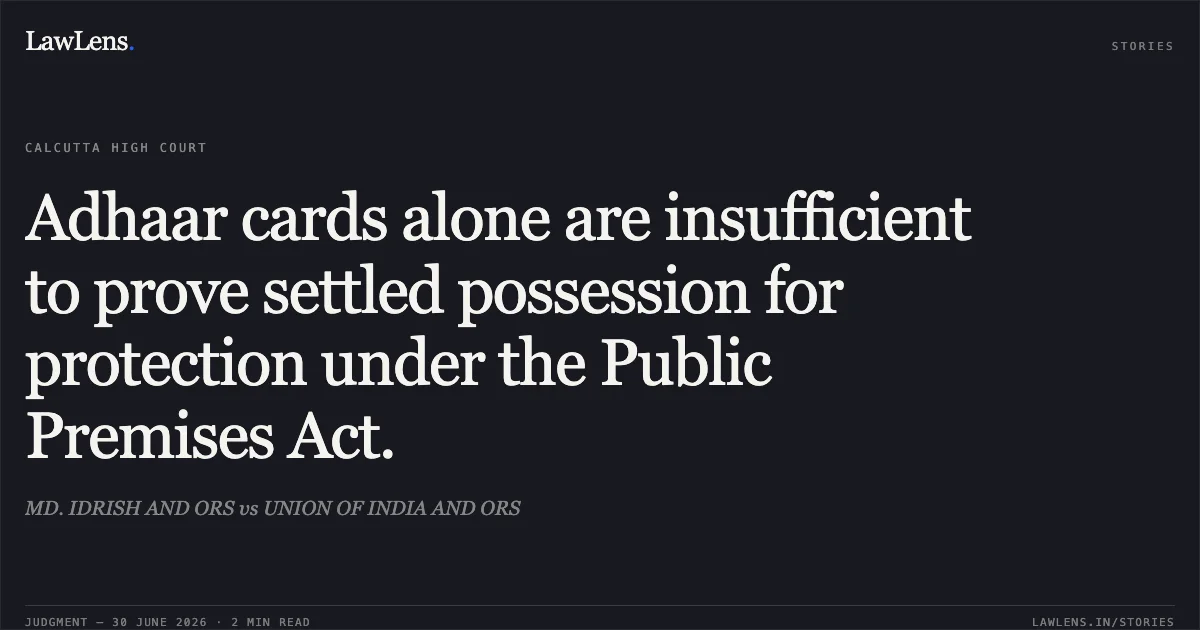
The Court found that while the petitioners submitted Aadhar Cards, these documents alone did not substantiate the "authority" under which they occupied the premises, nor did they prove actual possession of specific units
Source reference: para. 18Despite a specific judicial direction on 15.06.2026 to file a supplementary affidavit indicating their authority to occupy, the petitioners failed to provide any cogent evidence or "single scrap of paper" to establish how they came into possession
Source reference: paras. 17-18, 21The Court reasoned that the protections of Sections 4 and 5 of the Act of 1971 are triggered only when a person is an "unauthorised occupant" as defined by the Act; since the petitioners failed to prove the factum of their occupation or the nature of their claim, the statutory procedures did not apply
Source reference: paras. 19-20Furthermore, the Court noted the Port Trust's evidence regarding the "imminent risk of collapse" of the buildings
Source reference: para. 11Holding
The Court dismissed the writ petition, holding that the petitioners failed to substantiate their alleged occupation or authority over the premises, rendering the Act of 1971 inapplicable
The Court answered the issues by stating that in the absence of cogent evidence of occupation, the authorities were not bound by the notice requirements of Sections 4 and 5
Source reference: para. 20All interim orders were vacated
Source reference: para. 24Acts & Sections Cited
3 provisions across 1 statute referred to in this judgment. Each provision opens on LawLens.
Original Court PDF
MD. IDRISH AND ORSvsUNION OF INDIA AND ORS
Click to open original judgment
Original judgment, available to read, download and summarize on LawLens.in