Facts
The Petitioner, owner of a property in Mysuru, obtained a plan for residential construction after dismantling an old building
Source reference: p. 2Respondent No. 1 (Mysuru City Corporation) issued an order under Section 321(3) of the Karnataka Municipal Corporation Act, 1976, directing the removal of allegedly unauthorized construction built in violation of the sanctioned plan
Source reference: p. 3The Petitioner challenged this order in M.A.No. 43/2025 before the District Court.
Source reference: p. 3Respondent No. 3, an adjoining property owner and the original complainant whose report triggered the corporation's action, filed an application under Order 1 Rule 10(2) of the CPC to be impleaded
Source reference: p. 3The Trial Court allowed the application, holding her a "necessary party" to substantiate the implications of the construction
Source reference: p. 4The Petitioner challenged this impleadment via the present Writ Petition
Source reference: p. 2Issues
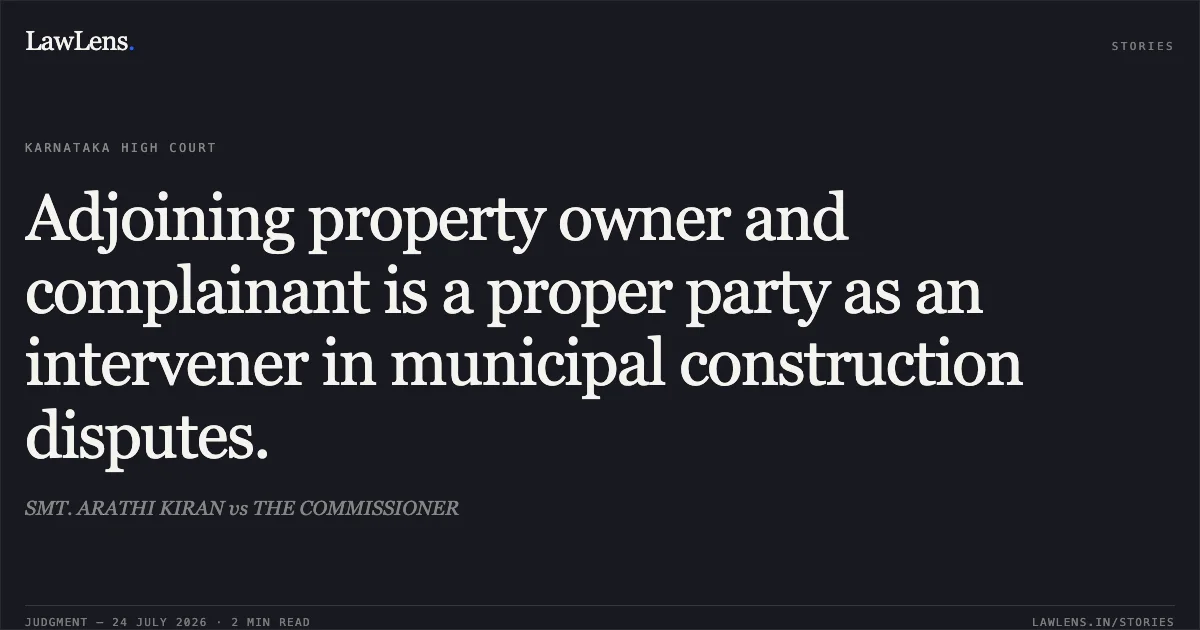
1. Whether an adjoining property owner/complainant is a necessary or proper party in an appeal challenging a municipal demolition order issued under the Karnataka Municipal Corporation Act
Source reference: p. 5, 8Law Applied
Order 1 Rule 10(2) of the Code of Civil Procedure (CPC) regarding the addition of parties
Source reference: p. 2Mohammed Rafiq v. Commissioner, HDMC (W.A.No. 100071/2018), which initially held that impleading a complainant is unwarranted as property rights aren't the subject of a statutory appeal
Source reference: p. 5Division Bench ruling in K.S. Jagadish Reddy v. Smt. Susheela (W.A.No. 460/2020), which followed a Supreme Court directive allowing complainants to participate as "interveners"
Source reference: p. 6-7A "proper party" is one whose presence facilitates effective adjudication and prevents future litigation
Source reference: p. 9Reasoning
The Court observed that while the statutory proceedings are technically between the Municipality and the builder, the factual foundation of the case rested on the third respondent's complaint
Source reference: p. 8If the petitioner succeeds, the complainant’s efforts to invoke the statutory mechanism would be frustrated; thus, the complainant is not a "complete stranger"
Source reference: p. 9The Court determined that while the complainant might not be a "necessary party" (without whom no order can be passed), they satisfy the definition of a "proper party" because their presence assists the Court in arriving at a just conclusion regarding the legality of the construction
Source reference: p. 9To Balance the interests, the Court followed the Supreme Court’s approach in Shantesh Gureddi, concluding that the third respondent should participate to support the municipal action without being allowed to expand the scope of the suit to personal property disputes
Source reference: p. 7, 10Holding
The Court held that the third respondent shall participate in the proceedings only as an intervener/proper party
The High Court declined to interfere with the Trial Court’s order but modified the status of the impleaded party. This participation is strictly limited to supporting the validity of the municipal proceedings and does not entitle her to claim independent relief or enlarge the litigation’s scope. The Writ Petition was disposed of accordingly
Source reference: p. 10, 11Acts & Sections Cited
2 provisions across 2 statutes referred to in this judgment. Each provision opens on LawLens.
Code of Civil Procedure, 19081
KARNATAKA MUNICIPAL CORPORATIONS ACT, 1976.1
Original Court PDF
SMT. ARATHI KIRANvsTHE COMMISSIONER
Click to open original judgment
Original judgment, available to read, download and summarize on LawLens.in