Facts
The petitioner purchased leasehold rights for a property in Indore via a registered sale deed in 2008 for ₹34,00,000 and paid stamp duty of ₹3,40,100.
Source reference: para 3The Sub-Registrar referred the matter to the Collector of Stamps alleging undervaluation.
Source reference: para 4On 26/09/2009, the Collector, proceeding ex-parte, determined the market value to be ₹80,67,000, assessed a deficit duty of ₹14,50,260, and imposed a five-times penalty of ₹72,51,300.
Source reference: para 5-6A Revenue Recovery Certificate (RRC) was issued in 2009, and the Board of Revenue dismissed the petitioner’s revision in 2012.
Source reference: para 7In 2020, the Tehsildar issued a public notification to auction the property to recover the dues, prompting this writ petition challenging the prior orders and the auction notice.
Source reference: para 8Issues
1. Whether the impugned orders were passed in violation of the principles of natural justice and the mandatory procedure for notice under the 1975 Rules.
Source reference: para 9, 222. Whether the Collector’s ex-parte determination of market value and imposition of a five-times penalty without physical verification or legal reasoning was sustainable.
Source reference: para 10, 14, 233. Whether the writ petition was barred by delay and laches, given the underlying order attained finality in 2012.
Source reference: para 15, 19Law Applied
Section 47-A(2) of the Indian Stamp Act, 1899, which mandates that the Collector must provide a "reasonable opportunity of being heard" and conduct an inquiry before determining market value.
Source reference: para 21Rules 4 and 5 of the Madhya Pradesh Prevention of Undervaluation of Instruments Rules, 1975, which prescribe the specific forms for notice and the criteria for determining market value.
Source reference: para 9, 10, 23The principle from Harvinder Kaur v. State of Madhya Pradesh, requiring "reasons to believe" for referrals.
Source reference: para 12The Full Bench decision in Mustaq Bai v. State of Madhya Pradesh regarding the bypass of limitation when orders are passed without jurisdiction.
Source reference: para 15Reasoning
The Court observed that while the respondents claimed notices were sent, there was no substantive evidence on record to prove effective service in compliance with Rule 4 of the 1975 Rules.
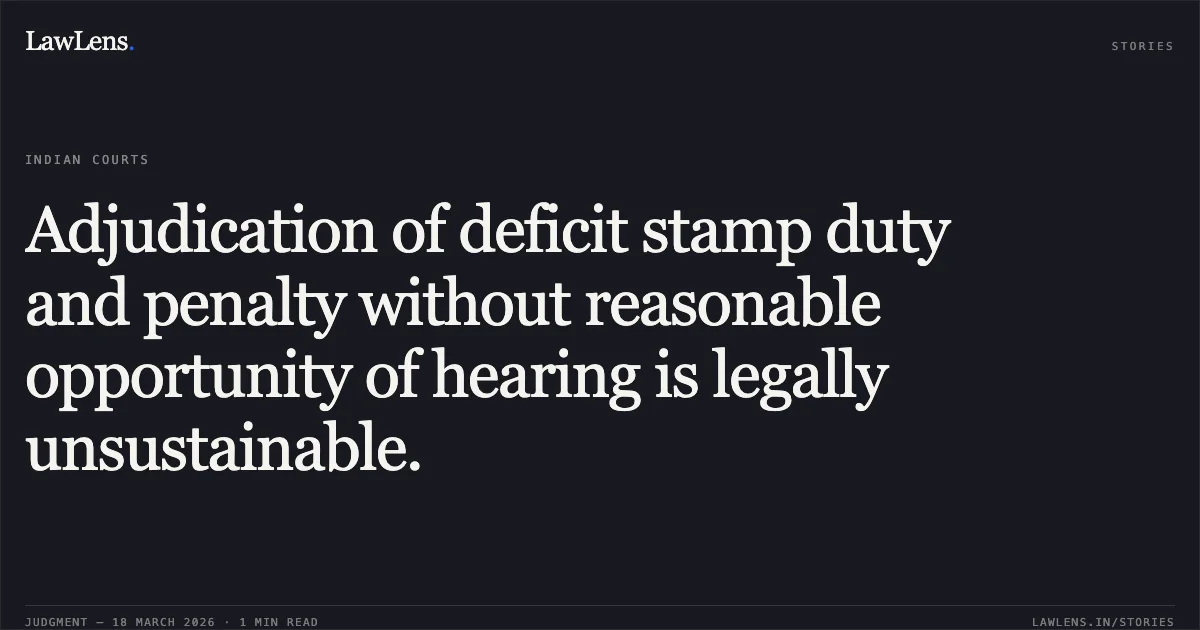
Source reference: para 22The Court found that the Collector failed to adhere to the foundational requirement of Section 47-A(2) by bypassing a "reasonable opportunity of being heard," which rendered the subsequent ex-parte adjudication and the five-times penalty under Section 40(b) legally unsustainable.
Source reference: para 23-24The Court noted that the authorities ignored the 2007-2008 Collector Guidelines and failed to follow the valuation parameters set out in Rule 5, such as distinguishing between residential and commercial use.
Source reference: para 10, 23Regarding the delay, the Court held that the 2020 auction notification created a continuing cause of action and that jurisdictional errors violating natural justice warrant interference despite the passage of time.
Source reference: para 15, 25Holding
The Court allowed the writ petition and quashed the order of the Board of Revenue (10/10/2012), the order of the Collector of Stamps (26/09/2009), the RRC (27/10/2009), and the auction notification (03/02/2020).
The Court remanded the matter to the Collector of Stamps, Indore, for a fresh determination on merits in accordance with law and the prevailing guidelines.
Source reference: para 25The petitioner was directed to appear before the Collector on 06/04/2026 to file a reply.
Source reference: para 27No order as to costs was made.
Source reference: para 29Acts & Sections Cited
4 provisions across 2 statutes referred to in this judgment. Each provision opens on LawLens.
Indian Stamp Act, 18992
Transfer of Property Act, 18822
Original Court PDF
Madhur DabanivsThe State Of Madhya Pradesh
Click to open original judgment
Original judgment, available to read, download and summarize on LawLens.in