Facts
The Petitioner, Navin Vishwanathan, operates a proprietorship, "M/s. Oriental Facility," with a distinct GST registration and place of business obtained in February 2023
Source reference: para. 3(e)His deceased father previously ran a separate business under the same trade name with a different GSTIN
Source reference: para. 3(a)Following the father's death on February 11, 2024, the Department issued a demand for approximately ₹4.15 crores against the father’s concern
Source reference: para. 3(g), (j)On March 21, 2025, Respondent No. 2 issued Form GST DRC-13 to the Petitioner’s bank, attaching his personal bank account for the recovery of his father's dues, invoking Sections 79 and 93 of the CGST Act
Source reference: para. 2, 3(j)This attachment occurred without any prior show cause notice or hearing to determine the Petitioner's liability as a legal heir or successor
Source reference: para. 3(k), 11Issues
1. Whether the Department can recover the tax dues of a deceased person from the legal heir's independent business entity without prior adjudication of liability under Section 93 of the CGST Act?
Source reference: para. 9, 132. Whether the provisional attachment of the Petitioner’s bank account without notice or hearing violates the principles of natural justice and the constitutional right to property under Article 300A?
Source reference: para. 15, 16Law Applied
Section 93(1)(a) of the CGST Act, which mandates that a legal representative is liable for the tax dues of the deceased only if they continue the business
Source reference: para. 10Section 83 regarding provisional attachment, emphasizing that such power must be exercised based on the formation of an opinion derived from "tangible material" rather than mere expediency
Source reference: para. 14Supreme Court precedent in Radha Krishan Industries v. State of Himachal Pradesh, which established that provisional attachment is a "draconian" measure requiring strict adherence to procedural safeguards and the doctrine of proportionality
Source reference: para. 14Article 300A of the Constitution, stating that a bank account is "property" and cannot be deprived without due process
Source reference: para. 15Reasoning
The court observed that under the GST regime, each GSTIN constitutes a separate taxable entity; therefore, the Petitioner and his father were legally distinct
Source reference: para. 11The Department’s assumption that similarity in trade names automatically implies a "continuation" of business under Section 93 was rejected as a mere presumption lacking evidentiary determination
Source reference: para. 12, 17The court reasoned that liability under Section 93 must be established through a formal adjudicatory process involving notice and a hearing
Source reference: para. 12, 13By bypassing this and proceeding directly to recovery under Section 79, the Department committed a jurisdictional error
Source reference: para. 18Applying the Radha Krishan test, the court found no "live link" or "tangible material" to justify the attachment of an independent third party's account without prior notice, thus violating the principles of natural justice and constitutional protections against arbitrary deprivation of property
Source reference: para. 15, 18Holding
The Court allowed the Writ Petition and quashed the impugned communication dated March 21, 2025
It held that the Department cannot effect recovery against a separate taxable person without first determining liability via a show cause notice
Source reference: para. 13, 17The Court directed Respondent No. 3 to de-freeze the Petitioner’s bank account within one week
Source reference: para. 20(ii)The Court granted the Department liberty to initiate fresh proceedings under Section 93 to determine if the father's dues are legally recoverable from the Petitioner, provided due process is followed
Source reference: para. 20(iii)Acts & Sections Cited
19 provisions across 3 statutes referred to in this judgment. Each provision opens on LawLens.
Central Goods and Services Tax Act, 2017
Indian Penal Code, 18602
Gujarat Value Added Tax Act, 2003.1
Original Court PDF
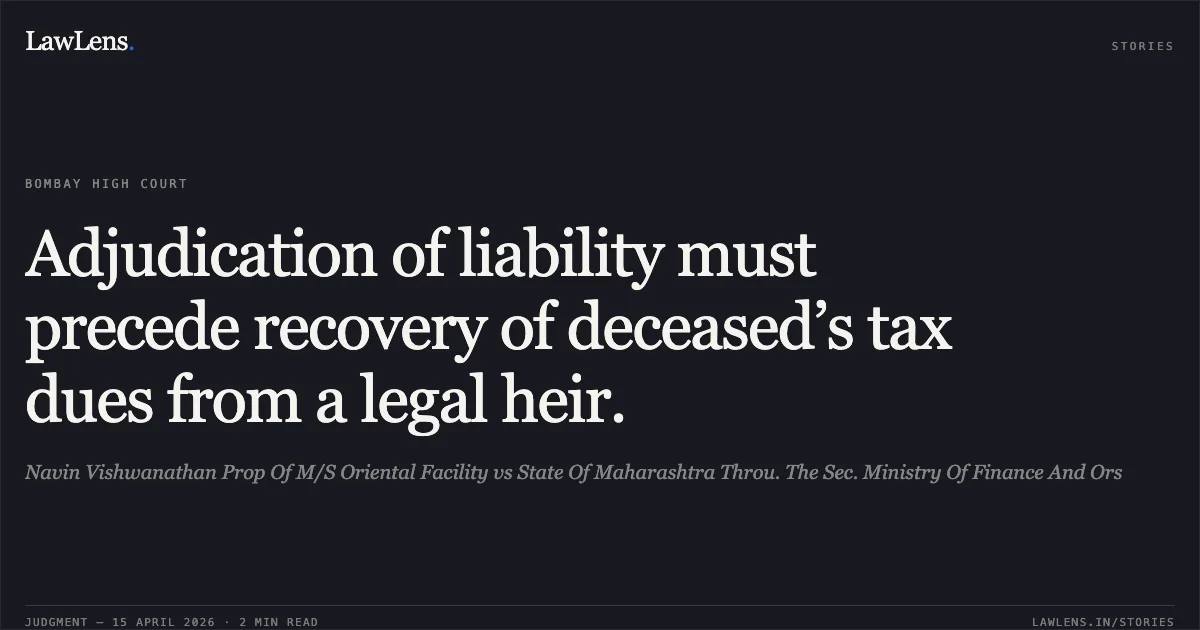
Navin Vishwanathan Prop Of M/S Oriental FacilityvsState Of Maharashtra Throu. The Sec. Ministry Of Finance And Ors
Click to open original judgment
Original judgment, available to read, download and summarize on LawLens.in