01Facts
The petitioner (defendant) is an individual against whom the respondent-Bank instituted a recovery suit (O.S. No. 118/2018) for unpaid dues
p. 2, 4Prior to the bank's suit, the petitioner had initiated insolvency proceedings in I.C. No. 30/2015
pp. 2-3The petitioner filed an interlocutory application (I.A. No. 3) under Section 10 of the CPC seeking to stay the recovery suit, contending that the pendency of insolvency proceedings barred the continuation of the civil suit
p. 2, 4The Trial Court (Prl. Senior Civil Judge, Hubballi) rejected the stay application on 23.02.2021
pp. 1-2During the pendency of this writ petition, the insolvency petition itself was rejected by the competent court and is currently under appeal
p. 802Issues
i.1. Whether the mere filing or pendency of an insolvency petition operates as an automatic stay on recovery proceedings initiated by a creditor against the debtor
p. 4, 6ii.2. Whether the conditions precedent for staying a suit under Section 29 of the Provincial Insolvency Act, 1920, were satisfied in the present case
pp. 7-803Law Applied
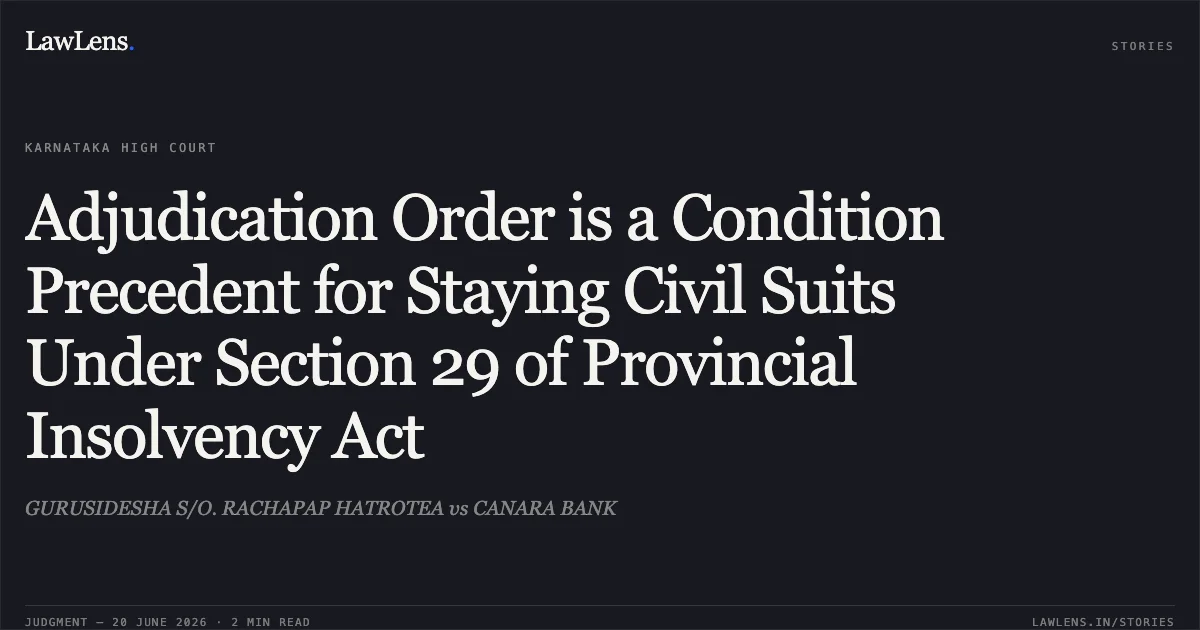
The court primarily interpreted Section 29 of the Provincial Insolvency Act, 1920, which mandates that a court shall stay proceedings against a debtor only upon "proof that an order of adjudication has been made against him"
p. 4The court clarified the legal distinction between the "filing of an insolvency petition" and an "order of adjudication," noting that adjudication is a formal judicial declaration that changes the debtor's legal status and vests the estate in a receiver
pp. 5-6The court also exercised its supervisory jurisdiction under Article 227 of the Constitution of India to determine if the lower court committed a jurisdictional error
p. 9Provisions in the judgment · 4 · Linked ones open on LawLens
Code of Civil Procedure, 1908 Section 10
Provincial Insolvency Act, 1920 Section 7Section 10Section 29
04Reasoning
The High Court reasoned that Section 29 of the Act does not create an automatic bar to civil suits upon the mere filing of an insolvency petition
p. 5The court emphasized that the legislative language "order of adjudication" is explicit and serves as a mandatory condition precedent for a stay
pp. 6-7In the present case, while the petitioner had filed for insolvency under Sections 7 and 10 of the Act, no order of adjudication had been passed when the recovery suit was filed
pp. 7-8Consequently, the petitioner retained his ordinary legal character, and the respondent-bank was not deprived of its independent remedy for recovery
p. 6The court further noted that since the insolvency petition had since been rejected by the competent court, the petitioner could not seek the protection of a stay, as the pendency of an appeal does not equate to an order of adjudication
pp. 8-905Holding
The Court answered the issues in the negative, holding that Section 29 of the Provincial Insolvency Act is triggered only by an adjudication order and not by the mere pendency of proceedings
p. 7, 9The Writ Petition was dismissed, and the order of the Trial Court rejecting the stay of the recovery suit was upheld as the High Court found no jurisdictional error or perversity in the Trial Court’s order dated 23.02.2021
p. 9, 10Original Court PDF
GURUSIDESHA S/O. RACHAPAP HATROTEAvsCANARA BANK
Click to open original judgment
Original judgment, available to read, download and summarize on LawLens.in