Facts
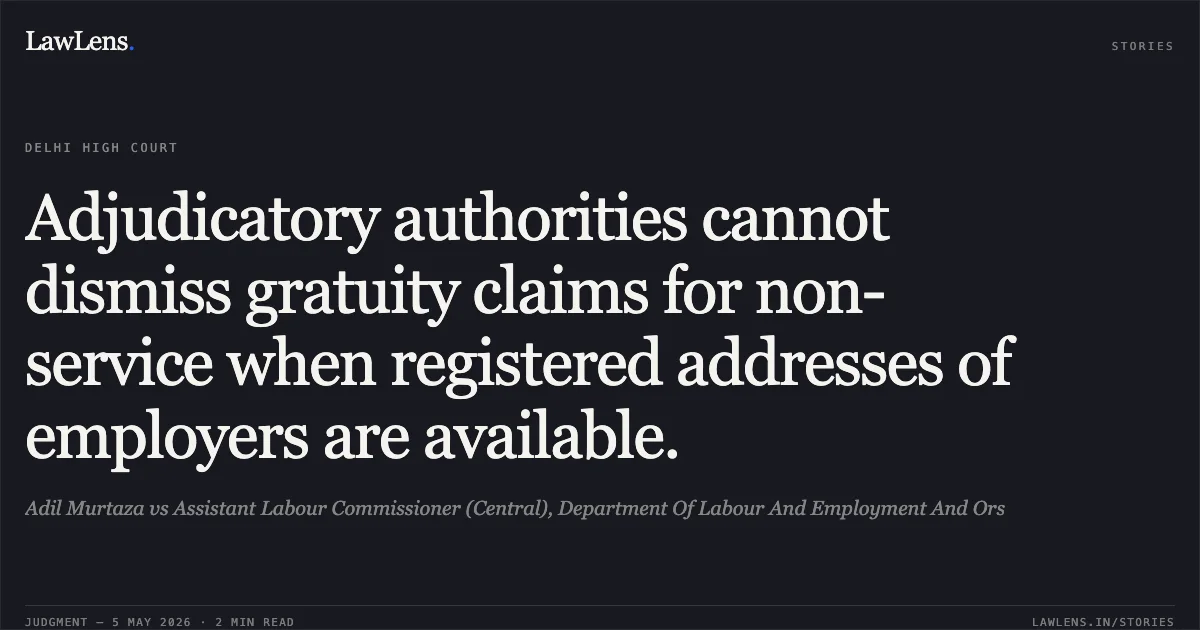
The petitioner filed a claim under the Payment of Gratuity Act, 1972 against his former employer, M/s Karvy Stock Broking Ltd. (Respondent No. 2).
Source reference: p.1On 20.02.2026, the Controlling Authority (Respondent No. 1) passed an order dismissing the petitioner’s claim solely because notices sent to the company at its Gurgaon address were returned unserved and its whereabouts were deemed untraceable.
Source reference: p.1The petitioner challenged this order via a writ petition, contending that the authority abdicated its adjudicatory functions.
Source reference: p.2During the High Court proceedings, the Assistant Labour Commissioner submitted a communication stating that service had subsequently been effected at the company's Hyderabad address in a related matter, and therefore, the petitioner’s case was being restored for hearing on 21.05.2026.
Source reference: p.3Issues
1. Whether the Controlling Authority was justified in dismissing a statutory claim for gratuity merely due to the failure of service of notice on the respondent at one of its known addresses.
Source reference: p. 2 / para. 22. Whether the conduct of the concerned authority in passing a dismissal order and subsequently issuing a contradictory administrative communication reflects a failure of the adjudicatory process.
Source reference: p. 4 / para. 8Law Applied
The Court applied the provisions of the Payment of Gratuity Act, 1972, which mandates the Controlling Authority to adjudicate claims on their merits.
Source reference: p. 1, 3The Court further relied on the principles of natural justice and administrative law, which prohibit authorities from "non-suiting" a claimant or abdicating adjudicatory functions due to procedural hurdles like service of notice, especially when registered addresses are available.
Source reference: p.2Reasoning
The Court observed that the Controlling Authority acted with a "casual and lackadaisical manner" by dismissing the case because the Gurgaon office was non-functioning.
Source reference: p.4It noted that the petitioner had taken appropriate steps to provide registered addresses and should not suffer adverse consequences if the respondent’s whereabouts were difficult to verify.
Source reference: p.2The Court highlighted the inconsistency in the Authority's conduct: while the formal order on 20.02.2026 recorded the matter as "dismissed," a subsequent internal communication by the same officer claimed the matter was still active and listed for May 2026 because service had been successful at a different address.
Source reference: p. 3-4The Court determined that such matters involving statutory dues like gratuity require higher sensitivity and diligence than what was displayed by the Respondent No. 1.
Source reference: p.4Holding
The High Court clarified that the petitioner’s complaint is not dismissed and must be adjudicated on its merits.
The Court directed the Controlling Authority to complete the adjudicatory exercise in an "expeditious manner" within three months from the date of the order. The Court issued a formal caution to the concerned officer regarding their conduct and warned that any future lapses would result in strictures and the imposition of costs. The petition was disposed of with these directions.
Source reference: p.4Acts & Sections Cited
1 provisions across 1 statute referred to in this judgment. Linked provisions open on LawLens.
PAYMENT OF GRATUITY ACT, 19721
Original Court PDF
Adil MurtazavsAssistant Labour Commissioner (Central), Department Of Labour And Employment And Ors
Click to open original judgment
Original judgment, available to read, download and summarize on LawLens.in


