01Facts
The Respondent was discharged from the Indian Air Force on December 31, 2018, after 29 years of regular service
¶ 4The Release Medical Board (RMB) assessed his disability, specifically Diabetes Mellitus Type-II (Old), at 20% for life.
¶ 5However, the RMB opined that the disability was "Neither Attributable to Nor Aggravated" (NANA) by military service because the onset occurred in June 2012 while the Respondent was posted at a peace station (Gurgaon), with no close association with field or high-altitude services
¶ 5The Petitioners rejected the Respondent's claim for a disability pension based on this RMB opinion
¶ 6The Armed Forces Tribunal (AFT) subsequently set aside this rejection and granted the disability pension, rounded off to 50% for life
¶ 3The Union of India challenged the AFT’s order through this writ petition, arguing that the AFT wrongly applied the 1982 Entitlement Rules instead of the 2008 Entitlement Rules
¶ 902Issues
i.1. Whether the Respondent is entitled to disability pension under the Entitlement Rules for Casualty Pensionary Awards to Armed Forces Personnel, 2008, despite the disability onset occurring at a peace station
¶ 10-11ii.2. Whether the onus to prove the causal connection between the disability and military service shifts to the service member under the 2008 Rules
¶ 11iii.3. Whether the writ petition is barred by the doctrine of delay and laches
¶ 2003Law Applied
The court applied the Entitlement Rules for Casualty Pensionary Awards to Armed Forces Personnel, 2008, which govern disability claims for personnel discharged after their notification
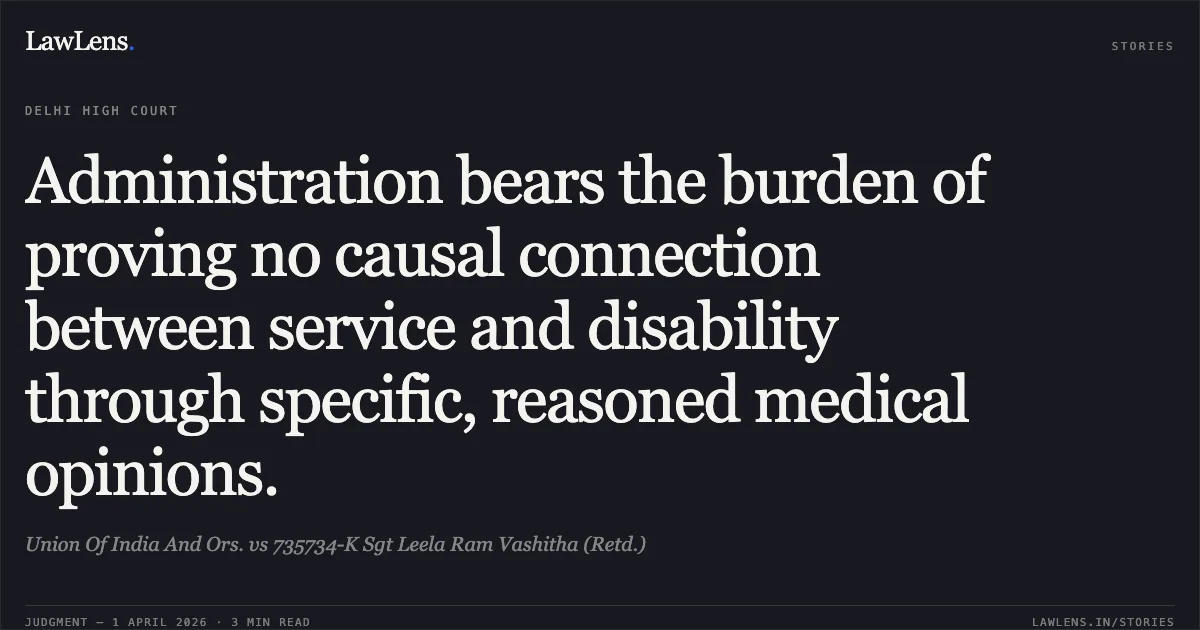
¶ 10It relied on the legal principle established in Union of India v. Ex. Sub Gawas Anil Madso and Union of India v. Col. Balbir Singh (Retd.), which holds that even under the 2008 Rules, the onus remains on the administration—not the officer—to prove the absence of a causal connection between service and disability
¶ 11Furthermore, citing Rajumon T.M. v. Union of India, the court applied the rule that a Medical Board must provide cogent reasons and identify specific causative factors to support a "NANA" opinion; a mere conclusion or bald statement is legally insufficient
¶ 1204Reasoning
The court rejected the Petitioners' argument that the 2008 Rules shifted the burden of proof to the Respondent.
¶ 14-15It noted that the Respondent had served for 23 years before the onset of the disease and that the RMB itself recorded the disability did not exist prior to entry into service and was not due to negligence
¶ 14-15The court observed that the RMB’s sole reason for the NANA classification—"onset at peace station"—has been repeatedly held by coordinate benches as a legally invalid ground for denying pension
¶ 18Following Bijender Singh vs. Union of India, the court emphasized that the Military Establishment failed to fulfill its burden of identifying any non-military cause for the ailment
¶ 12, 19The court also found the Petitioners' delay of over one year in challenging the AFT order, without explanation, to be a gross violation of timely compliance
¶ 2005Holding
The High Court dismissed the writ petition, upholding the AFT's order
¶ 21The court held that the Respondent is entitled to the disability element of pension for Diabetes Mellitus Type-II at 20%, rounded off to 50% for life from the date of discharge
¶ 3The court reaffirmed that under the 2008 Rules, an officer is ordinarily entitled to disability pension unless the administration provides reasoned, cogent evidence of a non-service related cause, which was absent in this case
¶ 11, 19The petition was also dismissed on the grounds of unexplained delay and laches
¶ 20Original Court PDF
Union Of India And Ors.vs735734-K Sgt Leela Ram Vashitha (Retd.)
Click to open original judgment
Original judgment, available to read, download and summarize on LawLens.in