Facts
The applicants, Special Land Acquisition Officers, sought condonation under Section 5 of the Limitation Act, 1963, of a delay of 975 days in filing First Appeals against the common judgment and award dated 10 March 2023 passed by the Special Judge (L.A.Q.), Narmada Yojana and Principal Senior Civil Judge, Ahmedabad (Rural), in several land-acquisition reference cases.
Source reference: paras. 1–2; pp. 2–3The applicants attributed the delay to obtaining the certified copy and legal opinion, inter-departmental correspondence, preparation and consideration of a proposal by departmental authorities and a committee, revised legal opinion, and eventual permission from the Legal Department to file the appeals.
Source reference: para. 5; pp. 4–6The respondent appearing before the Court opposed condonation, contending that the explanation was vague and merely referred to procedural delays without disclosing sufficient cause.
Source reference: paras. 4.1–4.3; pp. 3–4The remaining respondents either did not appear or were not served in the relevant matters.
Source reference: para. 4; p. 3Issues
1. Whether the applicants established “sufficient cause” under Section 5 of the Limitation Act, 1963, for condoning the delay of 975 days in filing the First Appeals.
Source reference: paras. 2–3, 6–10; pp. 2–82. Whether administrative processing, inter-departmental correspondence, procedural requirements, and governmental approvals constituted a legally acceptable explanation for the prolonged delay.
Source reference: paras. 5, 7–10, 14–15; pp. 4–8, 15–163. Whether the accompanying First Appeals could be registered after refusing to condone the delay.
Source reference: paras. 15–18; p. 16Law Applied
The Court applied Section 5 of the Limitation Act, 1963, under which an appeal may be admitted after the prescribed period only if the applicant satisfies the Court that sufficient cause prevented timely filing.
Source reference: para. 6; pp. 6–7The Court held that although “sufficient cause” may receive a liberal construction to advance substantial justice, liberal or justice-oriented principles cannot override the law of limitation, particularly where negligence, inaction, want of bona fides, or lack of due diligence is established.
Source reference: paras. 7–8; pp. 7–8Relying on Pathapati Subba Reddy (Died) by Legal Representatives v. Special Deputy Collector (LA), (2024) 12 SCC 336, the Court reiterated that condonation is discretionary, that inordinate delay and want of due diligence may justify refusal even where some explanation is offered, and that the merits of the proposed appeal are generally irrelevant at the condonation stage.
Source reference: para. 11; pp. 8–10It further relied on State of Odisha v. Managing Committee of Namatara Girls High School, 2026 INSC 148, Union of India v. Jahangir Byramji Jeejeebhoy (D) through LRs., 2024 INSC 262, and Office of the Chief Post Master General v. Living Media India Ltd., (2012) 3 SCC 563, for the principles that limitation binds the Government equally, bureaucratic or procedural delay is not by itself sufficient cause, and condonation cannot be claimed as a matter of right.
Source reference: paras. 12–14; pp. 10–15Reasoning
The Court found that the applicants’ chronology merely recorded departmental communications and approvals and did not demonstrate a legally sufficient impediment to filing the appeals within limitation.
Source reference: paras. 5, 9–10; pp. 4–8The delay of 975 days was considered substantial and remained unexplained in material particulars.
Source reference: paras. 5, 9–10; pp. 4–8The Court observed that the stated administrative steps did not prevent the applicants from instituting the appeals within the prescribed period, and that the pleadings were unsupported by documentary evidence establishing due diligence or bona fide efforts throughout the period of delay.
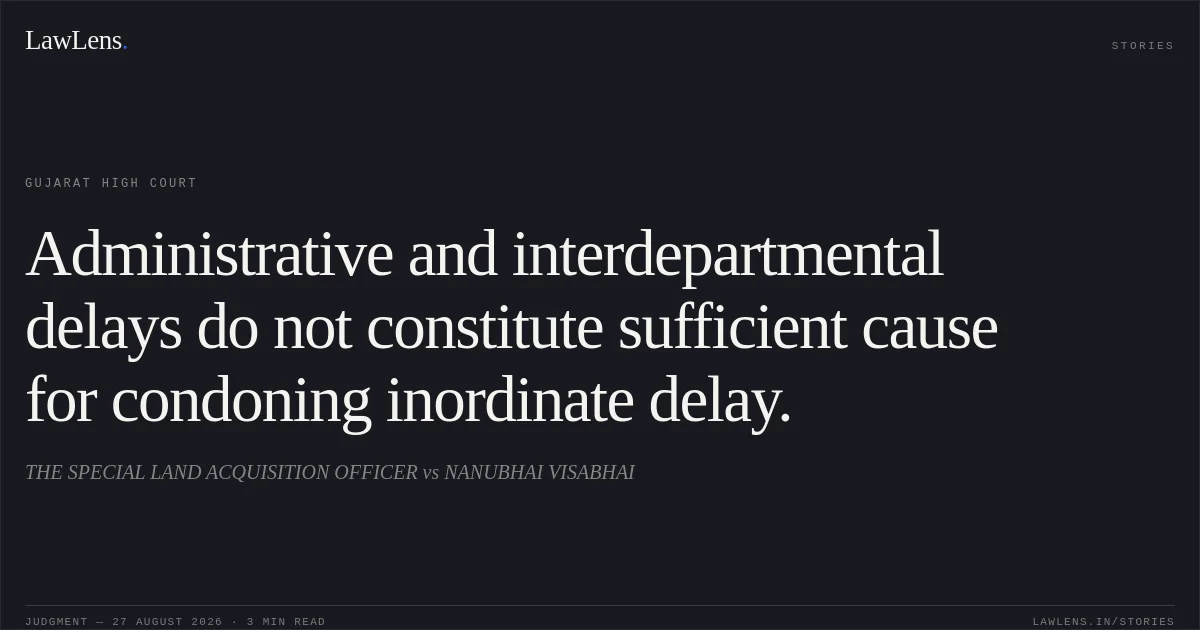
Source reference: para. 9; p. 8Applying the principles that governmental bureaucracy and inter-departmental processing cannot automatically constitute sufficient cause, the Court held that the applicants had failed to discharge the burden under Section 5 of the Limitation Act.
Source reference: paras. 10, 14–15; pp. 8, 15–16Holding
The Court answered the principal issue against the applicants, holding that no cogent or credible explanation sufficient to condone the 975-day delay had been established.
Accordingly, all civil applications for condonation of delay were dismissed, registration of the accompanying First Appeals was refused, and any pending civil applications were disposed of as having become infructuous.
Source reference: paras. 16–18; p. 16Acts & Sections Cited
2 provisions across 1 statute referred to in this judgment. Each provision opens on LawLens.
Original Court PDF
THE SPECIAL LAND ACQUISITION OFFICERvsNANUBHAI VISABHAI
Click to open original judgment
Original judgment, available to read, download and summarize on LawLens.in
![Courts will not interfere with transfers absent mala fides or violation of statutory rules.. M Ramya vs EMPLOYEES STATE INSURANCE CORPORATION (ESIC). CAT - ['Chennai']. LawLens](/stories/thumbnails/courts-will-not-interfere-with-transfers-absent-mala-fides-or-violation-of-statutory-rules-a6845e9ca6f548fca284c51c8351957f.webp)
![Courts cannot direct one-time recruitment age relaxation absent authority in the governing rules or advertisement.. UT OF PUDUCHERRY vs M ANDAL. CAT - ['Chennai']. LawLens](/stories/thumbnails/courts-cannot-direct-one-time-recruitment-age-relaxation-absent-authority-in-the-governing-895d78fde47143e2a8ed0207c4b6a44f.webp)
![A review cannot correct an allegedly erroneous decision absent an error apparent on the record.. Ajit Kumar Jha vs RAILWAY BOARD. CAT - ['Delhi']. LawLens](/stories/thumbnails/a-review-cannot-correct-an-allegedly-erroneous-decision-absent-an-error-apparent-on-the-re-8ac952fd4eba470c92f7da20af72a220.webp)