01Facts
The appellants challenged the judgment and award dated 7 November 2019 in LAC No. 43/2015 by an appeal under Section 74(1) of the Right to Fair Compensation and Transparency in Land Acquisition, Rehabilitation and Resettlement Act, 2013.
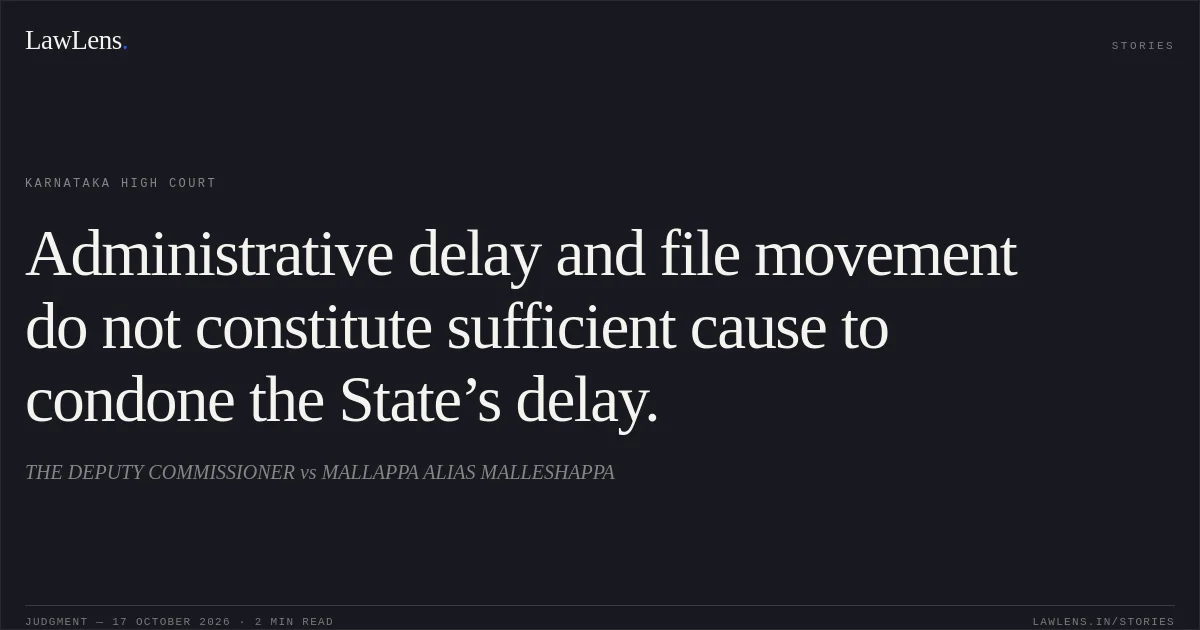
pp. 2–3The appeal was filed on 27 September 2025 with a delay of 1,376 days. In I.A. No. 1/2026, the appellants sought condonation of the delay, relying on an affidavit from an Assistant Executive Engineer that attributed it mainly to administrative processes and movement of files
pp. 2–3, 1302Issues
i.Whether the appellants had shown sufficient cause to condone the 1,376-day delay in filing the appeal
pp. 2–3, 13–14ii.Whether administrative delay and movement of files, without a satisfactory explanation covering the period of delay, justified condonation
pp. 3, 13–1403Law Applied
Section 74(1) of the 2013 Act provides for an appeal; the application to condone delay was assessed under the principles governing limitation and sufficient cause, including Section 5 of the Limitation Act, 1963
pp. 2, 6–7The Court relied on Shivamma v. Karnataka Housing Board, 2025 SCC OnLine SC 1969, for the principles that the State receives no automatic or special indulgence, must provide a bona fide and satisfactory explanation for the delay, and cannot rely on administrative lethargy as sufficient cause
pp. 4–10It also relied on State of Odisha v. Managing Committee of Namatara Girls High School, 2026 SCC OnLine SC 191, which distinguishes an explanation from a mere excuse and confirms that condonation is discretionary, not a matter of right.
pp. 11–12The length of delay is relevant, and limitation must be applied with its statutory rigour.
pp. 6–9Provisions in the judgment · 4 · Linked ones open on LawLens
Right to Fair Compensation and Transparency in Land Acquisition, Rehabilitation and Resettlement Act, 2013 Section 74
Limitation Act, 1963 Section 3Section 5
Code of Civil Procedure, 1908 Section 100
04Reasoning
The affidavit did not provide relevant dates or explain what prevented the appellants from filing the appeal within the prescribed period. Its general references to file movement and administrative approvals neither established bona fide diligence nor accounted for the entire delay
pp. 3, 13–14Applying the cited principles, the Court held that these assertions were an excuse rather than a reasonable and satisfactory explanation; the appellants, as public authorities, were not entitled to special treatment. The Court did not assess the merits of the appeal.
pp. 9–1405Holding
The Court answered the issues against the appellants, holding that no sufficient cause had been shown to condone the delay.
p. 14It dismissed I.A. No. 1/2026 and, consequently, dismissed the appeal; pending interlocutory applications, if any, were also disposed of
p. 14Original Court PDF
THE DEPUTY COMMISSIONERvsMALLAPPA ALIAS MALLESHAPPA
Click to open original judgment
Original judgment, available to read, download and summarize on LawLens.in