Facts
The Appellants (State of Chhattisgarh) filed a writ appeal challenging the order dated 07.08.2024 passed by a learned Single Judge in WPC No. 1739 of 2013.
Source reference: para. 2The appeal was filed with a delay of 386 days beyond the prescribed period of limitation.
Source reference: para. 1, 4The State attributed this delay to administrative procedures, the necessity of obtaining sanctions from multiple levels of approval, and general departmental formalities inherent in State machinery.
Source reference: para. 3, 4The Appellants contended they possessed a strong case on merits and that the delay was bona fide.
Source reference: para. 3, 4Issues
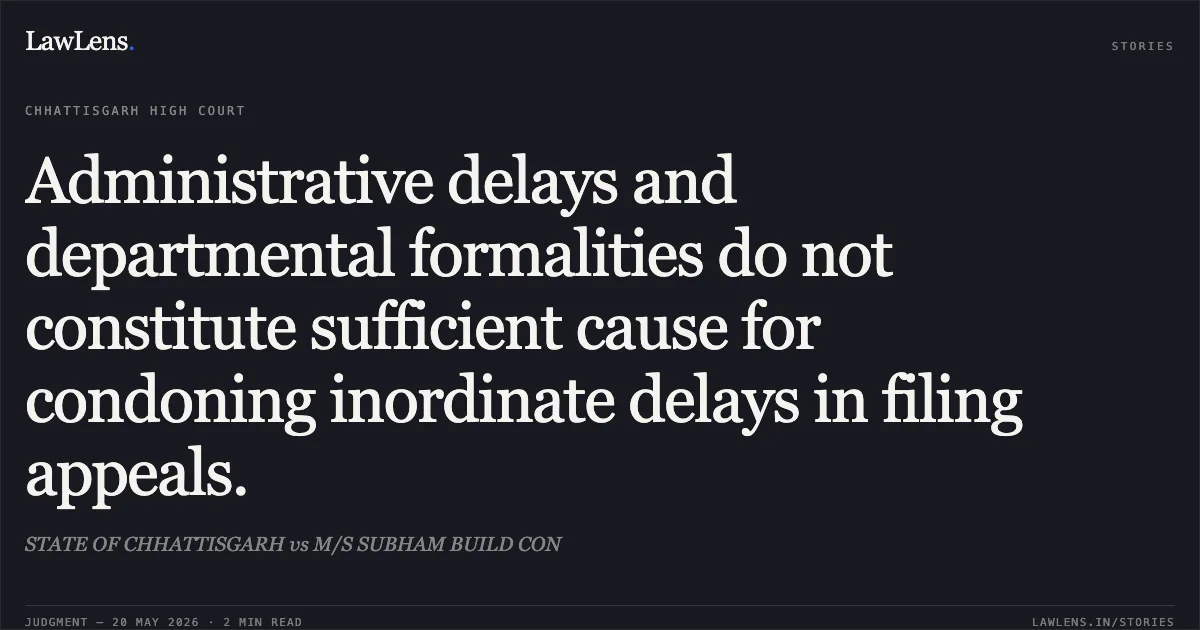
Whether the administrative delays and departmental formalities of the State constitute "sufficient cause" for condoning an inordinate delay of 386 days under the Limitation Act.
Source reference: para. 5, 9Whether the provisions of Section 5 of the Limitation Act, 1908 (or the corresponding extant law) would apply to the application for condonation of delay in this specific context.
Source reference: para. 6Law Applied
While the State may require some latitude due to administrative complexities (State of Haryana v. Chandra Mani, 1996), such latitude is not absolute and does not exempt the State from explaining inordinate delays with cogent reasons.
Source reference: para. 4, 5, 9The Court further applied the doctrine of laches and limitation as summarized in Union of India v. Tarsem Singh (2008), which establishes that belated claims are normally rejected unless they involve a "continuing wrong".
Source reference: para. 7The Court cited C. Jacob v. Director of Geology and Mining (2008) to reiterate that stale or dead claims cannot be revived through representations or subsequent orders if the party has been negligent or stayed silent for a long duration.
Source reference: para. 8Reasoning
The Court scrutinized the Appellants' justification for the 386-day delay and found it lacking in specificity. While the Appellants vaguely cited "departmental formalities" and "administrative procedures," they failed to provide a "plausible explanation" or "cogent reason" for the specific timeframe of the delay when queried by the Bench.
Source reference: para. 5The Court reasoned that the State’s status as a "multi-functioning body" does not grant it an indefinite license to bypass limitation periods. Applying the principles from Tarsem Singh and C. Jacob, the Court determined that the Appellants failed to demonstrate "sufficient cause" because the explanation provided did not satisfactorily account for the inordinate lapse of time, rendering the excuse insufficient to trigger the Court's discretionary power of condonation.
Source reference: para. 3, 9Holding
The Court held that the delay of 386 days was not satisfactorily explained and the Appellants failed to justify the exercise of judicial discretion in their favor.
The application for condonation of delay was rejected, and as a result, the writ appeal was dismissed as barred by limitation.
Source reference: para. 10Acts & Sections Cited
1 provisions across 1 statute referred to in this judgment. Linked provisions open on LawLens.
Limitation Act, 19081
Original Court PDF
STATE OF CHHATTISGARHvsM/S SUBHAM BUILD CON
Click to open original judgment
Original judgment, available to read, download and summarize on LawLens.in


