Facts
Several writ petitions were filed by educational institutions and staff (teaching and non-teaching) challenging various orders passed by the Education Department regarding approvals, transfers, and service benefits.
Source reference: p. 1-10The State Government had issued a Government Resolution (GR) dated 27-03-2024, constituting a Grievance Redressal Committee/Appellate Authority to handle such "petty matters" to reduce the burden on the High Court.
Source reference: p. 11-12The petitioners approached the High Court directly, noting that a coordinate Division Bench in Shri Agrasen Shikshan Sanstha v. State of Maharashtra (2024) had recently referred the question of the GR's constitutional validity to a Larger Bench, doubting whether such a forum could be created via executive power under Article 162.
Source reference: p. 12-13, 21Issues
1. Whether the High Court should decide matters based on existing law or await the outcome of a reference to a Larger Bench regarding the validity of the Grievance Redressal Committee.
Source reference: p. 132. Whether the State Government has the competence under Article 162 of the Constitution to constitute an executive Grievance Redressal mechanism for matters not covered under Section 9 of the MEPS Act.
Source reference: p. 12, 17, 23Law Applied
The Court primarily relied on the Supreme Court's ruling in Union Territory of Ladakh v. Jammu and Kashmir National Conference, which mandates that High Courts must decide matters based on the law as it stands, even if a reference to a larger bench is pending.
Source reference: p. 13Article 162 of the Constitution of India, which grants the State executive power over matters within its legislative competence, provided such actions do not conflict with existing statutes.
Source reference: p. 23-24The court followed principles from Ram Jawaya Kapur v. State of Punjab and Bishambhar Dayal Chandra Mohan v. State of Uttar Pradesh, establishing that the executive can issue administrative instructions to carry on general administration in the absence of specific legislation.
Source reference: p. 23-24The court also considered the MEPS Act, 1977 and Rules, 1981, specifically noting Section 9 (Appeals to School Tribunal) and Rule 41A (transfers).
Source reference: p. 21, 25-26Reasoning
The Court reasoned that until the Larger Bench decides otherwise, the validity of the GR dated 27-03-2024 remains upheld as per the Division Bench judgment in Komal v. State of Maharashtra.
Source reference: p. 13, 16The Court observed that the Grievance Committee is not a quasi-judicial body or a "Court" created under Articles 223-A/B, but rather an executive forum designed to ensure "fair play" and the effective implementation of settled law by the Education Department.
Source reference: p. 20The Court found that many petitions arise because officials ignore judicial precedents, leading to "unwarranted litigation".
Source reference: p. 19By applying Union Territory of Ladakh, the Court concluded it must relegate petitioners to the existing GR-mandated mechanism rather than keeping the petitions pending for the reference.
Source reference: p. 16-17To improve the mechanism, the Court identified a gap regarding approvals by the Commissioner of Education and suggested a State-level committee.
Source reference: p. 26Holding
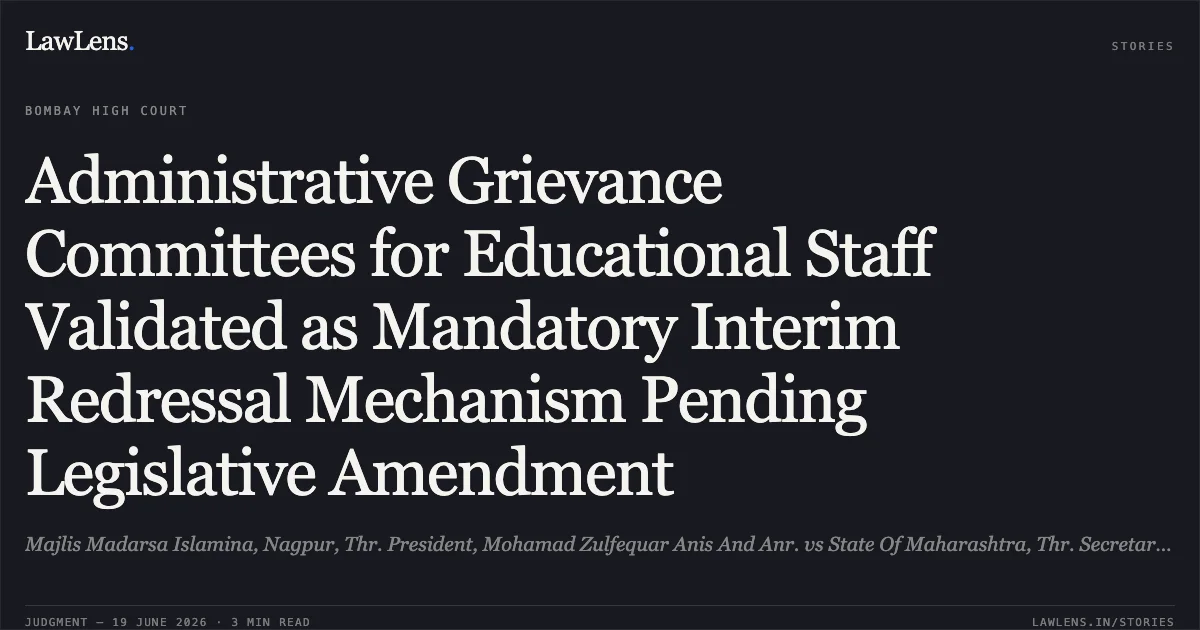
The Court disposed of the petitions, directing the petitioners to approach the Grievance Redressal Committee within six weeks.
The Court held that the GR mechanism shall operate as "directions/guidelines issued by this Court" pending statutory formalization.
Source reference: p. 26The State was directed to: (i) constitute a State-level Grievance Committee headed by the Secretary of Education for higher-level disputes [p. 27]; (ii) consider incorporating the mechanism into the MEPS Act or amending Section 9 [p. 25-26]; and (iii) ensure the Committee examines official delays under the Maharashtra Government Servants Regulation of Transfer and Prevention of Delay in Discharge of Official Duties Act, 2005.
Source reference: p. 27The Court also deprecated the conduct of counsel for shifting stances on the GR's validity.
Source reference: p. 18Acts & Sections Cited
2 provisions across 2 statutes referred to in this judgment. Each provision opens on LawLens.
Maharashtra Employees of Private Schools (Conditions of Service) Regulation Act, 1977.1
Maharashtra Government Servants Regulation of Transfers and Prevention of Delay in Discharge of Official Duties Act, 2005.1
Original Court PDF
Majlis Madarsa Islamina, Nagpur, Thr. President, Mohamad Zulfequar Anis And Anr.vsState Of Maharashtra, Thr. Secretary, Dept. Of School Education And Sports, Mumbai And Ors.
Click to open original judgment
Original judgment, available to read, download and summarize on LawLens.in