01Facts
The Municipal Corporation of Greater Mumbai (MCGM) filed a group of 26 civil applications seeking to condone delays in filing first appeals ranging from approximately one year to nine years
¶ 1The lead matter, Civil Application No. 3057 of 2018, sought to challenge an order dated 12 October 2009 by the City Civil Court, which had quashed a demolition notice issued under Section 351 of the Mumbai Municipal Corporation Act, 1888
¶ 2Although Section 15 of the Bombay City Civil Court Act, 1948, prescribes a 30-day limitation period, the appeal was filed on 29 June 2018, resulting in a delay of 8 years and 230 days
¶ 3The MCGM argued that the delay occurred because concerned officers failed to report the progress of the matters or the adverse judgments.
¶ 5The Corporation claimed it only realized these lapses during an internal investigation triggered by the 2017 Kamala Mills fire mishap
¶ 502Issues
i.1. Whether internal administrative negligence and the failure of officers to report case progress constitute "sufficient cause" for condoning a delay of over eight years
¶ 8ii.2. Whether a subsequent event in an unrelated matter (the Kamala Mills fire) justifies the reopening of litigation where the limitation period has long expired
¶ 8, 1103Law Applied
The court applied the "sufficient cause" standard for condonation of delay, primarily governed by the principles of the Limitation Act and Section 15 of the Bombay City Civil Court Act, 1948
¶ 3, 8It relied on the precedent established in Delhi Development Authority v. Tejpal and Others (2024) 7 SCC 433, which holds that subsequent events or changes in law do not automatically entitle a litigant to challenge orders after the expiry of limitation
¶ 11The court also emphasized the doctrine of finality of litigation, asserting that internal departmental lapses do not grant an indefinite right to appeal against a party who has succeeded in court
¶ 8Provisions in the judgment · 2 · Linked ones open on LawLens
Mumbai Municipal Corporation Act. Section 351
Bombay City Civil Court Act, 1948. Section 15
04Reasoning
The court rejected the MCGM’s contention that officer inaction discovered after a subsequent disaster (Kamala Mills) constitutes "sufficient cause."
¶ 8It noted that internal mismanagement is an administrative issue that does not suspend the statutory limitation period
¶ 8Justice Jain characterized the Corporation’s disciplinary actions against officers as a "show-off" to gain judicial sympathy rather than a genuine systemic correction
¶ 6, 9The court highlighted that a subsequent event in a different matter cannot be used as a tool to bypass the law of limitation, especially when no collusion between the parties was alleged
¶ 8, 11It criticized the MCGM for lacking an "inbuilt system" to monitor litigation and held that superiors are equally responsible for the dereliction of duty
¶ 10The court concluded that allowing such condonation would unfairly leave a "sword of litigation" hanging over respondents for an indefinite period
¶ 805Holding
The court dismissed all 26 civil applications for condonation of delay, and consequently dismissed the associated first appeals
¶ 14, 17The court held that administrative negligence and unrelated subsequent events do not constitute "sufficient cause" for extreme delays
¶ 10, 11However, to balance equity and public safety, the court granted MCGM liberty to conduct fresh inspections and initiate de novo actions against any current illegalities in accordance with the law, noting that the 2009 order would not bar new proceedings
¶ 13The Corporation was directed to file a report by 12 August 2026, detailing the final actions taken against delinquent officers and their superiors
¶ 15, 22Original Court PDF
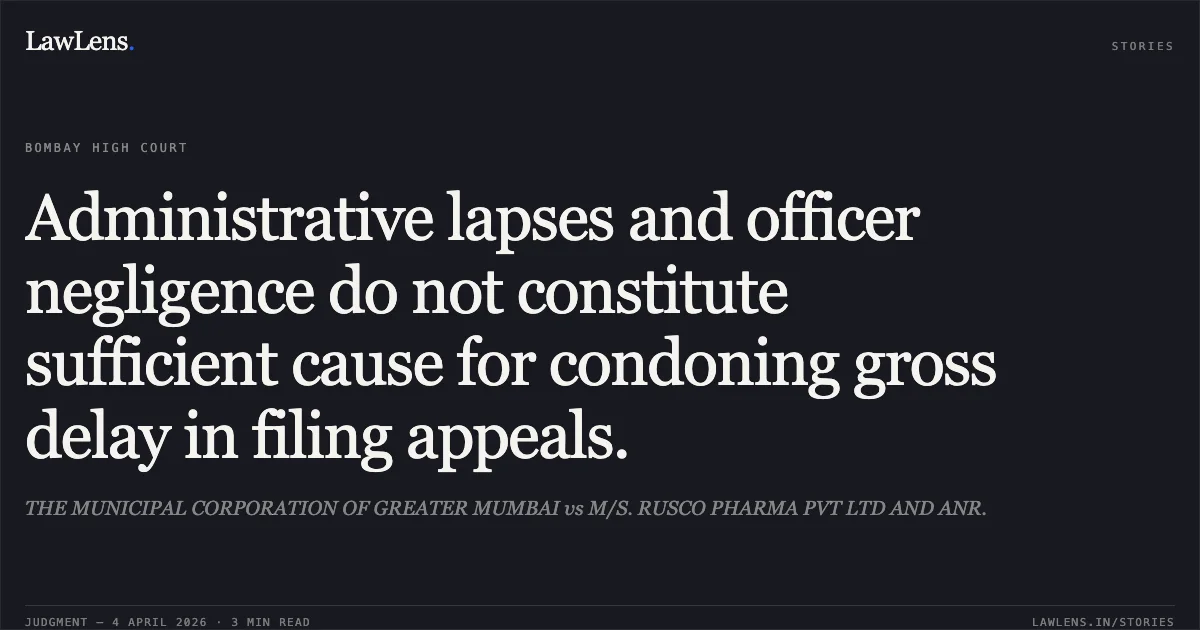
THE MUNICIPAL CORPORATION OF GREATER MUMBAIvsM/S. RUSCO PHARMA PVT LTD AND ANR.
Click to open original judgment
Original judgment, available to read, download and summarize on LawLens.in