Facts
The petitioners instituted RCS No. 30-A/2016 before the First Civil Judge, Class-II, Badnawar, seeking declaration and permanent injunction concerning Survey No. 420, admeasuring 0.089 hectare, situated at Village Kod, Tehsil Badnawar, District Dhar.
Source reference: para. 3The suit was decreed on 18.01.2017 in the petitioners’ favour, declaring their entitlement to mutation of their names in place of Shri Krishna Mandir through its Manager/Collector and granting permanent injunction.
Source reference: para. 3Although the respondents were represented through counsel when the decree was passed, they filed a first appeal under Section 96 CPC only on 17.03.2023, accompanied by an application under Section 5 of the Limitation Act seeking condonation of a delay of approximately six years and two months.
Source reference: paras. 4–5The respondents asserted that they acquired knowledge of the decree upon receiving notice of execution proceedings on 16.03.2022, obtained a certified copy on 25.11.2022, and thereafter obtained the Collector’s permission to file the appeal.
Source reference: paras. 5, 8 and 10The District Judge, by order dated 02.08.2024 in RCA No. 12/2024, condoned the delay and proceeded with the appeal. The petitioners challenged that order under Section 115 CPC.
Source reference: paras. 1 and 4Issues
Whether the respondents established “sufficient cause” under Section 5 of the Limitation Act for condoning the delay of approximately six years and two months in filing the first appeal?
Source reference: paras. 4–6, 10Whether the First Appellate Court erred in condoning the delay mechanically, without adequately examining the respondents’ explanation for the entire period of delay?
Source reference: paras. 6, 9–11Whether the fact that the appellants were State authorities and that government land was involved justified a more liberal approach to condonation of delay?
Source reference: paras. 6, 8 and 10Law Applied
The Court exercised revisional jurisdiction under Section 115 of the Code of Civil Procedure, 1908, in relation to the order condoning delay in a first appeal filed under Section 96 CPC.
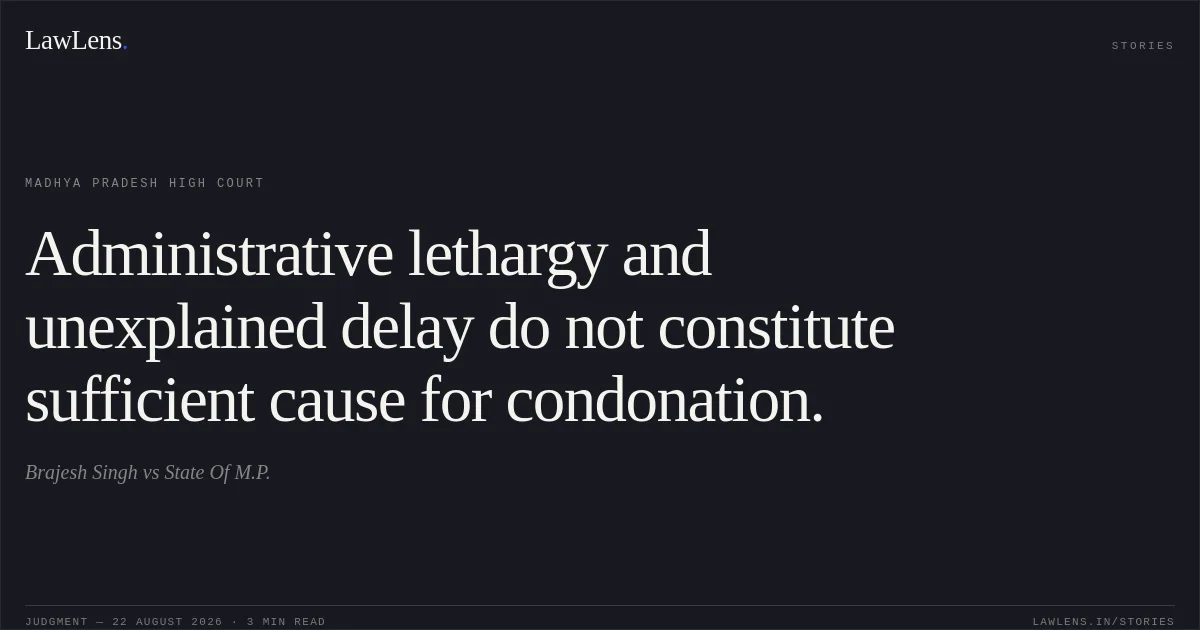
Source reference: para. 1Under Section 5 of the Limitation Act, 1963, delay may be condoned only when the applicant demonstrates sufficient cause; administrative lethargy, negligence, unexplained inaction, or a general plea of bureaucratic delay does not constitute sufficient cause.
Source reference: para. 6Relying on Shivamma (Dead) by LRs v. Karnataka Housing Board and Others, 2025 SCC OnLine SC 1969, the Court held that the State and its instrumentalities are not entitled to preferential treatment in limitation matters and must satisfy the same standard as private litigants.
Source reference: para. 6The Court also applied the principles that the length of delay is relevant, the entire period of delay must be satisfactorily explained, and courts must first examine the bona fides and sufficiency of the explanation rather than the merits of the proposed appeal.
Source reference: para. 6The decision further relied on the principles reiterated in State of Madhya Pradesh v. Bherulal, (2020) 10 SCC 654, that government authorities cannot disregard limitation and seek condonation merely because the case may have merit or involves government property.
Source reference: para. 6Reasoning
The Court found that the decree dated 18.01.2017 was passed in the presence of the respondents’ counsel, making the plea of complete lack of knowledge unacceptable.
Source reference: para. 10Even assuming that the concerned authorities became aware of the decree only upon receiving execution notice on 16.03.2022, the respondents failed to explain why they waited until 25.11.2022 to apply for the certified copy and why the appeal was filed only on 17.03.2023 after obtaining the copy.
Source reference: paras. 5 and 10The application under Section 5 did not account for the period from 18.01.2017 to 25.11.2022, or adequately explain the further delay between receipt of the execution notice and filing of the appeal.
Source reference: para. 10The requirement of obtaining departmental permission from the Collector could not, by itself, justify the unexplained delay.
Source reference: no citationApplying Shivamma, the Court held that the State’s status and the alleged involvement of government land did not relax the statutory limitation requirement.
Source reference: no citationThe First Appellate Court therefore acted erroneously in condoning the delay without recording a satisfactory finding of sufficient cause.
Source reference: paras. 6, 9–11Holding
The Court answered the issues against the respondents.
It held that the respondents had failed to establish sufficient cause under Section 5 of the Limitation Act for the six-year delay and that the First Appellate Court had mechanically condoned the delay.
Source reference: paras. 10–11The civil revision was allowed; the order dated 02.08.2024 was set aside; the application for condonation of delay was dismissed; and, consequently, First Appeal RCA No. 12/2024, State of M.P. through Collector, Dhar and Others v. Brajesh Singh and Another, was also dismissed.
Source reference: para. 11Acts & Sections Cited
4 provisions across 2 statutes referred to in this judgment. Each provision opens on LawLens.
Code of Civil Procedure, 19083
Limitation Act, 19631
Original Court PDF
Brajesh SinghvsState Of M.P.
Click to open original judgment
Original judgment, available to read, download and summarize on LawLens.in