Facts
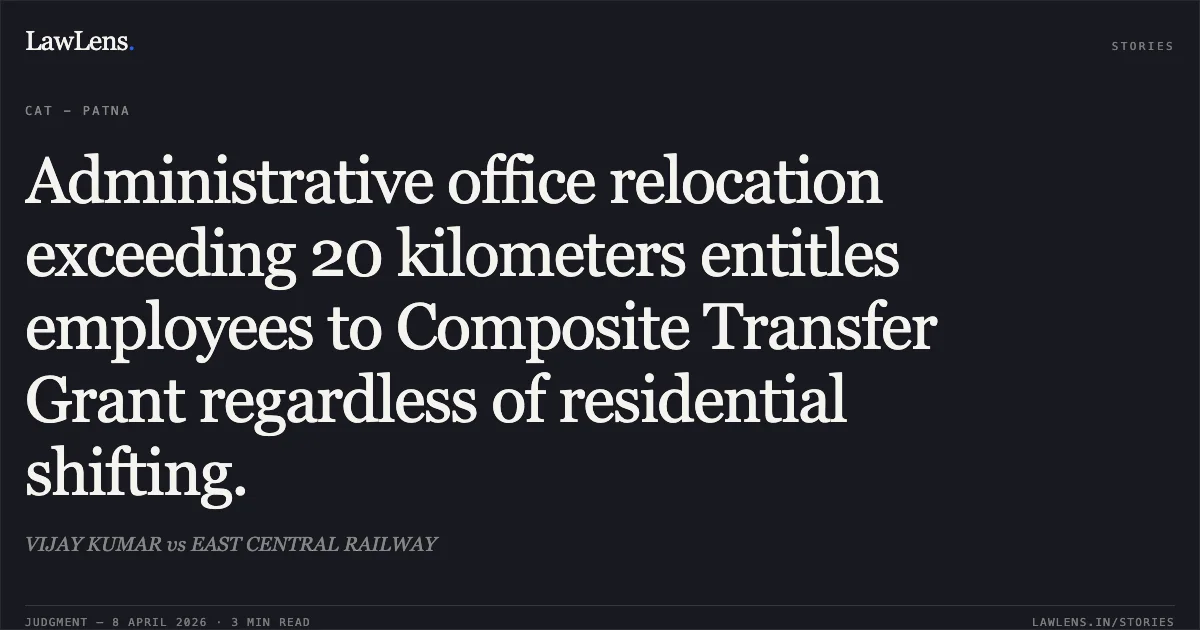
The twelve applicants were employees of the Accounts Department (Traffic) of the East Central Railway (ECR), functioning from a rented premises at Biscomaun Tower, Patna.
Source reference: p. 3-4On July 7, 2017, the entire office was relocated to a newly constructed building within the General Manager’s office campus at Hajipur
Source reference: p. 3-4Following this relocation, the applicants submitted representations for the grant of a Composite Transfer Grant (CTG).
Source reference: no citationThe respondents refused the claims, arguing that the collective shifting of an office did not constitute an individual transfer on administrative grounds and that the applicants had not changed their residences
Source reference: p. 4, 6Internal records revealed that while the applicants' claims were referred to the Railway Board for clarification in 2020, employees of the Audit Department—who were shifted from the same building to Hajipur—had already been paid the CTG
Source reference: p. 5, 7The applicants challenged the prolonged administrative delay and the denial of benefits.
Source reference: no citationIssues
1. Whether the relocation of an entire office establishment from Patna to Hajipur entitles the relocated employees to a Composite Transfer Grant (CTG)
Source reference: p. 9, para. 22. Whether the requirement of a change of residence can be rigidly applied to deny CTG when employees are compelled to work at a different station involving a distance of more than 20 kilometers
Source reference: p. 9, para. 43. Whether the denial of CTG to Accounts Department employees while granting it to Audit Department employees shifted under identical circumstances constitutes arbitrary discrimination
Source reference: p. 10, para. 5Law Applied
The Tribunal primarily applied Rule 1643(D) of the Indian Railway Establishment Code (IREC) and the Railway Board’s letter dated 24.08.2017, which delineate the conditions for the admissibility of the Composite Transfer Grant
Source reference: p. 4, 6The Tribunal also applied the principle that "hyper-technical" interpretations of administrative rules should not be used to defeat the spirit of the rules, particularly regarding the distance criteria for transfers
Source reference: p. 9Furthermore, it relied on the principle of parity and non-discrimination in administrative actions to ensure consistent application of rules across different departments under similar factual circumstances
Source reference: p. 10Reasoning
The Tribunal found the respondents' interpretation—that CTG requires individual transfer orders and a mandatory change of residence—to be "too narrow and hyper-technical" given that the entire office establishment was relocated
Source reference: p. 9It noted that the applicants were compelled to perform duties at a new station (Hajipur) involving increased travel distance, which satisfies the "essence of transfer"
Source reference: p. 9The Tribunal highlighted that the respondents' own internal office notings (Nos. 93 and 96) admitted the claims were technically in order and that denying them would defeat the spirit of the rules
Source reference: p. 5, 9Addressing the residence issue, the Tribunal held that a rigid insistence on shifting residence is unjustified when the relocation is an administrative consequence rather than a choice
Source reference: p. 9Finally, the Tribunal ruled that the inconsistency in paying CTG to Audit staff while denying it to Accounts staff was arbitrary and unsustainable in law
Source reference: p. 10Holding
The Tribunal held that the applicants are legally entitled to the Composite Transfer Grant (CTG).
It found the prolonged delay since 2020 in finalizing the claim to be unjustified
Source reference: p. 10The O.A. was allowed, and the respondents were directed to consider and release the admissible CTG to the applicants in accordance with the rules within three months from the date of receipt of the order
Source reference: p. 10No order as to costs was made
Source reference: p. 10Acts & Sections Cited
2 provisions across 1 statute referred to in this judgment. Each provision opens on LawLens.
Indian Penal Code, 18602
Original Court PDF
VIJAY KUMARvsEAST CENTRAL RAILWAY
Click to open original judgment
Original judgment, available to read, download and summarize on LawLens.in