Facts
The Respondent, a registered contractor with the Municipal Corporation of Delhi (MCD), executed civil works for the improvement and development of lanes under four work orders issued between 2019 and 2020
Source reference: p. 2Although the works were completed, the MCD withheld payments regarding running account bills, final bills, security deposits, and earnest money
Source reference: p. 3The Respondent filed a commercial suit for recovery of ₹9,33,105/-, which the Commercial Court partly decreed in his favor, awarding principal amounts plus 9% interest
Source reference: p. 4-5The MCD appealed, contending that the contractor failed to submit final bills in the prescribed format, that payments were subject to a "queue system" based on fund availability, and that interest was contractually barred
Source reference: p. 5-7Issues
1. Whether the suit was barred by limitation given that the works and certain deductions occurred in 2020-2021
Source reference: p. 4, para. 62. Whether the non-submission of final bills in the prescribed departmental format absolves the MCD of its liability to pay for executed works
Source reference: p. 5, para. 103. Whether the "Queue System" and contractual clauses barring interest prevent the court from awarding interest on delayed payments
Source reference: p. 6, para. 134. Whether the MCD could rightfully withhold security deposits in the absence of labor complaints or structural defects
Source reference: p. 7, para. 15Law Applied
The Court applied Clauses 7, 9, 17, and 45 of the General Conditions of Contract (GCC), noting that Clause 45 contains a "deeming provision" for labor clearances if no complaints are received within six months
Source reference: p. 14, para. 33It relied on the precedent Municipal Corporation of Delhi v. M/s Ram Niwas Goel [2026:DHC:177-DB], which established that a public body cannot escape debt once engineering divisions certify work execution
Source reference: p. 11, para. 27Regarding interest, the Court applied Section 34 of the Code of Civil Procedure, 1908, and the principle from North Delhi Municipal Corporation v. Sanjeev Oberoi, holding that statutory power to award interest overrides generic contractual bars when payments are unconscionably delayed
Source reference: p. 14, para. 36The Court also applied the Supreme Court's In Re: Cognizance for Extension of Limitation regarding pandemic-era timelines
Source reference: p. 13, para. 30Reasoning
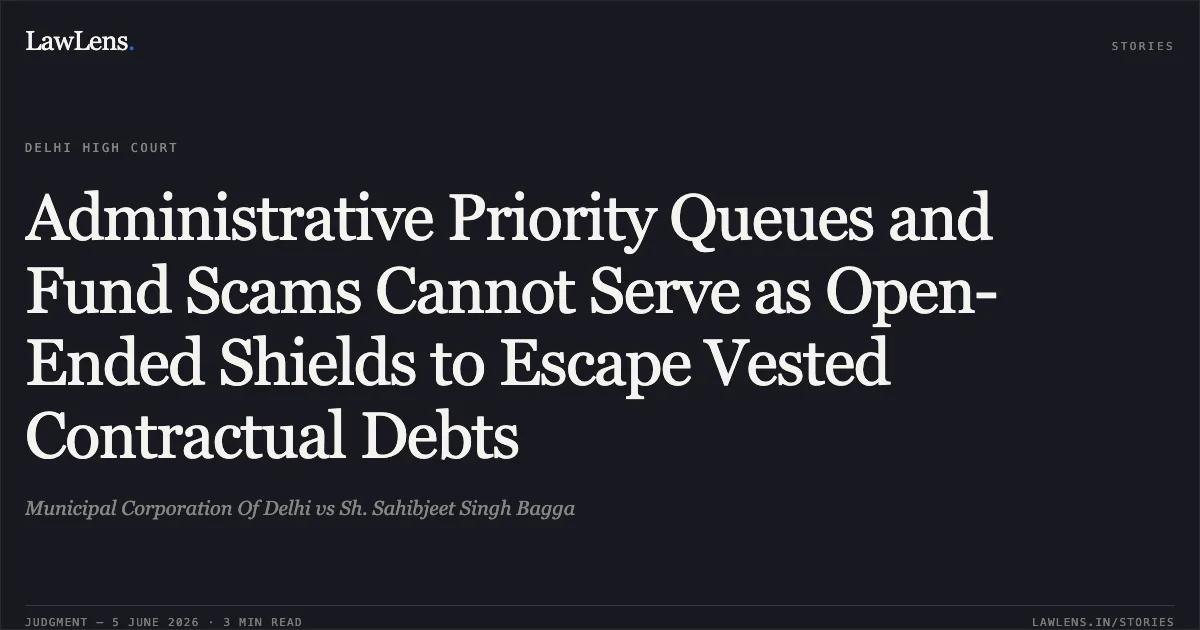
The Court rejected the MCD’s reliance on the "Queue System," ruling that an administrative priority list cannot be used as an open-ended license to block a contractor’s working capital for over five years
Source reference: p. 10, para. 25It found that the MCD’s own internal records (Ex.-DW1/13) verified and passed the amounts due; thus, the objection regarding the "format" of the final bills was a "hyper-technicality"
Source reference: p. 12, para. 29On security deposits, the Court noted that since the MCD admitted there were no labor disputes or defects, Clause 45 mandated the "deemed" release of funds
Source reference: p. 14, para. 34Regarding the "Accord and Satisfaction" defense, the Court held that accepting partial payments without a formal "No Dues Certificate" does not constitute a waiver, especially when the contractor is under economic duress
Source reference: p. 13, para. 31-32The Court affirmed the 9% interest rate as a proper exercise of judicial discretion to compensate for the loss of liquidity caused by the MCD
Source reference: p. 14-15, para. 36Holding
The High Court dismissed the appeal and affirmed the Trial Court’s judgment and decree in its entirety
The Court held that the Respondent was entitled to the recovery of ₹4,95,618/- for withheld bills and ₹1,88,711/- for security deposits, along with 9% per annum interest
Source reference: p. 4-5, para. 8The Appellant (MCD) was directed to clear all outstanding decretal amounts within eight weeks
Source reference: p. 15, para. 40Acts & Sections Cited
3 provisions across 3 statutes referred to in this judgment. Each provision opens on LawLens.
Commercial Courts Act, 20151
Code of Civil Procedure, 19081
Indian Contract Act, 18721
Original Court PDF
Municipal Corporation Of DelhivsSh. Sahibjeet Singh Bagga
Click to open original judgment
Original judgment, available to read, download and summarize on LawLens.in