Facts
The Appellants (Union of India and CRPF authorities) filed a writ appeal against a judgment dated 29.10.2025.
Source reference: para. 7Accompanying the appeal was I.A. No. 02/2026, an application seeking condonation of a 128-day delay in filing the appeal.
Source reference: para. 1The Appellants contended the delay was due to administrative hurdles, including obtaining records, securing departmental approvals, and seeking legal opinions.
Source reference: para. 2The Respondent opposed the application, arguing a lack of "sufficient cause".
Source reference: para. 3Issues
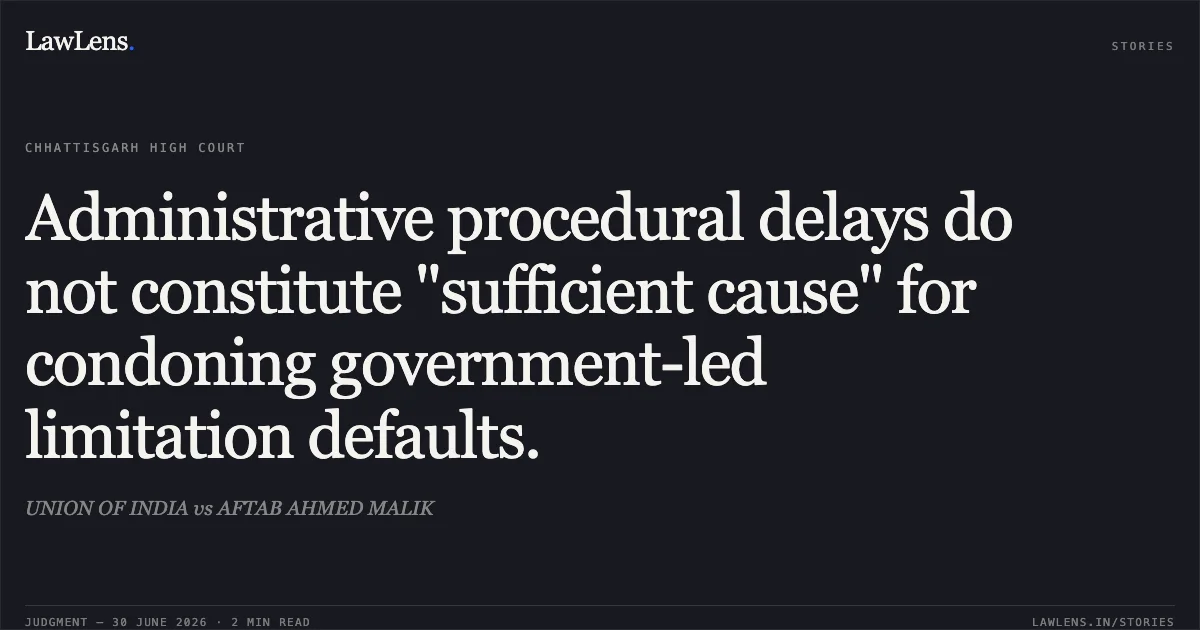
Whether the administrative and bureaucratic delays cited by the Government constitute "sufficient cause" for condoning a 128-day delay under the law of limitation.
Source reference: para. 7-8Law Applied
Section 2(1) of the Chhattisgarh High Court (Appeal to Division Bench) Act, 2006, which prescribes a 45-day limitation period for filing appeals.
Source reference: para. 7Postmaster General v. Living Media India Ltd. (2012), which established that government departments cannot claim a separate period of limitation or cite bureaucratic "red-tape" as a valid excuse for negligence.
Source reference: para. 4State of Madhya Pradesh v. Ramkumar Choudhary (2024), which held that "sufficient cause" must be established by events occurring within the limitation period and that condonation is an exception, not an anticipated benefit for the State.
Source reference: para. 5Reasoning
The Court observed that the Appellants failed to provide a day-to-day explanation for the 128-day delay beyond the statutory 45-day limit.
Source reference: para. 7It reasoned that the reasons provided—routine administrative procedures and seeking legal opinions—were "general in nature" and did not meet the threshold of "sufficient cause".
Source reference: para. 7-8The Court emphasized that the Union of India possesses a structured legal framework and is expected to act with greater diligence.
Source reference: para. 9Following Supreme Court precedents, the Court held that the law of limitation binds the State equally to private litigants, and bureaucratic methodology cannot be used to bypass statutory rigors unless exceptional circumstances are proven.
Source reference: para. 6, 8Holding
The Court answered the issue in the negative, finding no satisfactory explanation for the prolonged delay.
The Court rejected I.A. No. 02/2026 for condonation of delay and, consequently, dismissed the writ appeal as barred by limitation and laches.
Source reference: para. 10Acts & Sections Cited
1 provisions across 1 statute referred to in this judgment. Linked provisions open on LawLens.
Chhattisgarh High Court (Appeal to Division Bench) Act, 20061
Original Court PDF
UNION OF INDIAvsAFTAB AHMED MALIK
Click to open original judgment
Original judgment, available to read, download and summarize on LawLens.in