Facts
The respondent was allotted a residential plot in Faridabad in 2016.
Source reference: p. 1After the petitioner allegedly failed to provide its PAN details for TDS purposes and did not deliver possession within the stipulated period, the respondent filed a consumer complaint.
Source reference: p. 1; p. 2, para. 3The State Commission allowed the complaint on 27 September 2023 and directed the petitioner to deliver possession upon receipt of pending instalments.
Source reference: p. 1; p. 2, para. 3The petitioner filed an appeal before the National Consumer Disputes Redressal Commission (NCDRC) on 18 May 2026, 934 days after the State Commission’s order.
Source reference: p. 2, para. 4The NCDRC dismissed the appeal as time-barred, finding the explanation based on internal approval processes unsatisfactory.
Source reference: p. 2, para. 4The petitioner challenged that dismissal under Article 226, arguing before the High Court that the delay was attributable to its previous counsel.
Source reference: p. 2, para. 7; p. 3, para. 12Issues
1. Whether the NCDRC erred in refusing to condone the 934-day delay in filing the appeal against the State Commission’s order
Source reference: pp. 2–3, paras. 4, 8–92. Whether the petitioner’s explanations—internal approval processes and alleged failure by previous counsel to communicate the outcome of the complaint—justified High Court interference under Article 226
Source reference: pp. 3–4, paras. 10–15Law Applied
Under the Consumer Protection Act, 2019, an appeal from a State Commission order must be filed within 30 days.
Source reference: p. 3, para. 8In Postmaster General v. Living Media India Ltd., (2012) 3 SCC 563, the Supreme Court held that government departments are not entitled to a separate limitation standard; administrative procedures and bureaucratic delays do not, without a satisfactory explanation, justify condonation of delay.
Source reference: p. 3, para. 10In Anshul Aggarwal v. NOIDA, (2011) 14 SCC 578, the Supreme Court emphasised that entertaining belated appeals in consumer matters would frustrate the statutory objective of speedy dispute resolution.
Source reference: p. 4, para. 14The High Court’s jurisdiction under Article 226 does not warrant interference absent sufficient grounds.
Source reference: p. 4, para. 15Reasoning
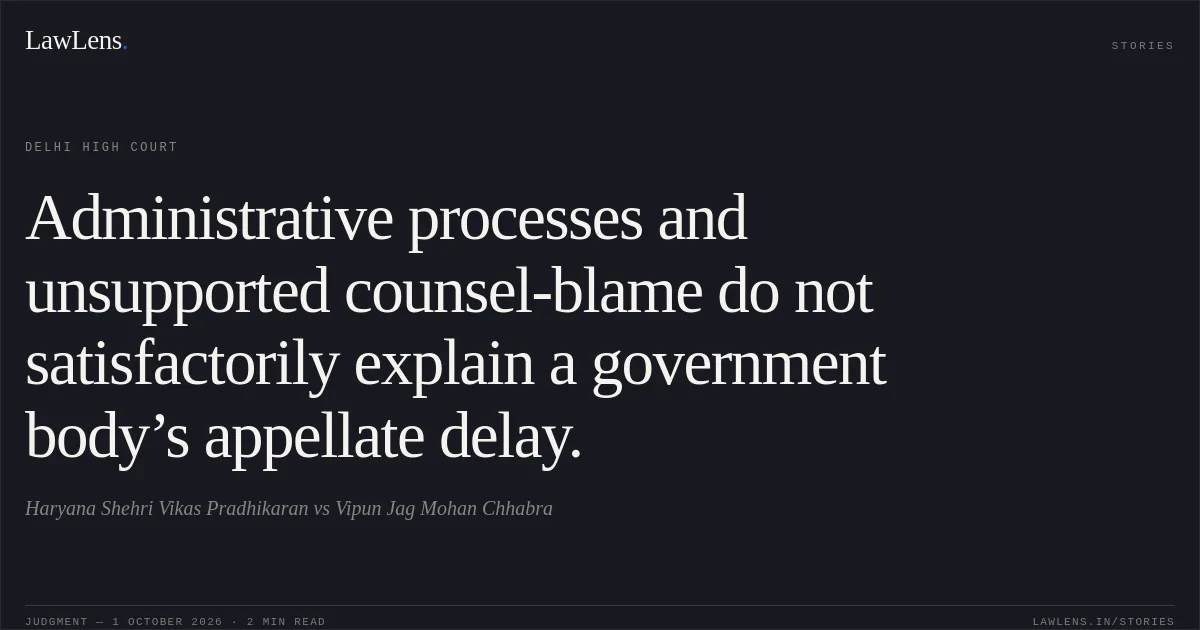
The appeal was filed 934 days after the State Commission’s order, far beyond the 30-day statutory period.
Source reference: p. 3, paras. 8–9Before the NCDRC, the petitioner attributed the delay to the time taken to obtain approvals at different administrative levels; the High Court held that this did not satisfactorily explain the delay, consistently with Living Media.
Source reference: pp. 2–3, paras. 4, 9–11The later allegation that previous counsel failed to communicate the complaint’s outcome did not persuade the Court: accepting such an explanation without adequate support could enable substantially delayed proceedings and undermine the consumer-law objective of expeditious adjudication.
Source reference: p. 4, paras. 12–14The Court therefore did not reach the merits of the petitioner’s dispute concerning possession or cancellation of the allotment.
Source reference: p. 3, para. 8Holding
The Court held that no ground for intervention under Article 226 had been established and dismissed the writ petition.
The pending application was also disposed of.
Source reference: p. 4, paras. 15–16Original Court PDF
Haryana Shehri Vikas PradhikaranvsVipun Jag Mohan Chhabra
Click to open original judgment
Original judgment, available to read, download and summarize on LawLens.in