Facts
The appellant was convicted by the Sessions Court under Sections 376(2)(i), 302 and 201 of the Indian Penal Code, 1860, and Sections 4 and 6 of the Protection of Children from Sexual Offences Act, 2012; the High Court affirmed the convictions.
Source reference: p.1The prosecution alleged that the appellant took his young niece from her home on 6 November 2013 and later confessed to raping and killing her.
Source reference: p.1The victim’s body was not recovered. The prosecution relied on alleged “last seen” evidence, recoveries said to have been made at the appellant’s instance, forensic and DNA reports, a brown shawl, and the appellant’s answers under Section 313 of the Code of Criminal Procedure, 1973.
Source reference: p.2The Supreme Court allowed the appellant’s appeal against conviction.
Source reference: p.3Issues
1. Whether the prosecution had established a complete chain of circumstantial evidence proving the appellant’s guilt beyond reasonable doubt.
Source reference: p.62. Whether the alleged last-seen evidence, recoveries, forensic and DNA reports, shawl, and the appellant’s Section 313 statement could collectively establish his guilt.
Source reference: p.7Law Applied
In a case based on circumstantial evidence, the circumstances must be fully established, consistent only with the accused’s guilt, conclusive, and collectively exclude every reasonable hypothesis of innocence (Hanumant v. State of Madhya Pradesh).
Source reference: p.6The last-seen theory is unsafe where a substantial time gap leaves open the possibility of another person intervening (State of U.P. v. Satish).
Source reference: p.11Under Section 27 of the Indian Evidence Act, 1872, recovery from a place accessible to others is not automatically inadmissible, but whether the concealed object was ordinarily visible is material to its reliability (State of Himachal Pradesh v. Jeet Singh).
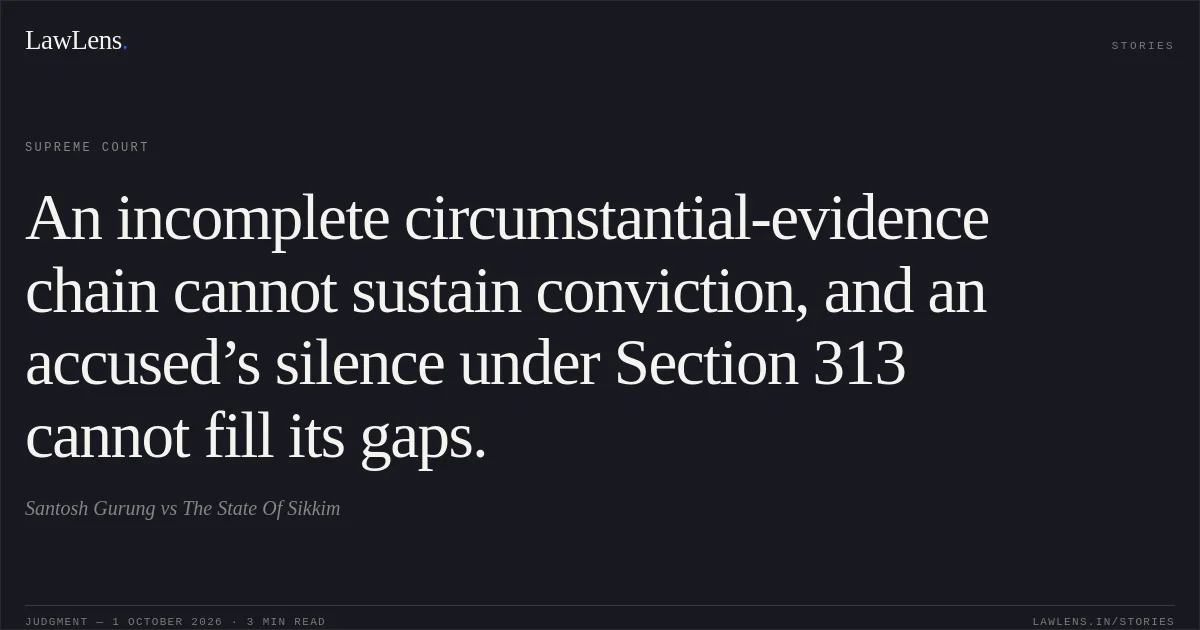
Source reference: p.13An accused’s failure to explain an incriminating circumstance may provide an additional link only where the prosecution has otherwise established the circumstances; a Section 313 CrPC statement cannot fill gaps in the prosecution case or independently sustain conviction (State of Rajasthan v. Kashi Ram; Raj Kumar Singh v. State of Rajasthan).
Source reference: p.18Reasoning
The Court found no reliable evidence that the appellant and victim left together: the grandmother was unsure whether they left together or separately, and other witnesses confirmed that no one had seen the appellant take the victim.
Source reference: p.8The significant interval between the alleged last sighting and discovery of the remains further weakened that circumstance.
Source reference: p.11The articles were recovered from a place frequented by members of the public and ordinarily visible, requiring caution; moreover, the DNA report identified the tested bone as human male in origin and did not connect it to the victim, while the FSL report was inconclusive.
Source reference: p.12The shawl was not identified as belonging to the appellant’s mother, and the Section 313 answers could not supply the missing evidentiary links.
Source reference: p.17Taken together, the circumstances did not form a complete chain pointing only to the appellant’s guilt.
Source reference: p.20Holding
The Court held that the prosecution had not proved the appellant’s guilt beyond reasonable doubt and that he was entitled to the benefit of doubt.
It quashed the Sessions Court’s judgment, as affirmed by the High Court, acquitted the appellant, and directed that he be set free forthwith unless required in another case.
Source reference: p.22Acts & Sections Cited
8 provisions across 3 statutes referred to in this judgment. Each provision opens on LawLens.
Indian Penal Code, 18603
Code of Criminal Procedure, 19733
Original Court PDF
Santosh GurungvsThe State Of Sikkim
Click to open original judgment
Original judgment, available to read, download and summarize on LawLens.in